

Key Takeaways
- Summer tyres deliver peak grip in warm, dry conditions but harden and lose traction below 45°F.
- Winter tyres use a softer compound and deeper sipes to maintain flexibility and grip on snow and ice.
- All-season tyres offer year-round convenience but represent a compromise in both extreme heat and severe cold.
- Stopping distance increases significantly when the wrong tyre type is used for current road conditions.
- Switching between dedicated tyres typically means storing one set — factor in that cost and logistics.
Our Verdict
No single tyre type excels across every condition. Summer tyres are the clear choice for warm-weather performance, while winter tyres are the safety-focused option for cold, snowy climates. All-season tyres serve drivers in mild climates who want simplicity over peak performance.
| Best for | Recommended |
|---|---|
| Drivers in warm or dry climates year-round | Summer tyres |
| Drivers facing regular snow, ice, or sub-freezing temperatures | Winter tyres |
| Drivers in mild climates with occasional rain and rare frost | All-season tyres |
Why Tyre Type Matters More Than Most Drivers Realize
Tyres are the only part of your vehicle actually touching the road, which makes the compound they're made from and the pattern cut into them critically important. Yet many drivers treat all tyres as interchangeable, switching between seasons without a second thought.
The rubber formulation, tread depth, and groove design of a tyre are engineered for specific temperature ranges and surface conditions. Using a summer tyre in freezing temperatures — or a winter tyre in midsummer heat — doesn't just reduce performance. It can meaningfully increase stopping distance and reduce your ability to steer out of a hazard. Understanding the differences is a practical safety matter, not just a technical curiosity.
For a deeper dive into the numbers that define tyre performance, see our guide to tyre pressure and tread depth.
Summer Tyres: Built for Warmth and Grip
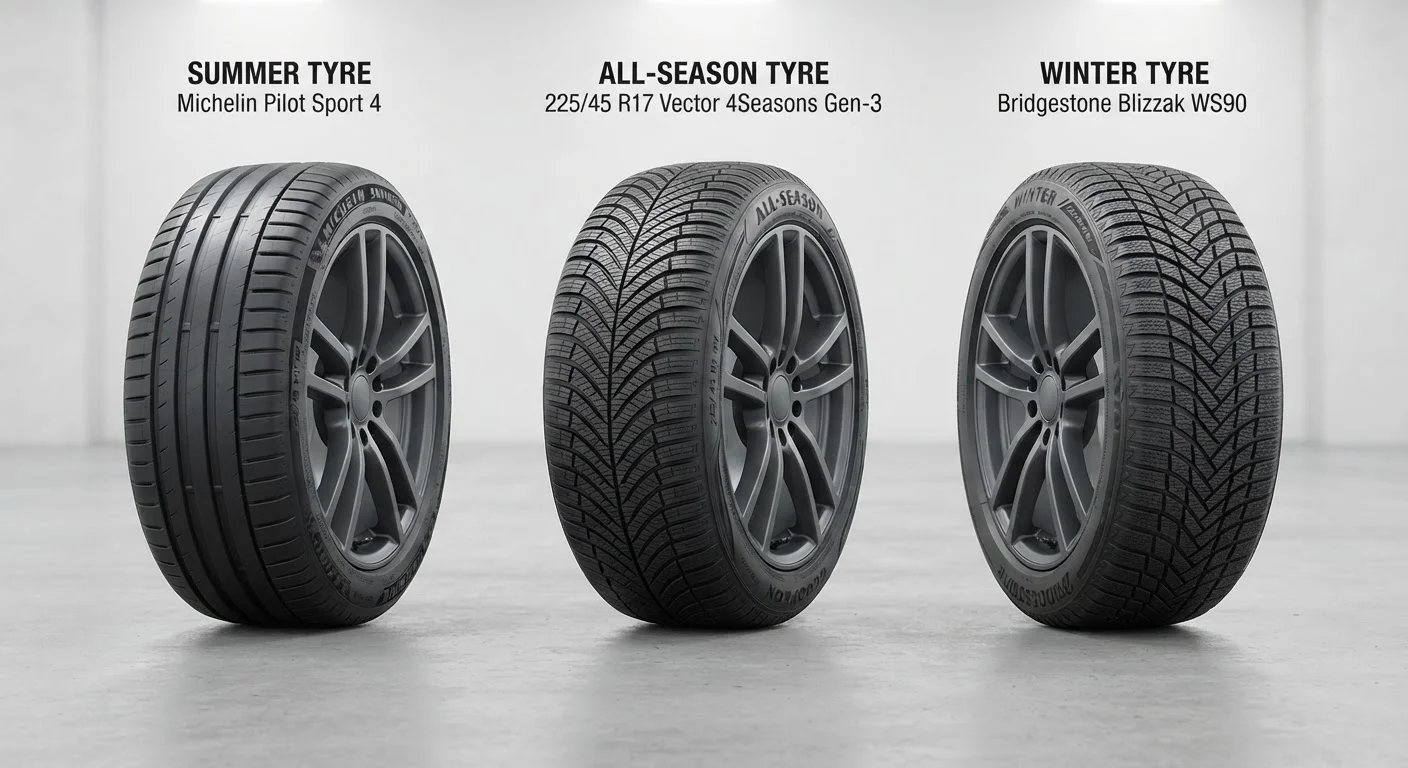
Summer tyres (sometimes called performance tyres) use a harder rubber compound specifically formulated to stay pliable and grippy in temperatures above roughly 45°F (7°C). Their tread patterns tend to have larger contact patches — more rubber touching the road at once — and shallower, straighter grooves designed to channel water away efficiently during warm rain.
The result is excellent handling precision, shorter braking distances on dry tarmac, and strong wet-weather grip in above-freezing conditions. Drivers who prioritize responsiveness and cornering stability in temperate or hot climates benefit most from summer tyres.
The significant limitation: as temperatures drop toward freezing, the compound stiffens. A hard tyre can't conform to road surface irregularities, which means reduced friction and substantially longer stopping distances. Summer tyres should not be used on snow or ice under any circumstances.
Check the Three-Peak Snowflake Symbol
If you need winter capability, look for the three-peak mountain snowflake (3PMSF) symbol molded into the tyre sidewall. This marking means the tyre has passed standardized testing for severe snow conditions — a higher bar than the common M+S (mud and snow) designation. The 3PMSF symbol applies to both dedicated winter tyres and some all-season products rated for serious cold-weather use.
Winter Tyres: Engineered for Cold and Snow
Winter tyres (also called snow tyres) use a softer rubber blend that stays flexible even at temperatures well below freezing. This flexibility allows the tyre to continuously grip the road surface rather than skating over it. Their tread designs feature deep grooves and hundreds of tiny cuts called sipes — small slits in the tread blocks that open up under load to bite into snow and slush.
Testing has consistently shown that winter tyres can reduce stopping distance on ice by a significant margin compared to all-season tyres on the same vehicle. If you drive regularly in temperatures below 45°F — even on dry roads — winter tyres offer a real safety advantage because of the compound alone, not just the tread pattern.
The trade-off is faster tread wear if used in warm weather, slightly higher road noise, and the need to store one set of tyres when not in use. For more on how cold temperatures affect your vehicle overall, see what happens under the hood in cold weather.
| Summer Tyres | All-Season Tyres | Winter Tyres | |
|---|---|---|---|
| Ideal temperature range | Above 45°F (7°C) | Roughly 20°F–80°F | Below 45°F (7°C) |
| Snow and ice grip | Poor — not recommended | Moderate in light snow | Excellent |
| Dry road performance | Excellent | Good | Adequate |
| Wet warm-weather grip | Excellent | Good | Reduced at high temps |
| Tread wear rate | Moderate in heat, fast in cold | Moderate year-round | Fast in warm weather |
| Seasonal changeover needed | Yes | No | Yes |
| Typical marking | None standard | M+S symbol | Three-peak mountain snowflake |
All-Season Tyres: The Everyday Compromise
All-season tyres are designed to function adequately across a wide temperature range and in a variety of conditions — dry roads, light rain, and light snow. Their rubber compound sits between summer and winter formulations: firm enough to resist heavy wear in summer heat, soft enough not to become dangerously rigid in mild cold.
For drivers in climates that rarely see heavy snowfall or prolonged freezing temperatures, all-season tyres are a practical choice. They eliminate the cost and hassle of a seasonal switchover and perform respectably across most everyday driving scenarios.
Where they fall short is at the extremes. In genuine winter conditions — packed snow, ice, or temperatures consistently below freezing — all-season tyres underperform dedicated winter tyres. In hot summer conditions, they can't match the grip or braking precision of summer tyres. The M+S (mud and snow) marking found on many all-season tyres indicates some capability in light winter conditions, but it should not be confused with the three-peak mountain snowflake symbol, which denotes a tyre tested to a higher winter performance standard.
If you're planning cold-weather travel, our guide to road tripping in winter covers what to reconsider before you go.
Don't Mistake M+S for Full Winter Capability
Many drivers assume the M+S marking on all-season tyres means they're cleared for serious winter driving. In practice, M+S simply indicates the tread pattern is designed to handle some mud and light snow — it sets no minimum cold-weather performance standard. For regular driving in packed snow, ice, or persistent sub-freezing temperatures, only tyres bearing the three-peak mountain snowflake symbol have been independently tested to a meaningful winter threshold.
Choosing the Right Tyre for Your Situation
The right choice depends primarily on your local climate and how you use your vehicle. Ask yourself two questions: How cold does it actually get where you drive most? And how often do you encounter snow or ice?
- Mild climates (rarely below 45°F, minimal snow): All-season tyres are a sensible, low-hassle choice.
- Warm or hot climates year-round: Summer tyres offer superior performance without meaningful drawbacks.
- Cold winters with regular snow or ice: Two dedicated sets — summer or all-season for warmer months, winter tyres for colder months — provides the safest coverage.
When making any switch between tyre types, replace all four simultaneously to maintain balanced handling. And keep tabs on tread depth and pressure year-round — seasonal tyre care explains how both factors shift with the weather. Safe driving in challenging conditions also depends on how you adapt behind the wheel; see our guide to driving in fog, ice, and heavy rain for practical techniques.
~50%
Stopping distance increase on ice
Industry testing has shown stopping distances on ice can be roughly 50% longer with all-season tyres compared to dedicated winter tyres under similar conditions.
45°F
Critical temperature threshold
Tyre engineers widely cite 45°F (7°C) as the point where summer tyre compounds begin to stiffen noticeably, reducing grip and increasing braking distances.