

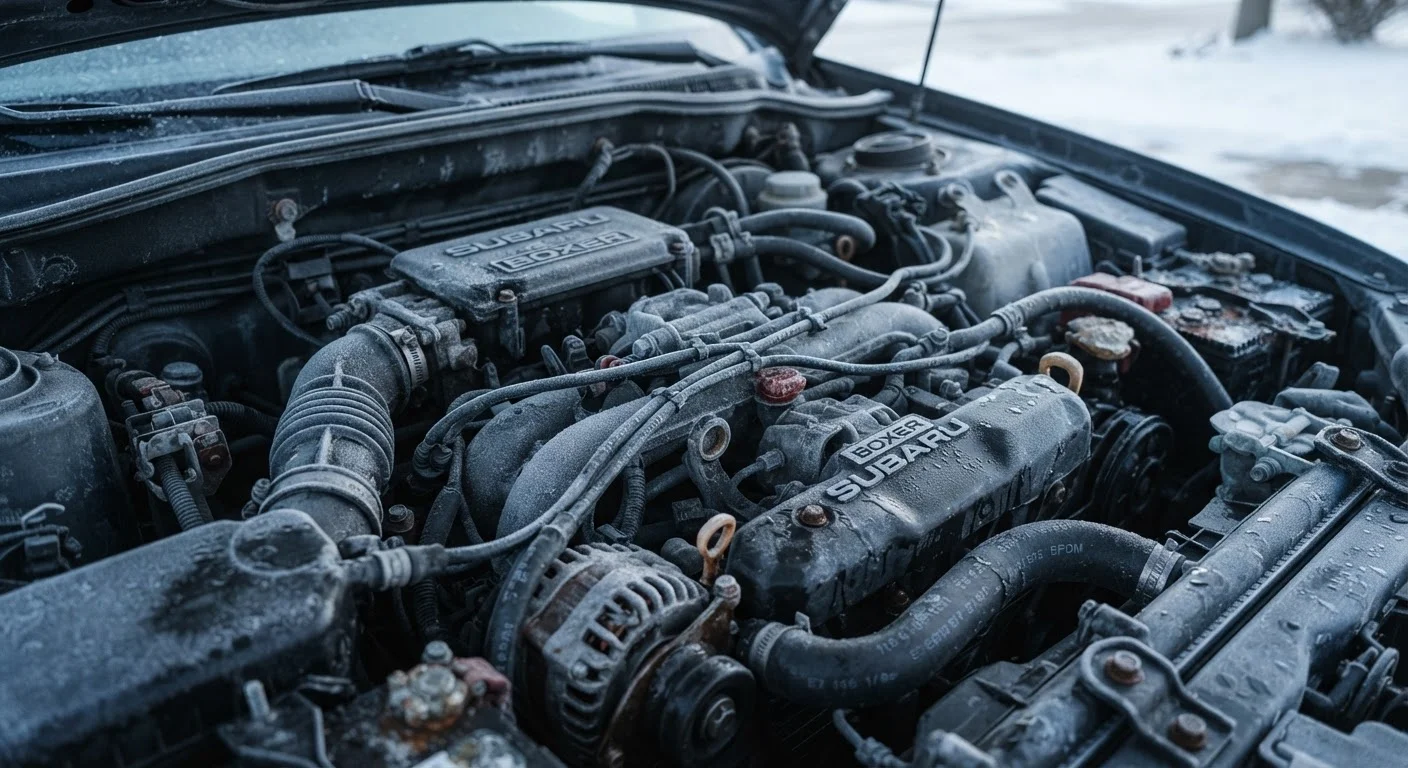
Key Takeaways
- Cold temperatures reduce a car battery's cranking power, making hard starts more likely in winter.
- Engine oil thickens in cold weather, slowing lubrication during the critical first seconds after startup.
- Tyre pressure drops roughly 1 PSI for every 10°F fall in ambient temperature.
- Coolant antifreeze concentration determines how low temperatures your cooling system can tolerate.
- Rubber seals, belts, and hoses become more brittle and prone to cracking in freezing conditions.
- Warming up a modern fuel-injected engine for more than 30–60 seconds is generally unnecessary.
Cold Weather Vehicle Stress
Cold weather vehicle stress refers to the cumulative strain that low temperatures place on a car's mechanical, chemical, and electrical systems. From thickening engine oil to reduced battery output, sub-freezing conditions change how virtually every component in your vehicle performs. Understanding these effects helps drivers anticipate problems before they become breakdowns.
Most effects become significant below 32°F (0°C), though battery capacity loss can begin as high as 40°F (4°C), and oil viscosity changes occur on a spectrum tied to the grade of oil used.
The Battery: Cold's First Casualty
A car battery generates electrical current through a chemical reaction between lead plates and sulfuric acid electrolyte. Cold temperatures slow that reaction significantly. At 32°F, a typical lead-acid battery can lose around 20% of its cranking capacity. By 0°F, that loss can approach 50% — just as the starter motor needs more current to turn over oil-thickened engine internals.
This is why dead batteries are the most common winter breakdown complaint. A battery that tests at the low end of acceptable in autumn may simply not have enough reserve to start a car on a January morning. Understanding how batteries age and how the charging cycle works can help you spot a weakening unit before it fails in the cold. For more warning signs specific to battery health, see the early indicators of a fading battery.
Test Your Battery Before Winter Hits
Many auto parts retailers and service shops offer free battery load tests. A load test reveals actual cranking capacity under demand — more useful than a simple voltage reading. Having this done in autumn gives you time to replace a marginal battery before cold weather puts it under stress.
Engine Oil: The Viscosity Problem
Engine oil is rated by viscosity — its resistance to flow — using a system that includes a winter grade (the "W" in designations like 5W-30). The lower the winter number, the better the oil flows in cold temperatures. Conventional oils thicken significantly below freezing, meaning the first few seconds after a cold start are the most wear-intensive moments of an engine's life.
Modern fully synthetic and synthetic-blend oils are formulated to maintain flow at lower temperatures than conventional oils of the same grade. Your owner's manual specifies the correct viscosity range for your climate. Using an oil grade suited to winter conditions is one of the simplest steps to protect engine internals during cold starts. For a broader look at the fluids your car depends on, the guide to fluid levels that keep a car running smoothly covers what to check and when.
~50%
Battery capacity lost at 0°F
Cold-weather battery performance data widely cited by automotive engineering sources shows significant capacity reduction at sub-zero temperatures.
1 PSI
Tyre pressure drop per 10°F temperature fall
This follows the ideal gas law and is consistent with guidance from US tyre safety organizations.
–34°F
Freeze protection from a 50/50 antifreeze mix
A correctly mixed 50/50 solution of ethylene glycol and water provides freeze protection to approximately –34°F in standard formulations.
Tyres, Rubber, and the Pressure Drop
Tyre pressure follows a predictable physical law: gases contract in cold. For every 10°F drop in ambient temperature, tyre pressure falls by approximately 1 PSI. A tyre set to 35 PSI during a warm autumn day could read as low as 31–32 PSI after a cold snap — enough to affect handling, braking distance, and fuel efficiency.
Beyond pressure, the rubber compound itself changes character. At low temperatures, standard summer-compound tyres stiffen and lose the pliability that generates grip. Winter tyres use different compounds that remain flexible closer to freezing, and feature tread patterns engineered to channel slush and bite into light snow. Understanding the differences between tyre categories is worth reviewing before temperatures drop.
Cold also affects belts, hoses, and seals across the vehicle. Older rubber components that are already cracked or hardened are most vulnerable; a visual inspection before winter is a practical safeguard.
Check Tyre Pressure After Overnight Cold
For the most accurate reading, check tyre pressure first thing in the morning before the car has been driven. Driving even a short distance warms the air inside the tyre and raises pressure, which can mask underinflation. Always compare to the placard value on the driver's door jamb, not the maximum pressure printed on the tyre sidewall.
Cooling System, Condensation, and Cold-Start Habits
The coolant system's antifreeze concentration directly determines how cold a temperature your engine can safely tolerate. A 50/50 mix of ethylene glycol antifreeze and water protects to approximately -34°F in most formulations. If that ratio drifts toward too much water — through top-ups with plain water over time — the freezing point rises dangerously. A frozen coolant jacket can crack an engine block catastrophically. How the cooling system works explains the role each component plays.
On cold starts, condensation is a secondary concern. Short trips in winter don't allow the engine to reach full operating temperature, so water vapor in the exhaust system and crankcase never fully evaporates. Over time, this contributes to internal moisture buildup. Driving until the temperature gauge stabilizes — rather than just idling — helps burn off condensation more effectively.
Finally, the instinct to idle a car for ten minutes before driving is outdated for modern engines. Fuel injection systems reach operating parameters quickly; gentle driving for the first few miles warms the engine, transmission, and wheel bearings more efficiently than stationary idling. For more on how driving habits affect long-term wear, see the overlooked habits that accelerate vehicle wear. And if you're planning to drive in winter conditions, adapting your driving to ice and rain is essential reading.
“The components most likely to fail in winter are the ones that were already marginal going into the season. Cold doesn't create problems so much as reveal them.”
— ASE-Certified Master Technician, Automotive service professional with over 20 years of diagnostic experience