

Key Takeaways
- Fog demands slower speeds and low-beam headlights — high beams reflect back and reduce visibility.
- Ice requires the lightest possible inputs: gradual braking, gentle steering, and significant following distance.
- Heavy rain hydroplaning risk peaks at highway speeds — reducing speed is the single most effective countermeasure.
- Each condition changes what your vehicle's tires, brakes, and visibility systems can actually deliver.
- Preparation before adverse weather — tires, wipers, lights — reduces in-the-moment risk significantly.
Our Verdict
Fog, ice, and heavy rain each compromise a different link in the driving chain — visibility, traction, or both simultaneously. There is no single technique that covers all three; skilled adaptation means recognizing which hazard is dominant and adjusting speed, following distance, and inputs accordingly. Preparing your vehicle before bad weather arrives is as important as how you drive once conditions deteriorate.
| Best for | Recommended |
|---|---|
| Drivers navigating low-visibility fog | Fog driving techniques |
| Those encountering icy or black-ice road surfaces | Ice driving techniques |
| Drivers in heavy rain or flash flood risk areas | Heavy rain driving techniques |
| Anyone planning a long drive in uncertain weather | Pre-trip vehicle preparation |
Why Each Condition Demands a Different Response
Most drivers treat bad weather as a single category — slow down, be careful — but fog, ice, and heavy rain attack very different aspects of vehicle control. Fog is a visibility crisis. Ice is a traction crisis. Heavy rain is often both simultaneously, with the added threat of hydroplaning. Treating them identically means applying the wrong correction at the wrong moment.
Understanding what each condition actually does to your vehicle's physics helps you respond with precision rather than instinct alone. As a foundation, see our guide to defensive driving principles — the same anticipation mindset applies here, with condition-specific adjustments layered on top.
| Fog | Ice | Heavy Rain | |
|---|---|---|---|
| Primary hazard | Severely reduced visibility | Near-zero traction | Reduced visibility and hydroplaning |
| Headlight setting | Low beams or fog lights | Low beams on | Low beams on |
| Speed adjustment | Match to sight distance | Significantly below limit | Reduce with rain intensity |
| Recommended following distance | 4+ seconds | 8–10 seconds | 5–6 seconds |
| Braking approach | Normal, early application | Gradual, steady pressure | Early, progressive braking |
| Biggest driver mistake | Using high beams | Overconfidence in AWD | Maintaining highway speed |
Driving in Fog: Managing the Visibility Wall
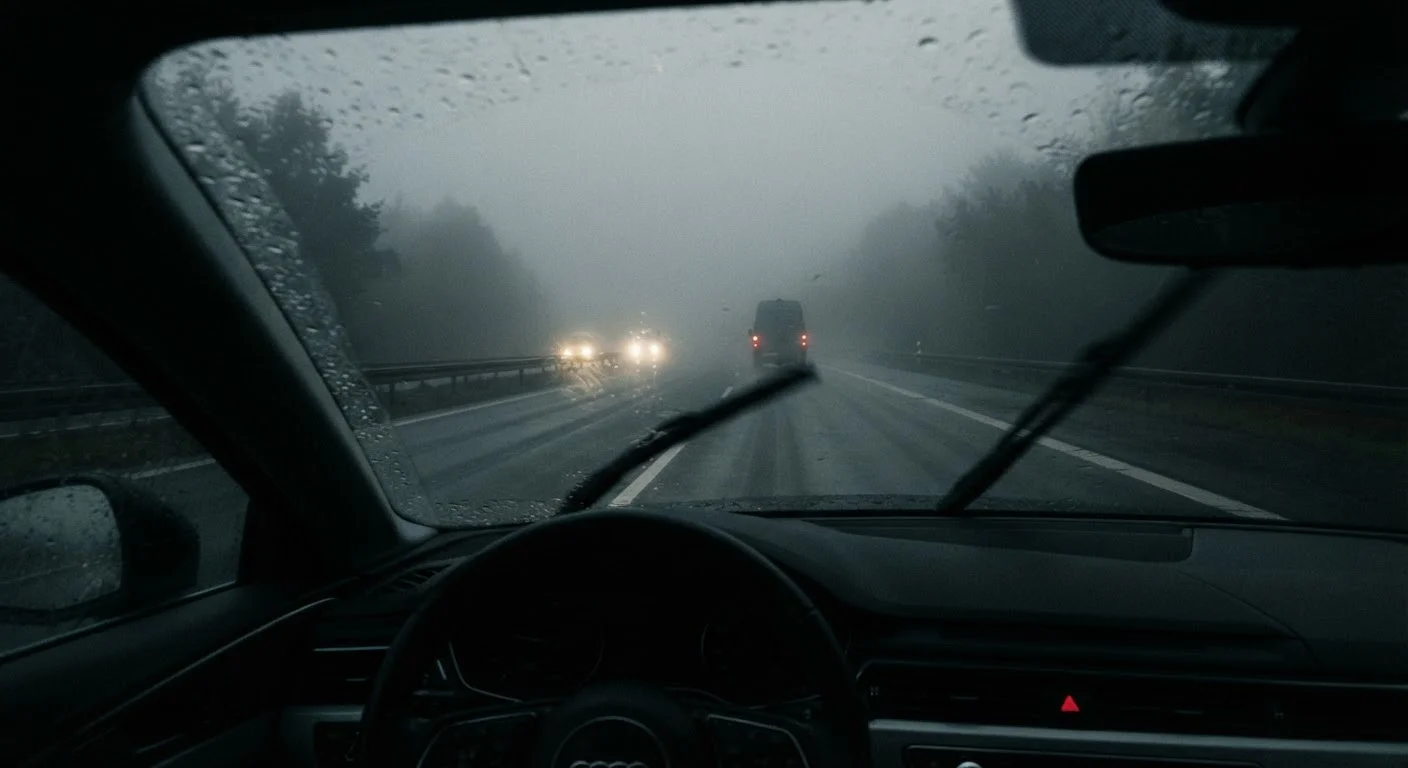
Fog reduces sight distance to as little as 100 feet in dense conditions, creating what safety researchers call the "visual wall" — a uniform grey barrier that strips depth perception and makes stationary hazards nearly invisible. The instinct to switch on high beams is counterproductive: high beams reflect off water droplets and create glare that further degrades your forward view. Use low-beam headlights, and if your vehicle has dedicated fog lights, use those instead.
The core fog rule is to drive within your sight distance. If you can see 150 feet ahead, you should be able to stop within 150 feet at your current speed. Most drivers dramatically overestimate how quickly they can stop. This connects directly to the concept covered in our night driving visibility guide — overdriving your sight line is dangerous in darkness and in fog alike.
- Turn on low beams (or dedicated fog lights) regardless of daytime
- Reduce speed well below the posted limit if visibility is significantly impaired
- Increase following distance to at least four seconds — more in thick fog
- Use the right edge of the road or lane markings as a visual guide rather than oncoming lights
- Avoid stopping on the roadway; if you must pull over, turn off your lights so others don't follow them into your parked vehicle
When to Pull Over and Wait
If fog becomes dense enough that you cannot see beyond the hood of your vehicle, pulling off the road entirely is often safer than continuing. Choose a parking lot, rest area, or safe shoulder well clear of travel lanes. Turn off your headlights once stopped so other drivers do not mistake them for a moving vehicle and follow you off the road.
Driving on Ice: When Traction Nearly Disappears
Ice reduces tire grip to a fraction of what dry pavement provides. Black ice — a thin, transparent glaze that forms on bridges, overpasses, and shaded roadway sections — is particularly dangerous because it is visually indistinguishable from wet pavement. Your first warning may be the steering suddenly feeling light or the vehicle not slowing when you expect it to.
On ice, every input must be gradual. Sudden braking locks wheels and causes skids; sudden steering inputs cause slides. If your vehicle has ABS (anti-lock braking system), apply firm, steady brake pressure and let the system modulate — do not pump the pedal. If you begin to skid, steer gently in the direction you want to go and avoid overcorrecting.
17%
Weather-related US crash share from ice and snow
According to the Federal Highway Administration, approximately 17% of all vehicle crashes occur on snowy, slushy, or icy pavement each year.
10x
Stopping distance increase on black ice vs. dry road
Transportation safety research indicates stopping distances can increase up to ten times on icy surfaces compared to dry pavement at the same speed.
Following distance on ice should be eight to ten seconds — far more than the three-second rule used in normal conditions. Slow down before curves, not during them; turning and braking simultaneously overwhelms available grip. For a deeper look at how cold temperatures affect your vehicle's mechanical systems, including tire pressure and battery performance, see our article on what cold weather does to your car.
Driving in Heavy Rain: Hydroplaning and Flood Risks
Heavy rain introduces two compounding problems: reduced visibility from precipitation and spray, and reduced traction from water film between tires and road. Hydroplaning occurs when that water film builds faster than tire tread can channel it away, causing the tire to ride on water rather than road surface. Steering and braking become ineffective almost instantly. Speed is the primary factor — hydroplaning risk increases significantly above 35 mph on a wet surface, and worn tires worsen the threshold considerably.
If hydroplaning occurs, ease off the accelerator smoothly — do not brake hard or steer sharply — and allow the vehicle to slow until the tires re-establish contact. On highways, move toward the center lanes where water tends to drain toward the edges. Turn on headlights to improve your visibility to others, not just your own view.
- Reduce speed progressively as rain intensifies — posted speed limits assume dry conditions
- Avoid standing water of unknown depth; six inches of moving water can stall a vehicle, and twelve inches can float many cars
- Follow the tracks of the vehicle ahead rather than the road crown where water pools
- Increase following distance to at least five or six seconds
Before any trip in uncertain weather, running through a pre-trip vehicle safety check — particularly tires, wipers, and lights — provides a meaningful safety margin. Also relevant for longer trips: our pre-road-trip vehicle checklist covers emergency essentials worth carrying in poor conditions.
Never Drive Through Flooded Roads
The phrase "turn around, don't drown" reflects a genuine risk: moving water as shallow as twelve inches can sweep a vehicle off a road, and most flood deaths in vehicles occur in less than two feet of water. Road surface under floodwater is invisible, meaning you cannot assess depth or whether the pavement is intact. If water covers a road ahead, treat it as impassable and seek an alternate route.
Vehicle Systems and Their Limits in Adverse Conditions
Modern vehicles include systems designed to help in poor conditions — ABS, electronic stability control (ESC), traction control, and on newer models, a range of ADAS driver-assistance features. These systems can reduce the severity of mistakes, but they cannot override physics. ESC can help prevent a spin, but it cannot create traction that ice has eliminated.
Critically, all-wheel drive (AWD) improves acceleration traction on slippery surfaces but provides no additional braking advantage — a common misconception that leads AWD drivers to travel too fast in icy or wet conditions. Tire condition matters more than drivetrain type in most adverse-weather scenarios. A vehicle with quality winter tires will generally outperform an AWD vehicle on worn all-seasons in snow and ice.
For drivers planning winter road trips, the winter road trip planning guide covers route, timing, and equipment decisions that compound the techniques described here.