

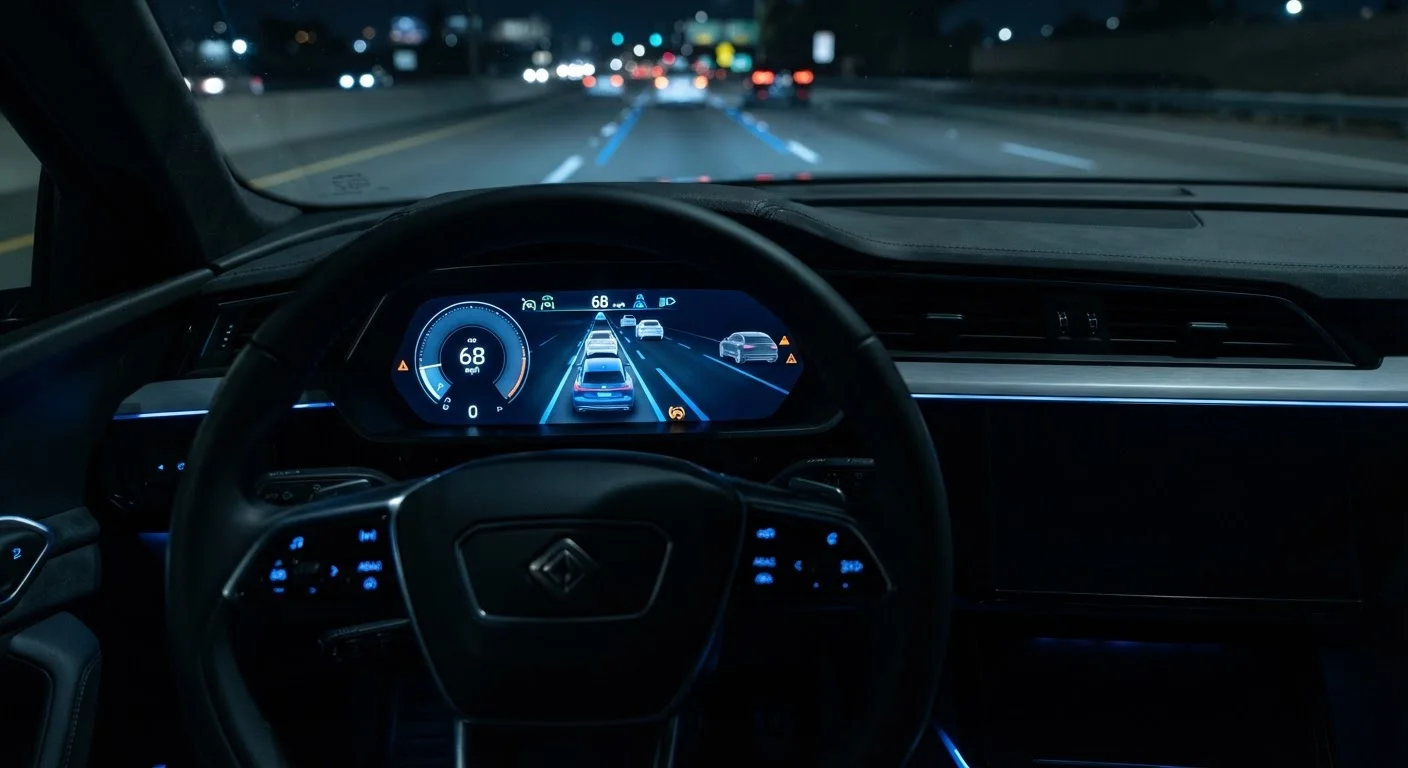
| ADAS full form | Advanced Driver-Assistance Systems |
| AEB federal mandate | Required on all new US passenger vehicles by NHTSA rule (NHTSA final rule) |
| Primary sensors used | Radar, cameras, ultrasonic sensors (often combined) |
| SAE automation level | Most standard ADAS = Level 1–2 (driver always responsible) (SAE International J3016) |
| Common limitation | Performance degrades in heavy rain, snow, fog, or sensor obstruction |
Why ADAS Is Now Part of Nearly Every New Car
Advanced Driver-Assistance Systems — commonly abbreviated as ADAS — have moved rapidly from luxury options to standard equipment. Federal regulators, insurance groups, and safety researchers have consistently tied these technologies to reductions in crash frequency and severity, driving automakers to fit them across model lines regardless of price tier.
The National Highway Traffic Safety Administration (NHTSA) has mandated automatic emergency braking on all new passenger vehicles sold in the US by a near-term compliance deadline, and many manufacturers met that bar ahead of schedule. Understanding what each system does — and what it cannot do — is essential for any driver. These are assistance tools, not substitutes for attentive driving.
| ADAS full form | Advanced Driver-Assistance Systems |
| AEB federal mandate | Required on all new US passenger vehicles by NHTSA rule (NHTSA final rule) |
| Primary sensors used | Radar, cameras, ultrasonic sensors (often combined) |
| SAE automation level | Most standard ADAS = Level 1–2 (driver always responsible) (SAE International J3016) |
| Common limitation | Performance degrades in heavy rain, snow, fog, or sensor obstruction |
The Core Systems and What They Actually Do
The following ADAS features appear most frequently as standard or near-standard fitment on new vehicles sold in the United States.
Automatic Emergency Braking (AEB)
AEB monitors the road ahead using radar, cameras, or a combination of both. When the system detects an imminent collision and the driver has not reacted in time, it applies the brakes autonomously. Some systems also detect pedestrians and cyclists. AEB can reduce rear-end crash rates significantly, though stopping distance still depends on speed and road conditions.
Forward Collision Warning (FCW)
Closely related to AEB, forward collision warning alerts the driver — usually with an audible tone and a visual indicator — that a collision risk has been detected. It warns but does not intervene. FCW typically activates before AEB, giving the driver the first opportunity to brake. See our guide to defensive driving for context on how situational awareness complements these alerts.
Lane Departure Warning and Lane Keeping Assist
Lane departure warning (LDW) signals when the vehicle drifts across a lane marking without a turn signal active. Lane keeping assist (LKA) goes a step further by applying gentle steering corrections or brake inputs to nudge the vehicle back toward the center of the lane. The two systems are often paired and are distinct from lane centering, which actively steers the car continuously.
Adaptive Cruise Control (ACC)
Standard cruise control holds a fixed speed. Adaptive cruise control adds a radar-based gap sensor that automatically slows the vehicle when traffic ahead decelerates and resumes the set speed when traffic clears. Many systems now include stop-and-go capability, bringing the car to a complete halt in traffic and pulling away again. ACC does not monitor lane position on its own.
Blind-Spot Monitoring (BSM)
Rear-corner radar sensors detect vehicles in adjacent lanes that fall outside the driver's natural mirror view. A warning indicator — typically an icon in the corresponding mirror — illuminates when a vehicle is detected, with many systems adding a stronger alert if the driver signals toward that side.
Rear Cross-Traffic Alert
When reversing, rear cross-traffic alert (RCTA) detects vehicles, cyclists, or pedestrians approaching from either side behind the vehicle and warns the driver before they enter the camera's field of view. It is a complement to, not a replacement for, the reversing camera.
ADAS
Advanced Driver-Assistance Systems — a collective term for electronic safety and convenience features that monitor vehicle surroundings and can alert or intervene to help prevent collisions. They are driver aids, not autonomous driving systems.
Automatic Emergency Braking (AEB)
A system that detects an imminent forward collision and autonomously applies the brakes if the driver fails to respond in time. Performance varies by system design, speed, and conditions.
Adaptive Cruise Control (ACC)
Cruise control that uses radar or cameras to automatically maintain a set following distance from the vehicle ahead, slowing or accelerating as traffic changes. It does not steer the vehicle.
Lane Keeping Assist (LKA)
A system that detects unintentional lane drift and applies corrective steering or braking to guide the vehicle back within its lane. It is distinct from full lane-centering, which steers continuously.
Blind-Spot Monitoring (BSM)
A radar-based system that alerts the driver to vehicles occupying the adjacent blind-spot zone, typically through a mirror-mounted indicator light and an additional warning if the driver signals toward that side.
Forward Collision Warning (FCW)
A warning-only system that alerts the driver to a detected collision risk ahead through sound and visuals. It does not apply the brakes — that function belongs to AEB, which often accompanies FCW.
Important Limitations Drivers Should Know
ADAS features have measurable safety benefits, but every system has documented limitations. Sensors can be impaired by heavy rain, snow, mud, direct sunlight, or frost. Lane keeping systems may struggle on faded or missing lane markings. AEB systems have performance thresholds — most are calibrated for specific speed ranges and may not engage effectively in all real-world scenarios.
ADAS Does Not Replace Driver Attention
Every current ADAS feature sold in the US is classified as a driver-assistance tool, not an autonomous system. Regulators and automakers are explicit that the driver remains responsible for safe vehicle operation at all times. Relying on these systems without maintaining attention is both unsafe and, in most jurisdictions, carries the same legal liability as any other lapse in driver duty of care.
Automakers publish system operating ranges and conditions in the owner's manual; reading that section is one of the most practical steps a new-car buyer can take. If a dashboard indicator related to one of these systems illuminates, see our guide to warning lights to understand what action to take. For conditions where ADAS performance varies most — heavy precipitation, fog — review adapting your driving to each condition.
Looking further ahead, these systems form the foundation of the SAE autonomy scale. Our article on SAE autonomous driving levels explains how current ADAS fits within the broader path toward self-driving technology. For everyday vehicle knowledge, the Vehicle Basics hub and the Driving & Safety hub are useful ongoing references.