

| Recommended pressure source | Driver's door jamb sticker or owner's manual |
| Pressure unit (US standard) | PSI (pounds per square inch) |
| Legal minimum tread depth (US) | 2/32 of an inch (US Federal Motor Vehicle Safety Standards) |
| Recommended replacement threshold | 4/32 of an inch (wet-weather safety) (AAA and NHTSA general guidance) |
| Pressure change per 10°F temperature drop | Approximately 1 PSI decrease (General engineering principle) |
| TPMS alert threshold | 25% below recommended pressure (US TPMS regulation (FMVSS No. 138)) |
Why These Two Numbers Matter More Than Most Drivers Realise
Tyre pressure and tread depth are two of the most consequential numbers on any vehicle — yet they're among the most commonly neglected. Both directly affect how well your car grips the road, how quickly it stops, and how much fuel it burns. Underinflated or worn tyres don't just cost money; they reduce your margin for error in emergency situations.
This reference guide explains what the numbers mean, where to find them, and how to check them yourself without any specialist knowledge. For a broader look at pre-trip checks, see what road trip ready actually means for your vehicle.
| Recommended pressure source | Driver's door jamb sticker or owner's manual |
| Pressure unit (US standard) | PSI (pounds per square inch) |
| Legal minimum tread depth (US) | 2/32 of an inch (US Federal Motor Vehicle Safety Standards) |
| Recommended replacement threshold | 4/32 of an inch (wet-weather safety) (AAA and NHTSA general guidance) |
| Pressure change per 10°F temperature drop | Approximately 1 PSI decrease (General engineering principle) |
| TPMS alert threshold | 25% below recommended pressure (US TPMS regulation (FMVSS No. 138)) |
Tyre Pressure: Reading the Numbers Correctly
Tyre pressure is measured in PSI (pounds per square inch) in the US, though you may also see bar on European vehicles (1 bar ≈ 14.5 PSI). The correct pressure for your car is set by the manufacturer — not the number printed on the tyre sidewall. That sidewall figure is the maximum pressure the tyre can safely hold, which is almost always higher than what you should actually inflate to.
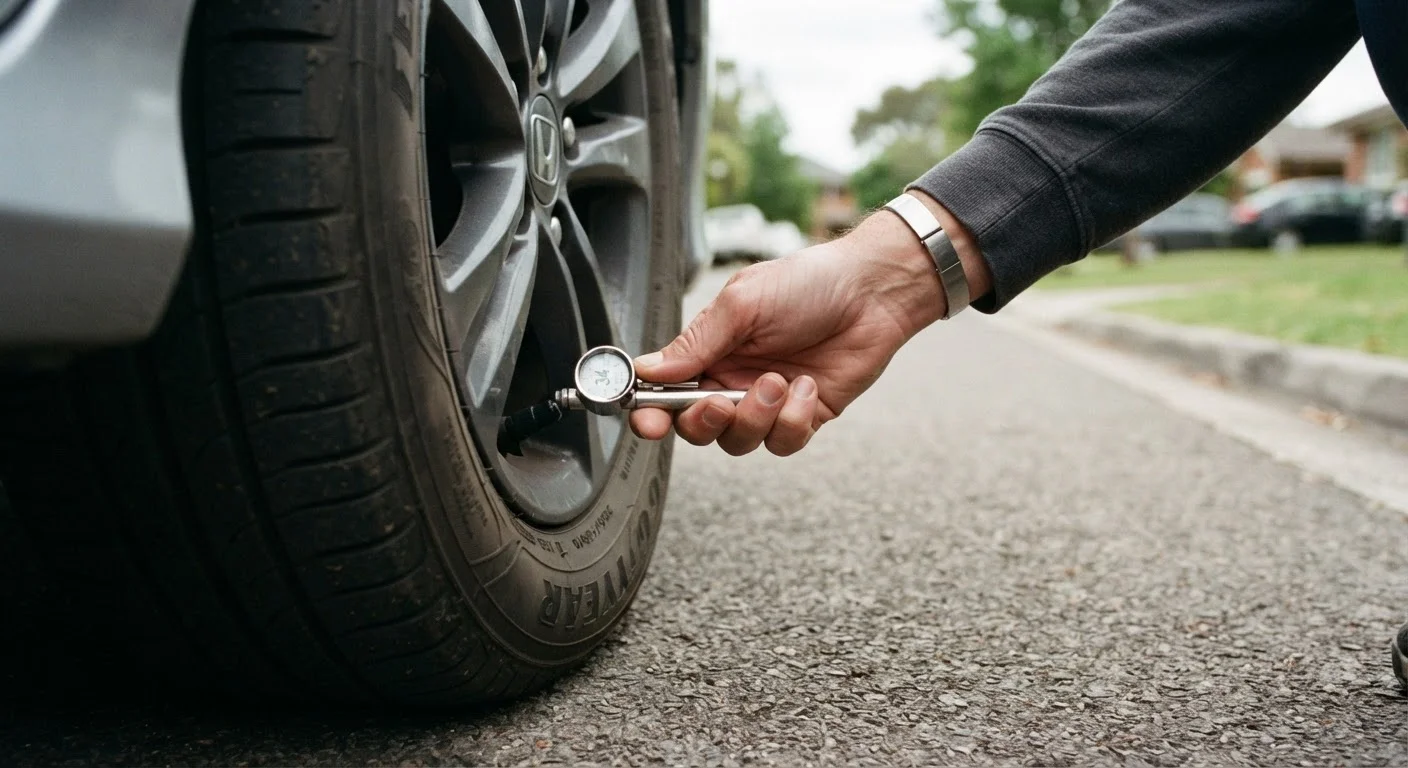
Find your vehicle's recommended pressures on the sticker inside the driver's door jamb, in the glove box, or in the owner's manual. Many vehicles specify different pressures for front and rear tyres, and a higher figure when carrying a full load. Always check pressure when tyres are cold — meaning the car has been parked for at least three hours — because driving heats the air inside and raises the reading artificially.
PSI
Pounds per square inch — the standard US unit for measuring tyre inflation pressure. Most passenger cars require between 30 and 35 PSI.
TPMS
Tyre Pressure Monitoring System — a sensor-based system required on US vehicles since 2008 that triggers a dashboard warning when a tyre drops significantly below recommended pressure.
Tread depth
The measurement from the top of the tread block to the bottom of the groove, expressed in 32nds of an inch in the US. It indicates how much grip-providing rubber remains.
Cold inflation pressure
The recommended pressure measured when tyres have not been driven on for at least three hours. Always use this benchmark because driving heats and temporarily expands the air inside a tyre.
Rolling resistance
The force a tyre must overcome as it rolls along the road. Underinflated tyres increase rolling resistance, which causes the engine to work harder and burn more fuel.
Underinflation increases rolling resistance and heat buildup, wears tyre edges faster, and can reduce fuel economy noticeably. Overinflation reduces the tyre's contact patch with the road, making handling feel stiff and wear the tread centre prematurely. Both extremes are worth avoiding. For more on how tyre pressure ties into fuel consumption, see how tyre pressure affects fuel economy.
Tread Depth: The Legal Limit and the Safer Threshold
Tread depth is measured in 32nds of an inch in the US. New tyres typically start with 10/32" to 11/32" of tread. The federal legal minimum is 2/32", but most safety organisations recommend replacing tyres at 4/32" — particularly if you drive in wet conditions — because stopping distances increase significantly as tread wears down.
The quickest field check is the penny test: insert a penny into the tread groove with Lincoln's head pointing down. If you can see the top of his head, the tread is at or below 2/32" and the tyre should be replaced immediately. For a more conservative check, use a quarter instead — if the top of Washington's head is visible, you're at roughly 4/32" and approaching replacement territory.
4/32"
Tread depth at which wet stopping distances increase substantially
Safety researchers and organisations such as the NHTSA note a meaningful rise in wet-road stopping distances as tread wears below this threshold.
~1 PSI
Pressure lost per 10°F temperature drop
This relationship between temperature and tyre pressure is a well-established physical principle, making seasonal checks especially important.
25%
Pressure drop that triggers a TPMS warning light
Under US federal regulation FMVSS No. 138, the TPMS system must alert the driver when any tyre falls 25% below the vehicle's recommended cold inflation pressure.
Look for uneven wear patterns too. Wear concentrated on the outer edges often points to chronic underinflation; centre wear suggests overinflation; one-sided wear can indicate an alignment problem. The tyre type you're running also affects how quickly tread wears — all-season, summer, and winter tyres each have different tread compounds and wear rates. For a full seasonal maintenance picture, tyre care through the seasons covers rotation schedules and when to swap tyres.
How Often to Check and What to Do Next
Tyre pressure should be checked at least once a month and before any long drive. Temperature swings affect pressure: a rough rule is that pressure drops about 1 PSI for every 10°F decrease in air temperature. This makes autumn and winter particularly important times to monitor inflation. If your dashboard shows a TPMS warning light, that signals a tyre is 25% or more below the recommended pressure — address it promptly rather than waiting. Learn more about reading warning lights in your car's warning lights, decoded.
Tread should be visually inspected every month and measured with a depth gauge (inexpensive and widely available) at each tyre rotation — typically every 5,000 to 7,500 miles. If any single tread groove reads at or below 2/32", replace the tyre. Always replace tyres in pairs on the same axle to preserve balanced handling. A qualified tyre technician can also assess internal damage, bulges, or cracking that visual tread checks alone won't reveal.
This article provides general vehicle information for educational purposes. For guidance specific to your vehicle, consult your owner's manual or a qualified automotive professional.