

Key Takeaways
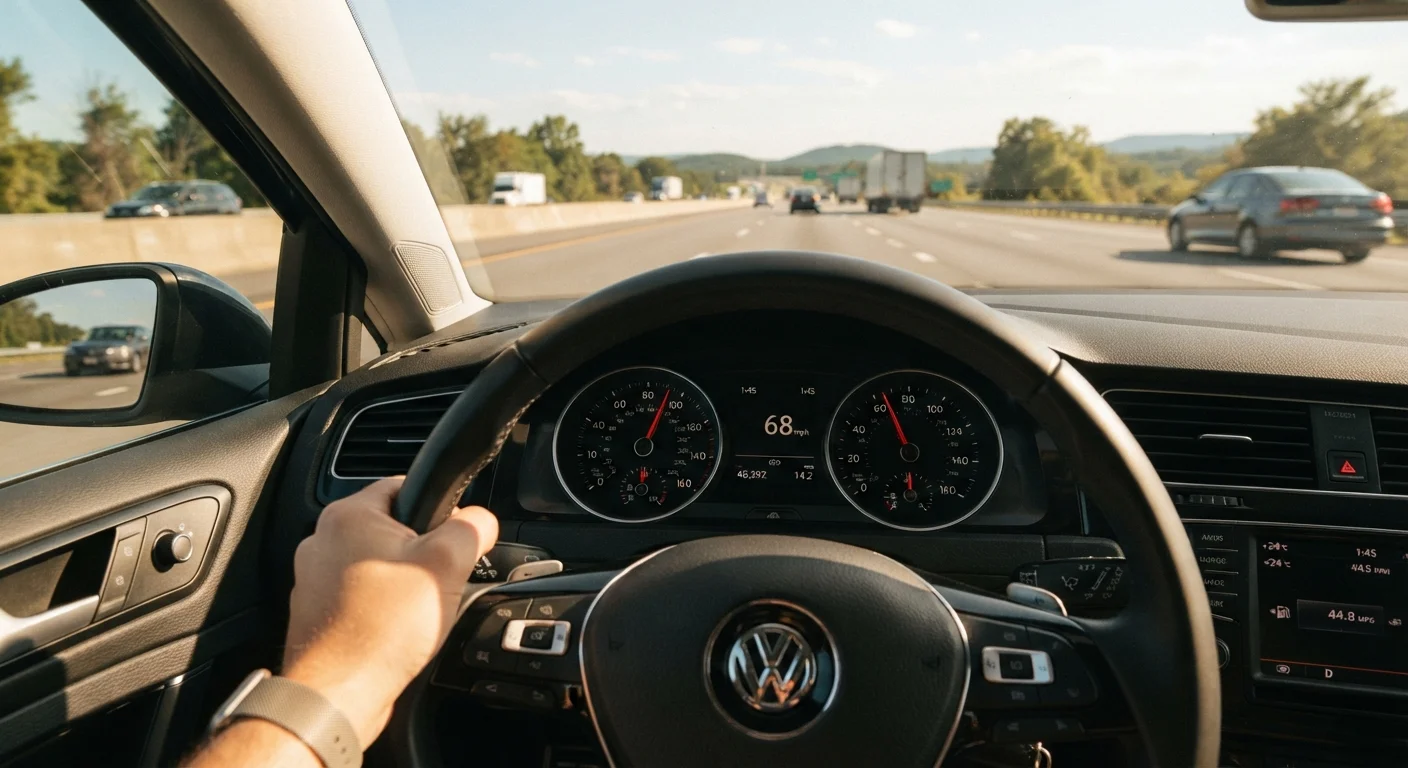
- Speed has the single largest effect on fuel economy — drag increases exponentially above 50 mph.
- Under-inflated tyres increase rolling resistance, directly raising fuel consumption.
- Air conditioning adds a real but modest fuel cost; its impact is often overstated.
- Short trips are disproportionately fuel-inefficient because engines burn more fuel when cold.
- Official fuel economy ratings are tested under controlled conditions and rarely match real-world driving.
Why Fuel Economy Numbers Rarely Match Reality
Every new car comes with an official fuel economy figure — a miles-per-gallon (MPG) number printed on the window sticker. Yet most drivers find their real-world mileage falls noticeably short. The reason isn't faulty advertising; it's the gap between controlled test conditions and actual roads.
Official ratings in the US are determined by the EPA using standardised laboratory tests. These simulate a range of speeds and conditions, but they cannot fully replicate hills, headwinds, stop-and-go traffic, or the weight of a full load of passengers and luggage. Understanding that gap is the first step toward making sense of what actually drains your tank.
For a closer look at how driving habits create hidden vehicle costs beyond just fuel, see how everyday driving habits affect long-term reliability.
Myth
Premium fuel gives better mileage in any car, so it's worth paying extra.
Fact
Premium fuel only benefits engines designed or tuned to require it. Using it in a standard engine produces no measurable efficiency gain.
Fuel octane rating measures a fuel's resistance to pre-ignition (knocking), not its energy content. Engines with high-compression or turbocharged designs may need higher octane to perform properly. In a standard engine, the combustion process is calibrated for regular fuel, and substituting premium delivers identical performance and fuel economy at a higher cost.
Myth
Letting your engine idle to warm up improves fuel economy on the first drive.
Fact
Modern fuel-injected engines reach operating temperature faster by being driven gently than by idling in the driveway.
Long idling warm-ups were sensible advice for carburetted engines common before the 1980s. Today's fuel-injected engines use sensors to manage the fuel mixture automatically. Idling in place warms the engine slowly and burns fuel with zero forward progress. A gentle drive almost immediately after starting is more effective and wastes less fuel.
Myth
Driving with windows down is always more fuel-efficient than using air conditioning.
Fact
At higher speeds, open windows create enough drag to offset the fuel saved by skipping the AC — the crossover point is roughly 50–60 mph for most vehicles.
At city speeds, the AC compressor's load on the engine is more significant than the drag from open windows, so windows-down wins. At highway speeds, the aerodynamic penalty of open windows grows significantly. Most automotive engineering research suggests that above roughly 55 mph, AC is the more fuel-efficient choice — though the exact threshold varies by vehicle.
Myth
A car's fuel economy is fixed by its design and cannot be improved by the driver.
Fact
Driving style, tyre pressure, load, and speed all significantly influence real-world fuel consumption — often by 20–30% compared with aggressive driving.
Vehicle design sets the outer limits of efficiency, but driver behaviour operates within a wide range inside those limits. Studies on 'eco-driving' techniques consistently show that smooth acceleration, anticipating traffic flow, maintaining correct tyre pressure, and reducing unnecessary load can yield meaningful, measurable reductions in fuel use — without requiring any hardware changes to the vehicle.
Myth
Filling up with fuel in the morning when it's cooler gives you more fuel for your money.
Fact
Fuel stored in underground tanks stays at a relatively constant temperature regardless of outdoor air temperature, so the density difference is negligible.
The idea is based on the physics that liquids are denser when cold, meaning a gallon of cold fuel contains slightly more energy. However, underground storage tanks are insulated from daily temperature swings, keeping fuel temperature fairly stable year-round. The density variation at the pump between morning and midday is too small to produce a meaningful cost difference.
Speed, Load, and the Physics of Fuel Consumption
Aerodynamic drag — the resistance air exerts on a moving vehicle — is the dominant fuel cost at highway speeds. Because drag increases with the square of velocity, a relatively small speed increase carries a disproportionately large fuel penalty. Driving at 70 mph instead of 60 mph can raise fuel consumption by roughly 15–20%, though the exact figure varies by vehicle shape and size.
~17%
Fuel economy drop from 60 to 70 mph
US Department of Energy estimates suggest fuel economy typically decreases by about 7–14% for each 5 mph driven above 50 mph, with the effect compounding at higher speeds.
0.2% per PSI
Fuel consumption increase per pound of tyre under-inflation
The US Department of Energy estimates that under-inflated tyres reduce fuel economy by roughly 0.2% for every 1 PSI drop below the recommended level across all four tyres.
Vehicle weight matters too, especially in city driving where acceleration and braking cycles are frequent. Every extra 100 pounds of cargo nudges fuel consumption upward — a modest but real effect over a long trip. Roof racks and cargo carriers add both weight and drag, compounding the impact.
Tyre condition is another underappreciated variable. Under-inflated tyres flex more with each rotation, generating heat and resistance that the engine must overcome. Keeping tyres at the manufacturer's recommended pressure — not the maximum printed on the tyre sidewall — is one of the simplest ways to protect fuel economy. For the full picture on tyre numbers, see tyre pressure ratings and tread depth.
Don't Rely on the Tyre Sidewall Pressure Figure
The maximum pressure moulded into a tyre's sidewall is a structural limit, not a driving recommendation. Using that figure instead of your vehicle manufacturer's specification — found on the door jamb sticker or owner's manual — can lead to uneven tread wear, reduced grip, and a harsher ride. Always follow the vehicle-specific recommendation.
Driving Smarter: Evidence-Based Habits That Help
Smooth, anticipatory driving consistently outperforms aggressive acceleration and hard braking in fuel efficiency. When you accelerate gradually and use engine braking — easing off the throttle well before a red light rather than braking at the last moment — the engine does less work overall. This is the same principle behind the efficiency gains seen in hybrid vehicles, which recover some braking energy.
Cold starts are a frequently overlooked source of fuel waste. A cold engine runs on a richer fuel mixture (more fuel relative to air) until it reaches operating temperature, which can take several minutes of driving. Frequent short trips — say, a half-mile to a convenience store — mean the engine never fully warms up, making each trip significantly less efficient per mile than a longer journey.
Air conditioning does increase fuel use, but by a more modest amount than many drivers assume. The compressor adds load to the engine, typically reducing MPG by a few percent under normal highway conditions — though the effect is more pronounced in very hot weather or at low speeds. Opening windows at city speeds is generally more efficient; at highway speeds, the aerodynamic drag from open windows often offsets any AC savings.
These habits connect directly to vehicle longevity as well. Common car care myths — such as needing to warm up a modern engine for several minutes before driving — can themselves influence how efficiently you use fuel day to day.
Official MPG Ratings Are a Guide, Not a Guarantee
EPA fuel economy figures are useful for comparing vehicles but should not be treated as a prediction of what you will achieve. Real-world driving almost always produces different results due to traffic patterns, climate, driving style, and vehicle condition. Use the official figure as a baseline for comparison, not an expected outcome.