

Key Takeaways
- Minimalism prioritizes negative space and deliberate object placement; maximalism embraces layering, pattern, and personal narrative.
- Neither approach is inherently easier or more affordable — both require thoughtful curation.
- The two philosophies can coexist in one home by assigning each room a dominant approach.
- Your lifestyle, maintenance tolerance, and how a space makes you feel are the best guides to choosing.
- Strong design principles — balance, proportion, and cohesion — apply equally to both styles.
Our Verdict
Minimalism and maximalism are not opposing mistakes waiting to happen — they are two equally valid answers to the question of how a home should feel. Minimalism rewards those who find calm in openness and are willing to be selective about every object they own. Maximalism rewards those who draw energy from color, texture, and the accumulated story of a life well-lived. Most homes end up somewhere between the two, and that middle ground is often where the most personal and enduring spaces are found.
| Best for | Recommended |
|---|---|
| Those who find visual calm restoring and prefer low-maintenance upkeep | Minimalism |
| Collectors, creatives, and those who want every surface to tell a story | Maximalism |
| Households with varied tastes or mixed family dynamics | A room-by-room hybrid approach |
What Each Philosophy Actually Asks of a Space
Minimalism and maximalism are often reduced to shorthand — one means bare, the other means cluttered. Neither description is accurate. As explored in the core principles behind well-decorated rooms, every intentional interior style relies on balance, proportion, and cohesion. The difference lies in how those principles are expressed.
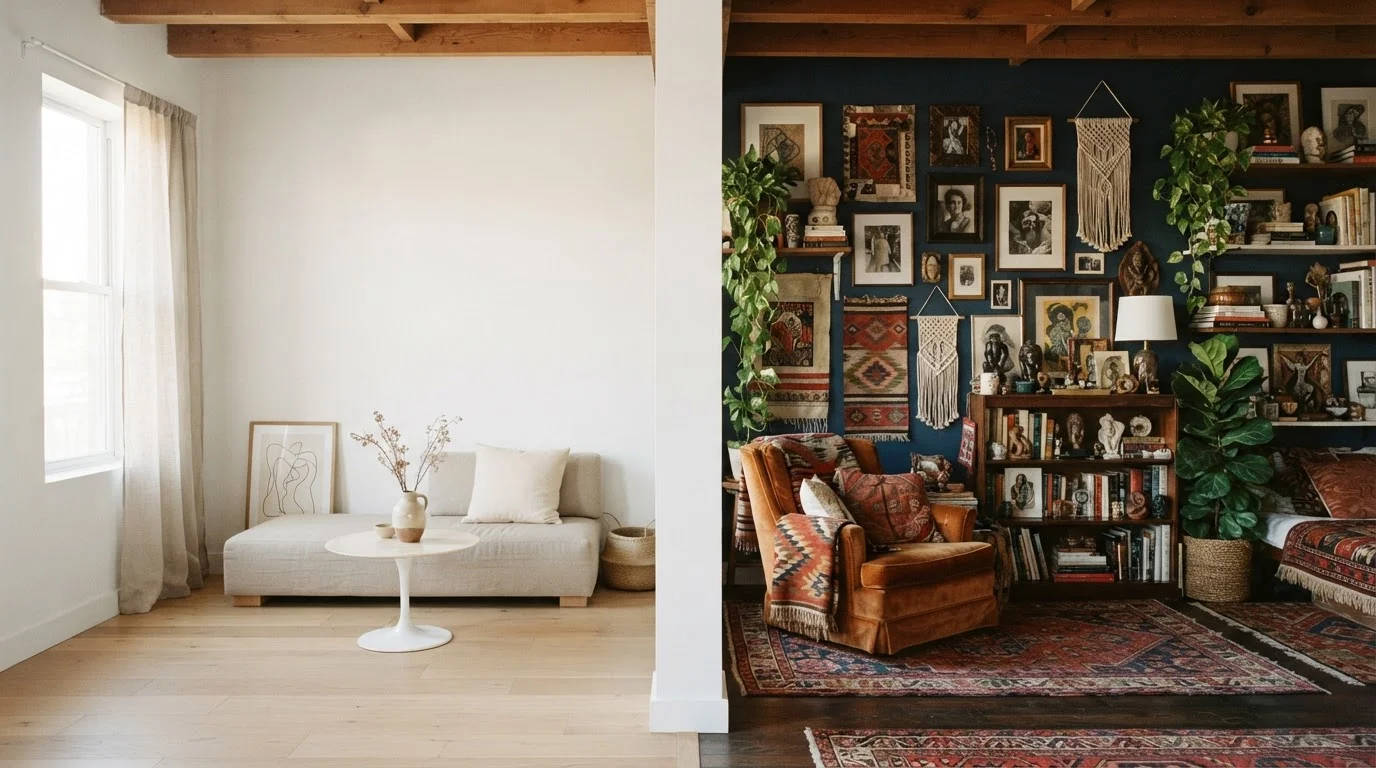
Minimalism asks you to treat negative space — empty wall, open floor, a surface with a single object — as an active design element rather than a gap to fill. Each piece earns its place and carries more visual weight as a result. The discipline is curatorial: what stays matters more than what arrives.
Maximalism asks you to embrace layering — stacking patterns, mixing textures, clustering collections — so that the whole reads as intentional abundance rather than chaos. The discipline here is compositional: how things relate to each other determines whether the result feels curated or overwhelming.
Both styles demand decision-making. Neither is a license to stop thinking about the room.
| Minimalism | Maximalism | |
|---|---|---|
| Core principle | Negative space as a design element | Layering and intentional abundance |
| Object count | Few, highly selective | Many, relationally composed |
| Budget implication | Higher cost per item typical | Flexible; mixes price points well |
| Daily maintenance | High — disorder shows quickly | Moderate — tolerates visual noise |
| Key skill required | Curation and restraint | Composition and editing |
| Best suited to | Those who find calm in openness | Those energized by color and story |
Practical Realities: Maintenance, Budget, and Daily Life
A common assumption is that minimalism is more affordable because it involves fewer objects. In practice, minimalism often demands higher quality per item — a single sofa or light fixture carries the entire room, so it tends to be chosen (and priced) accordingly. Maximalism distributes visual interest across many pieces, which allows for more flexibility in sourcing and price points.
Maintenance tells a similar story. Minimalist spaces show dust, fingerprints, and misplaced items immediately — the style requires consistent tidying to function as intended. Maximalist spaces are more forgiving of everyday disorder, but periodic editing is essential to prevent genuine clutter from overwhelming the intentional layers.
Try a Room-by-Room Audit First
Before committing to a style, spend a week noticing which rooms you gravitate to and which feel draining. Often, the rooms you find most comfortable already lean toward one philosophy — that's useful data. Rather than redecorating all at once, use that insight to guide one room at a time, starting with the space where the change will have the most daily impact.
For households with children, pets, or high foot traffic, maximalism's tolerance for visual "noise" can be genuinely liberating. For those who work from home and need a visually quiet environment, a minimalist primary workspace may support focus even if other rooms lean busier.
If you're decorating your first home from scratch, starting with fewer, considered pieces and adding over time is a practical path that happens to align with minimalist principles — and leaves room to discover whether you want to stay there.
Where Myths Get in the Way
Several persistent decorating rules distort how people approach both styles. As popular décor myths show, rules like "light colors make rooms bigger" or "never mix metals" are more convention than law.
In minimalism, the myth is that restraint is neutral or easy. Choosing one chair, one rug, one lamp for a room and having that room feel complete requires significant skill and often significant investment in the right piece. It is not a default — it is a practice.
In maximalism, the myth is that more is always more. Successful maximalist interiors are edited repeatedly. Items that don't contribute to the room's overall palette or narrative are removed, even if they are loved individually. The challenge of open shelving illustrates this perfectly: styled shelving looks intentional; random accumulation does not, regardless of how many objects are present.
Avoid Decorating to Trend Rather Than Lifestyle
Both minimalism and maximalism cycle in and out of editorial popularity. Committing to a style because it dominates social media right now can leave a room feeling dated faster than a style chosen for personal resonance. Decorate for how you live — your storage habits, your relationship with objects, your sensory preferences — rather than for a mood board that will look different next season.
Mixing Both Styles in One Home
Most households don't commit fully to either camp, and that's not a failure of nerve — it's practical design. The most livable approach assigns each room or zone a dominant character while maintaining a through-line of color, material, or scale that unifies the whole.
A common pattern: public rooms (living room, entryway) lean toward the more expressive end, showcasing collections and personality, while private rooms (bedroom, home office) lean quieter, prioritizing rest and focus. Hallways and transitional spaces can bridge the two with a shared palette or a consistent flooring material.
The language of each style is worth understanding clearly. For a quick reference to terms like Japandi, wabi-sabi, or biophilic design — all of which intersect with both philosophies — the interior style glossary is a useful starting point.
Ultimately, the question isn't which philosophy is correct. It's which one — or which blend — reflects how you actually want to live in a space, not just how you want it to photograph.