

Key Takeaways
- Balance distributes visual weight so a room feels stable rather than lopsided.
- Scale and proportion govern how furniture and objects relate to each other and the room.
- Rhythm creates flow by repeating colors, shapes, or textures throughout a space.
- A clear focal point gives the eye a natural place to land and anchor the room.
- Contrast and emphasis add visual interest and prevent a room from feeling flat.
- These principles work on any budget — arrangement and proportion cost nothing to adjust.
Interior Design Principles
Interior design principles are the foundational guidelines that professional stylists and designers use to arrange, proportion, and harmonize the elements within a room. They include concepts like balance, scale, rhythm, emphasis, and contrast. Applying even a few of these principles helps a space feel cohesive and intentional rather than random or cluttered.
These principles draw from classical visual art theory — particularly Gestalt psychology — which describes how humans naturally perceive and organize visual information into unified wholes.
Balance: The Foundation of Every Comfortable Room
Balance is the principle most people sense instinctively, even if they can't name it. A room feels balanced when its visual weight — the perceived heaviness of objects based on size, color, and texture — is distributed in a way that feels stable.
There are three types of balance to know:
- Symmetrical balance mirrors objects on either side of a central axis. Think matching bedside lamps flanking a bed. It reads as formal and calm.
- Asymmetrical balance achieves equilibrium through different objects of similar visual weight. A large artwork on one side might be balanced by a cluster of smaller pieces on the other. This feels more dynamic and contemporary.
- Radial balance radiates outward from a central point — a round dining table with chairs is a common example.
You don't need to pick one type exclusively. Most well-decorated rooms blend all three. Before spending anything on new pieces, audit your existing room to identify where imbalance is already happening.
Test Balance Before Buying Anything New
Take a photo of your room from the doorway. On a screen, imbalance becomes far more obvious than it does when you're standing inside the space. Move existing furniture or wall art to redistribute visual weight before purchasing anything new — you may find the room just needed rearranging.
Scale, Proportion, and Why Size Relationships Matter
Scale refers to the size of an object relative to the room; proportion describes how objects relate in size to each other. Both are critical. An oversized sofa in a small room overwhelms the space, while too many small items scattered across a large room create visual noise without presence.
A commonly used guideline is the rule of thirds — dividing a space or surface into thirds and placing key elements at those intersections rather than dead-center. This prevents a room from feeling overly rigid.
When grouping decorative objects on a shelf or table, varying heights in odd numbers (three or five pieces) typically produces the most visually interesting arrangements. Mixing one tall item, one medium, and one low item creates rhythm and prevents a flat, uniform look.
60-30-10
Classic color distribution rule for rooms
Interior designers commonly advise allocating 60% of a room's color to a dominant hue, 30% to a secondary color, and 10% to an accent — a proportion formula that creates visual harmony.
2:3
Recommended sofa-to-rug size ratio
A widely cited guideline in furniture styling is that a rug should be large enough that at least the front legs of all seating rest on it, maintaining a proportional relationship between the pieces.
Rhythm, Emphasis, and the Art of Visual Flow
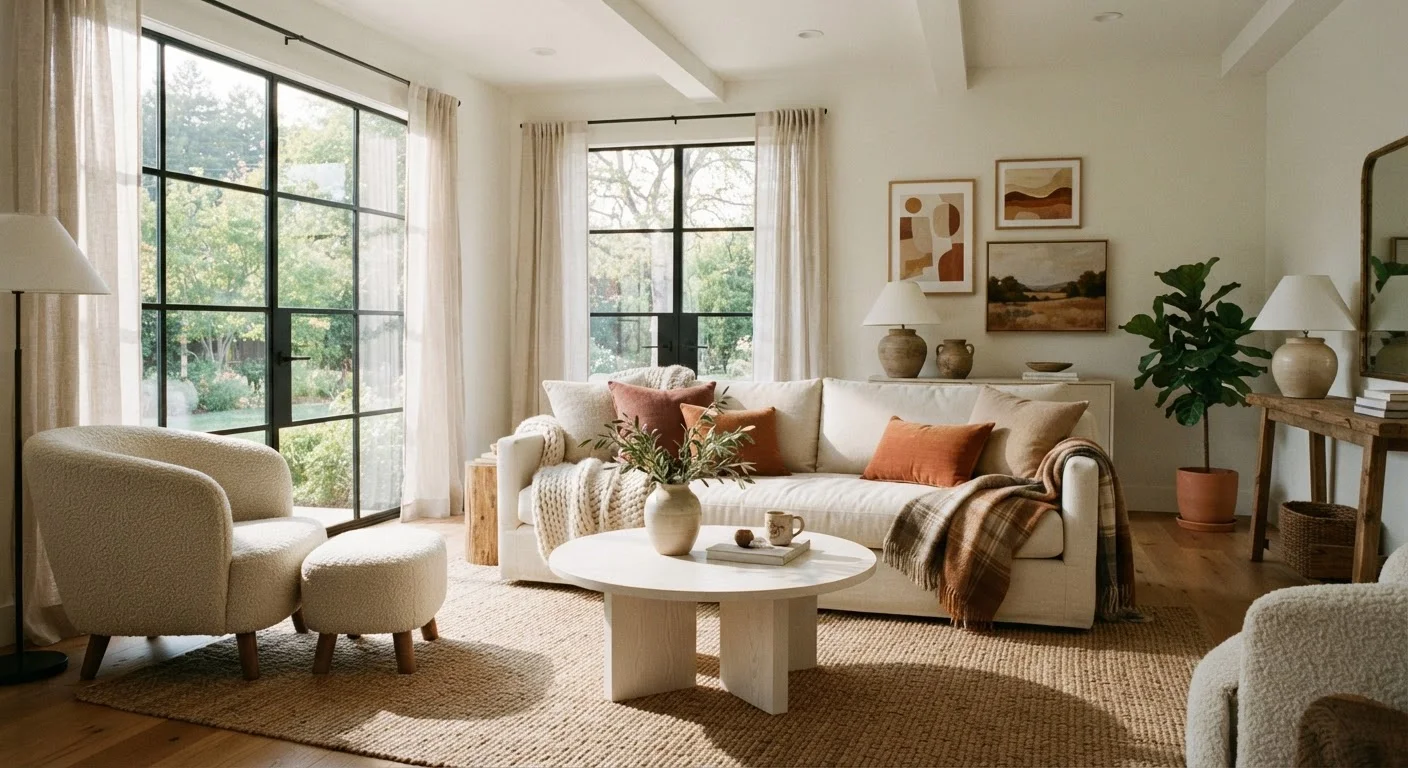
Rhythm in interior design works much like rhythm in music — it's created through repetition and variation that move the eye naturally around a room. You can establish rhythm by repeating a color across multiple elements (a pillow, a vase, a piece of artwork), echoing a shape in different objects, or using a consistent material in varied forms.
Emphasis is the principle that ensures a room has a clear focal point — one element the eye gravitates toward first. In a living room, this is often a fireplace, a large window, or a statement piece of artwork. Every other element should support rather than compete with that focal point.
Contrast — placing opposing colors, textures, or scales next to each other — adds the visual tension that keeps a room interesting. Without contrast, even a well-proportioned room can feel bland. A smooth linen sofa gains definition against a rough jute rug; a light wall makes dark furniture feel more anchored.
If you're just getting started, our guide to decorating your first home from scratch walks through how to apply these ideas room by room. For a plain-language reference to any terms you encounter along the way, the Interior Style Glossary is a useful companion.
Principles Apply Across All Budgets
None of the core design principles require expensive purchases. Balance, proportion, and rhythm are about arrangement and relationship — not price tags. A room styled with inexpensive pieces but strong principles will consistently outperform an expensive room where those principles have been ignored.