

| Number of major named design styles | Dozens, with new hybrids emerging regularly (Interior design publications, general consensus) |
| Origin of 'Japandi' as a coined term | Early 2010s, popularised through design media (Design industry usage) |
| Most referenced décor philosophy globally | Minimalism (Scandinavian variant most cited in US content) (Design trend reporting, general consensus) |
| Key principle shared by most styles | Intentionality — every object should earn its place (Interior design education, general practice) |
| Biophilic design element most cited for impact | Natural light (Architectural and environmental psychology research, general consensus) |
Why Décor Terminology Matters
Whether you're browsing a design blog, scrolling through social media, or chatting with an interior designer, the conversation is full of shorthand — Japandi, biophilic, liminal, wabi-sabi. These aren't empty buzzwords. Each term carries a precise set of principles that can genuinely help you make better decisions about your space.
This glossary is a plain-language reference for the décor terms you're most likely to encounter. Use it as a starting point before you begin decorating your first home, or keep it handy as you audit a room before redecorating.
| Number of major named design styles | Dozens, with new hybrids emerging regularly (Interior design publications, general consensus) |
| Origin of 'Japandi' as a coined term | Early 2010s, popularised through design media (Design industry usage) |
| Most referenced décor philosophy globally | Minimalism (Scandinavian variant most cited in US content) (Design trend reporting, general consensus) |
| Key principle shared by most styles | Intentionality — every object should earn its place (Interior design education, general practice) |
| Biophilic design element most cited for impact | Natural light (Architectural and environmental psychology research, general consensus) |
The Glossary: Décor Terms Decoded
The terms below cover design philosophies, spatial concepts, and material language. They're grouped loosely by theme so related ideas sit near each other.
Biophilic Design
An approach that integrates natural elements — plants, natural light, water features, wood, stone — into interior spaces. The goal is to strengthen the occupant's connection to nature, which research suggests supports wellbeing.
Japandi
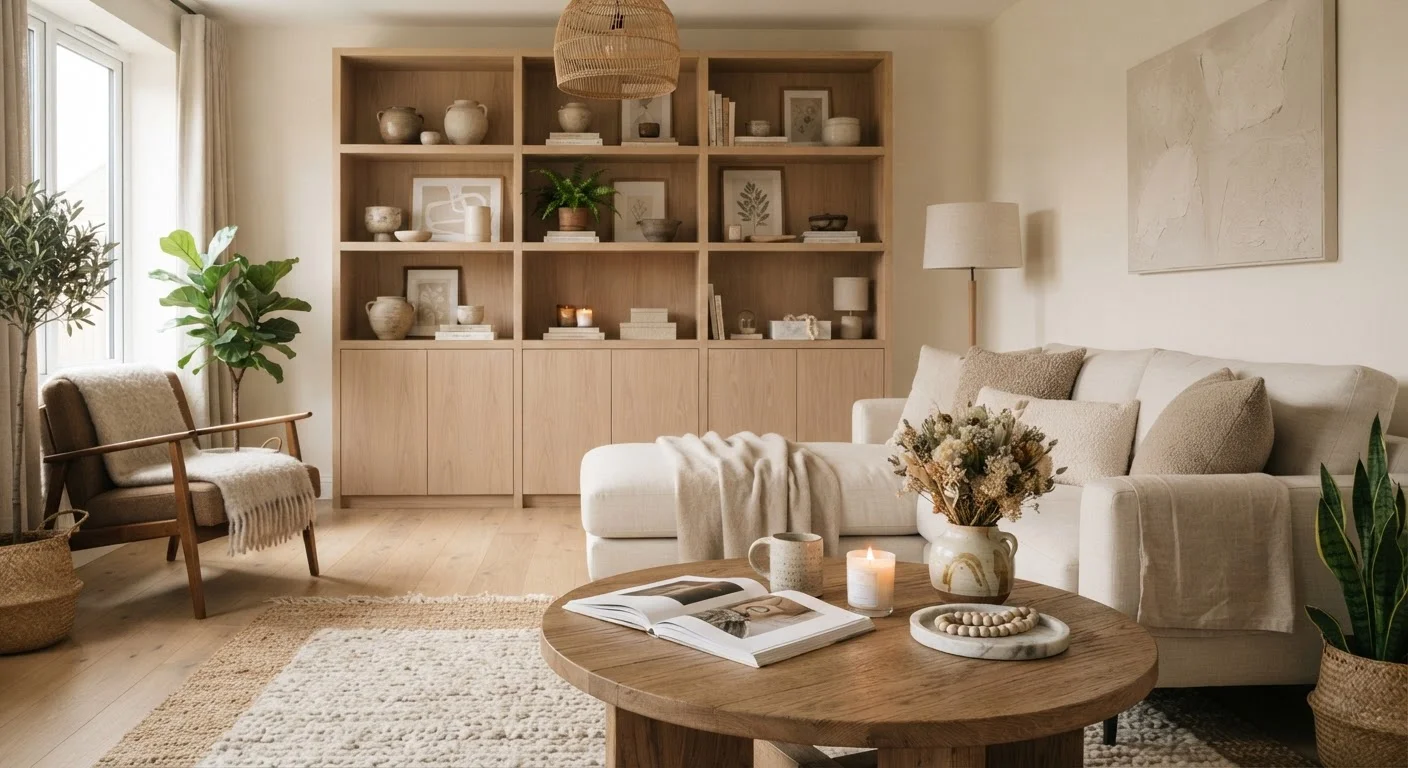
A hybrid aesthetic blending Japanese and Scandinavian design principles. It emphasises simplicity, craftsmanship, natural materials, and a muted colour palette, while embracing the Japanese concept of wabi-sabi and the Scandinavian idea of hygge.
Wabi-Sabi
A Japanese aesthetic philosophy that finds beauty in imperfection, impermanence, and incompleteness. In décor, it translates to handmade objects, natural textures, worn surfaces, and an intentional absence of polish.
Maximalism
A decorating philosophy centred on abundance, layering, and self-expression. Maximalist spaces typically feature bold colour, pattern mixing, extensive collections, and a sense of curated visual richness.
Negative Space
The intentional empty area around or between objects in a room. Designers use negative space to prevent visual clutter, direct the eye, and allow individual pieces to breathe and be appreciated.
Vignette
A small, intentionally composed arrangement of objects — typically on a shelf, console, or tabletop — that tells a visual story. A well-constructed vignette usually varies objects by height, texture, and scale.
Focal Point
The dominant visual anchor of a room that draws the eye first. Common focal points include a fireplace, a large piece of artwork, an accent wall, or a statement piece of furniture.
Eclectic Style
An intentional mix of periods, cultures, and styles within a single space. Successful eclectic interiors are unified by a consistent colour palette or repeated material, preventing the look from feeling chaotic.
Hygge
A Danish and Norwegian concept describing a quality of cosiness, comfort, and convivial warmth. In interior terms, hygge is achieved through soft lighting, textural layers like throws and rugs, and intimate furniture arrangements.
Mid-Century Modern
A design movement broadly spanning the 1940s through 1960s, characterised by clean lines, organic curves, minimal ornamentation, and a marriage of form and function. Tapered legs on furniture are a signature visual marker.
Transitional Style
A blend of traditional and contemporary elements that avoids extremes of either direction. Transitional rooms feel timeless rather than trend-driven, balancing classic shapes with updated finishes and neutral palettes.
Accent Wall
A single wall in a room treated differently from the others — through paint colour, wallpaper, cladding, or texture — to create visual interest and define a focal zone without overwhelming the entire space.
Minimalism vs. Maximalism
These two approaches are often framed as opposites, but they share the same core question: how should a space make its occupants feel? Minimalism answers with restraint and openness; maximalism answers with richness and abundance. Neither is inherently superior, and many well-designed rooms live somewhere between the two poles. For a deeper comparison, see Minimalism vs. Maximalism: Two Decorating Philosophies, One Home.
Colour and Material Terms
When designers talk about a neutral palette, they mean colours with low saturation — whites, greys, beiges, and warm taupes — that recede visually and let other elements lead. A saturated colour, by contrast, is vivid and intense. Tone-on-tone layering uses different shades of the same hue to create depth without contrast. Patina refers to the surface character that develops on materials — wood, metal, leather — through age and use, and is frequently celebrated in both wabi-sabi and vintage-inspired interiors.
Style Labels Are Starting Points, Not Rules
No space needs to conform perfectly to a single named style. Design labels are useful shorthand for communicating preferences, not prescriptions for how a room must look. Most satisfying interiors blend elements from several aesthetics, unified by a consistent colour story or material thread. Use these terms to clarify your thinking, not to restrict your choices.
How to Apply These Concepts Practically
Knowing a term is only useful if it changes how you act. Here's how to translate terminology into tangible decisions:
- Identify your anchor philosophy first. Are you drawn to spare, airy rooms (minimalism, Scandinavian) or layered, storied ones (maximalism, eclectic, bohemian)? Your anchor shapes every subsequent choice.
- Use the vocabulary to filter. When sourcing furniture or accessories, search using style terms to get more relevant results — and to avoid pieces that will feel jarring.
- Blend intentionally. Styles like Japandi are themselves hybrids. There's no rule against mixing biophilic elements into a mid-century modern room, or pairing wabi-sabi ceramics with a contemporary sofa.
- Let spatial terms guide arrangement. Understanding concepts like negative space, vignette, and focal point helps you edit and arrange what you already own — often at no cost.
For broader guidance on home projects, the Home Improvement hub covers structural and functional upgrades that create the backdrop for all of the décor decisions above.
≈60%
US homeowners who say style consistency is a top redecorating challenge
Based on general homeowner surveys cited across design publications; exact figures vary by source and year.
3–5 objects
Typical object count for a balanced tabletop vignette
Widely recommended guideline in interior styling education and design guides.