

Key Takeaways
- Open shelving adds visual openness and personality but requires deliberate, ongoing curation to avoid clutter.
- Dust accumulation and display fatigue are real maintenance demands most design inspiration skips.
- Grouping items in odd numbers and varying heights are foundational styling principles for open shelves.
- Households with young children or pets may find open shelving less practical than enclosed storage.
- Mixing functional items with decorative objects keeps shelves feeling lived-in rather than staged.
Creates a sense of visual openness and airiness
Exposed shelves don't block sightlines the way tall, solid furniture does, making a room feel less enclosed — particularly useful in smaller living spaces.
Puts personality and collections on display
Books, plants, ceramics, and art objects become part of the room's décor rather than hidden away, giving visitors an immediate sense of who lives there.
Generally less expensive than built-in cabinetry
Floating shelf brackets and boards typically cost significantly less than custom or flat-pack cabinet units, making open shelving accessible across most budgets.
Keeps frequently used items easily accessible
Remote controls, books, candles, and other everyday items are quick to grab without opening doors or drawers — a practical advantage in a busy living room.
Encourages intentional, edited ownership
Because everything is on view, homeowners tend to curate more carefully, keeping only items they find genuinely beautiful or useful.
Dust accumulates quickly and visibly
Every surface on an open shelf is exposed to airborne particles, meaning objects and the shelf itself need wiping down regularly — a maintenance commitment that surprises many first-time adopters.
Clutter becomes immediately visible
Without doors to close, any disorganisation is on full display, and a single busy week can make well-intentioned shelves look chaotic rather than curated.
Requires ongoing styling effort to maintain
The editorial look of well-styled shelves doesn't maintain itself — items get moved, displaced, or piled up over time, calling for periodic re-editing and re-arranging.
Less practical for households with children or pets
Open shelves at reachable heights put breakables within easy reach of curious hands and paws, limiting where and how items can be safely displayed.
Can visually overwhelm a small or busy room
In rooms that already have a lot going on — bold wallpaper, patterned rugs, mixed furniture — open shelving can add visual noise rather than interest.
Our Verdict
Open shelving in the living room rewards people who genuinely enjoy curating and maintaining a display — it can make a room feel more personal, airy, and visually interesting. For those who prefer low-maintenance storage or live in busy, high-traffic households, the upkeep and visual noise can outweigh the aesthetic payoff. The honest answer is that open shelving works best as a complement to — not a replacement for — some enclosed storage.
Best for style-minded homeowners who enjoy arranging objects, can commit to periodic editing, and want their living room to feel curated and expressive rather than purely functional.
Why Open Shelving Is Having a Moment
Open shelving has migrated from kitchens and home offices into living rooms in a big way. The appeal is straightforward: exposed shelves invite you to put personality on display, create a sense of openness in a room, and sidestep the visual weight of large, solid cabinets. They can make a living room feel more like a thoughtfully assembled home and less like a showroom.
But the version you see in design magazines is almost always a carefully edited snapshot — not an honest picture of daily life. Understanding both sides of the equation will help you decide whether open shelving is genuinely right for your space or whether the idea looks better on Pinterest than it will on your wall. For a broader grounding in what makes a room feel cohesive, see the principles behind every well-decorated room.
The Real Advantages of Open Shelves
When done well, open shelving delivers benefits that enclosed storage simply cannot match.
Creates a sense of visual openness and airiness
Exposed shelves don't block sightlines the way tall, solid furniture does, making a room feel less enclosed — particularly useful in smaller living spaces.
Puts personality and collections on display
Books, plants, ceramics, and art objects become part of the room's décor rather than hidden away, giving visitors an immediate sense of who lives there.
Generally less expensive than built-in cabinetry
Floating shelf brackets and boards typically cost significantly less than custom or flat-pack cabinet units, making open shelving accessible across most budgets.
Keeps frequently used items easily accessible
Remote controls, books, candles, and other everyday items are quick to grab without opening doors or drawers — a practical advantage in a busy living room.
Encourages intentional, edited ownership
Because everything is on view, homeowners tend to curate more carefully, keeping only items they find genuinely beautiful or useful.
3–5
Items per shelf cluster for best visual balance
Interior design guidelines consistently recommend grouping objects in odd numbers to create arrangements the eye finds naturally pleasing.
20–30%
Ideal empty space to leave on each shelf
Professional stylists generally advise leaving roughly a quarter of each shelf empty to avoid the cramped appearance of overfilled displays.
One underrated advantage: open shelves force you to own less. Because everything is visible, you're naturally motivated to keep only items worth looking at — a form of built-in editing that can reduce overall household clutter over time.
The Honest Drawbacks You Should Know
The cons of open shelving aren't dealbreakers for everyone, but ignoring them leads to frustrated homeowners a few months down the line.
Dust accumulates quickly and visibly
Every surface on an open shelf is exposed to airborne particles, meaning objects and the shelf itself need wiping down regularly — a maintenance commitment that surprises many first-time adopters.
Clutter becomes immediately visible
Without doors to close, any disorganisation is on full display, and a single busy week can make well-intentioned shelves look chaotic rather than curated.
Requires ongoing styling effort to maintain
The editorial look of well-styled shelves doesn't maintain itself — items get moved, displaced, or piled up over time, calling for periodic re-editing and re-arranging.
Less practical for households with children or pets
Open shelves at reachable heights put breakables within easy reach of curious hands and paws, limiting where and how items can be safely displayed.
Can visually overwhelm a small or busy room
In rooms that already have a lot going on — bold wallpaper, patterned rugs, mixed furniture — open shelving can add visual noise rather than interest.
If you're working with a small living room, visible clutter can make a space feel even more compressed. Thoughtful shelf placement and strict editing become even more critical — strategies covered in detail in our guide to styling a small living room.
Floating Shelves vs. Freestanding Units
Floating shelves are mounted directly into wall studs or using appropriate wall anchors, which means installation does require some DIY confidence — and ideally, a stud finder. For heavier loads like books, proper stud anchoring is essential for safety. Freestanding shelving units sidestep the installation concern entirely and can be repositioned as your layout evolves. If you're renting, always check your tenancy agreement before drilling into walls.
How to Style Open Shelves So They Actually Work
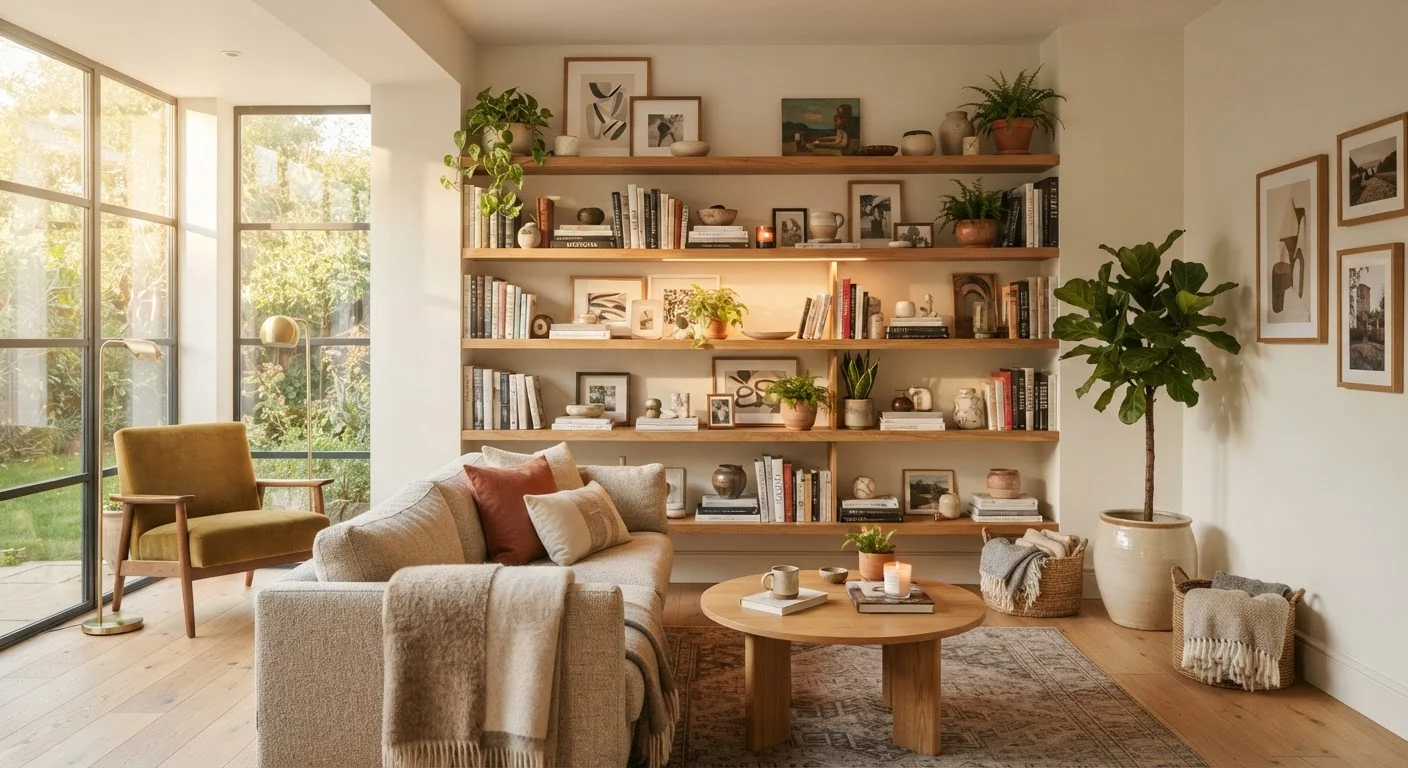
Successful open shelving follows a few consistent principles that interior stylists rely on:
- Group in odd numbers. Three or five items in a cluster reads more naturally to the eye than two or four.
- Vary height and texture. Pair a tall vase with a low stack of books and a small ceramic piece to create rhythm without symmetry.
- Leave breathing room. Shelves packed to capacity look messy regardless of how nice each individual item is. Aim to leave roughly 20–30% of shelf space empty.
- Anchor with larger pieces. One or two substantial items per shelf — a larger plant, a meaningful artwork print, a grouped book collection — give the eye somewhere to land.
- Edit seasonally. Rotating a few items every few months keeps shelves feeling fresh and prevents visual fatigue.
Alcoves and corners are ideal locations for open shelving because built-in placement gives structure to the display. Our guide to styling corners, alcoves, and awkward nooks explores this further.
Making the Decision for Your Home
Before committing to open shelving, answer these practical questions honestly:
- Do you enjoy arranging and re-arranging objects, or does that feel like a chore?
- How much dust does your home accumulate, and how often do you dust?
- Do you have young children or pets who might reach or knock items?
- Is your existing collection of objects shelf-worthy, or would you need to acquire new items?
If most answers give you pause, a hybrid approach often works well: open shelving for a single accent wall combined with enclosed cabinetry below or beside it. You get the aesthetic payoff without the full maintenance commitment. If you're starting from scratch and building out a room's storage plan, decorating your first home from scratch offers a grounded starting framework.