

Key Takeaways
- Awkward corners and alcoves are opportunities for storage, seating, or focal points — not wasted space.
- Vertical elements like tall shelves or floor lamps draw the eye upward and make nooks feel intentional.
- Lighting is one of the most affordable and effective tools for transforming neglected corners.
- Matching the function of a nook to an existing room need — reading, display, or storage — creates cohesion.
- Renters can style corners effectively using freestanding furniture and removable hardware.
Why Corners Deserve More Attention
Walk into almost any room and you'll find at least one corner doing nothing — an empty diagonal of wall, an awkward recess beside the chimney breast, or a shallow alcove that somehow got overlooked when the rest of the space was furnished. These spots tend to collect clutter by default, not design.
The good news is that corners and alcoves respond exceptionally well to intentional styling. Because they're bounded on two or three sides, they naturally frame whatever you place inside them — creating a sense of completeness that open-plan areas can't always achieve. Understanding a few core design principles makes it much easier to approach these spaces with confidence rather than guesswork.
Below are seven practical strategies, each adaptable to different room types, budgets, and skill levels.
Anchor the corner with a tall vertical element
Low, wide furniture placed in a corner often disappears. A tall bookcase, a floor lamp, or a large potted plant draws the eye upward and signals that the space was considered. Vertical height also makes ceilings feel taller in proportion — a useful trick in smaller rooms.
If the corner is particularly narrow, a slender ladder shelf or a single tall vase with stems can achieve the same upward pull without crowding the space. The goal is to give the eye somewhere deliberate to travel.
Vertical height in a corner signals intention and makes the whole room feel taller.
Use built-in or alcove shelving to your advantage
Alcoves beside fireplaces, chimney breasts, or under staircases are ideal candidates for shelving — either fitted or freestanding. Shelving here serves double duty: it stores or displays items while filling a recess that would otherwise look incomplete.
For display purposes, vary the height and depth of objects grouped on each shelf — a mix of books, small plants, and a few sculptural objects avoids the flat, catalogue look. Open shelving works best when it's edited regularly; resist the urge to fill every inch.
Alcove shelving solves two problems at once: it fills dead space and adds useful storage or display.
Create a reading nook with a chair and focused light
A corner with even 36 inches of diagonal clearance can accommodate a compact armchair or a floor cushion setup. Add a floor lamp positioned over one shoulder and a small side table, and you have a genuinely functional reading spot rather than an empty corner.
The key is focused, warm-toned lighting — it defines the nook visually while making it feel cozy rather than cavernous. If the chair faces outward into the room, it also becomes a secondary seating option for guests.
A chair, a lamp, and a side table can transform 36 inches of empty corner into a reading retreat.
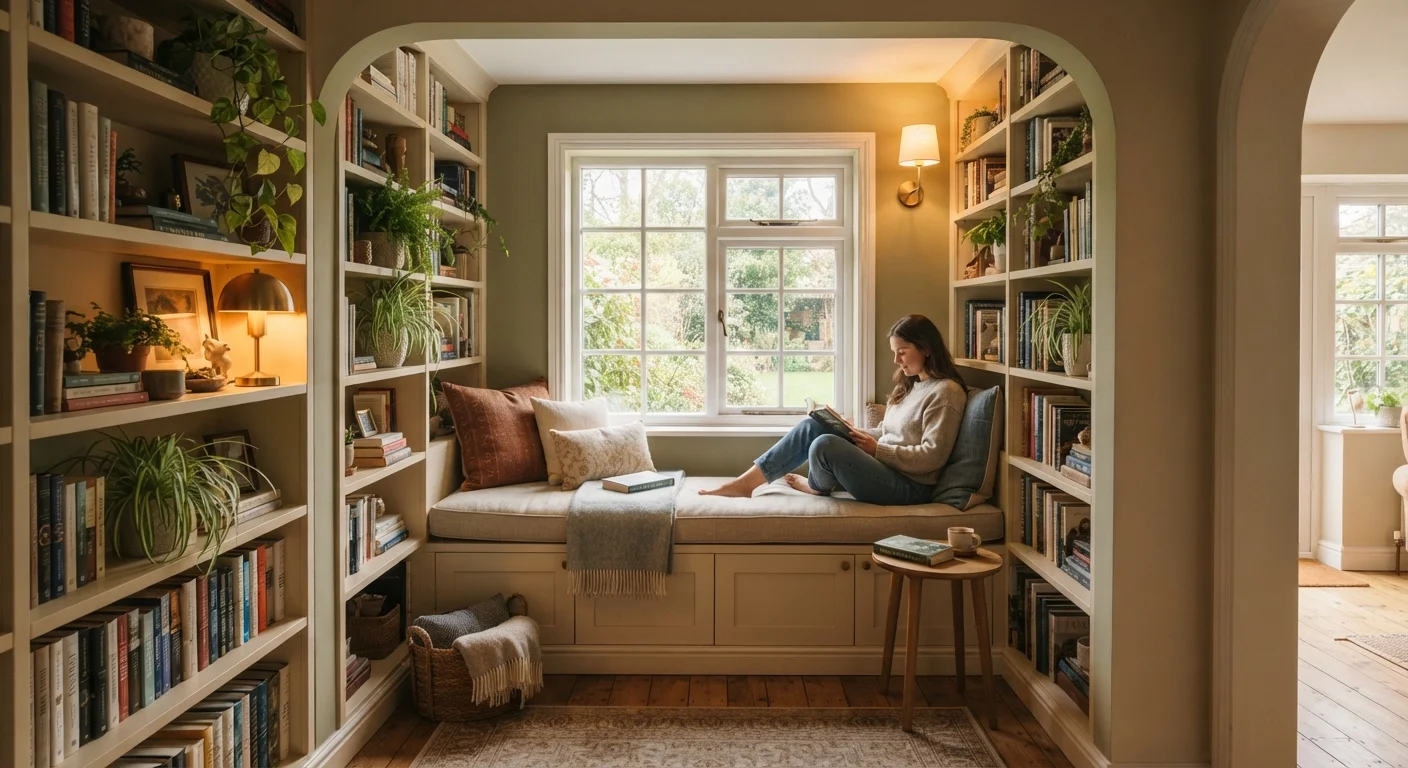
Install a window seat in a bay or deep recess
Bay windows and deep-set recesses often go underused because standard furniture doesn't fit them neatly. A built-in or freestanding window seat changes that entirely — it turns the awkward depth into an asset, providing seating, a surface for plants or books, and often hidden storage beneath the seat cushion.
Even without a bay, a shallow bench or upholstered cube placed beneath a window in a corner creates a similar effect at lower cost and without any permanent construction. This is particularly useful in small living rooms where every inch of multi-use furniture counts.
A window seat turns an awkward bay or recess into purposeful seating with potential hidden storage.
Layer lighting to define the nook without renovation
One of the most budget-friendly ways to transform a dark or uninviting corner is to add a light source within or beside it. A plug-in wall sconce, a table lamp on a stool, or even a string of warm-white lights along a shelf edge all shift the visual weight of a corner from forgotten to featured.
Layered lighting — combining ambient, task, and accent sources — is a principle used by professional interior stylists to make rooms feel considered. A corner that has its own dedicated light source reads as an intentional zone, not leftover space.
A dedicated light source turns a dark corner into a deliberate zone — no renovation required.
Introduce a gallery wall or single large artwork
A bare corner wall is a natural gallery opportunity. A cluster of framed prints at varying heights fills the vertical space and adds personality without requiring furniture. If the corner has two visible walls meeting at a right angle, wrapping artwork around both sides creates an immersive, gallery-style effect.
Alternatively, one oversized piece hung low and centered in a recess can act as an anchor — much like a window gives a wall a focal point. Either approach works; what matters is committing to a deliberate arrangement rather than hanging pieces randomly over time.
Wrapping artwork around two walls of a corner creates an immersive gallery effect with minimal cost.
Bring in a plant or small indoor tree for organic structure
A large fiddle-leaf fig, olive tree, or similarly structured indoor plant placed in a corner adds organic height and warmth that furniture alone rarely achieves. Plants also soften the hard right angle where two walls meet, which helps the corner feel less abrupt within the overall room.
Choose a plant whose mature size suits the space — a floor-standing specimen works best in corners with reasonable ceiling height and adequate natural or supplemental light. If light is limited, shade-tolerant species such as Dracaena or Sansevieria are worth considering.
A structured indoor plant softens the hard angle of a corner and adds living warmth to any room.
Putting It All Together
The most common mistake with awkward spaces is treating them as afterthoughts — filling them at the last minute with whatever doesn't fit elsewhere. A more effective approach is to identify the nook first and ask what the room actually needs: more storage, a reading spot, a display moment, or simply visual balance.
Start With Function, Then Style
Before choosing furniture or décor for a nook, decide what job you need it to do. Storage, seating, display, and greenery all call for different approaches. Matching the nook's purpose to a genuine room need — rather than filling it for filling's sake — produces results that look intentional and stay functional. If you're starting from scratch in a new space, the decorating your first home from scratch guide walks through a planning process that applies equally well to individual corners.
If you're working in a rental, most of these ideas translate without permanent changes. Freestanding shelving, removable picture ledges, and plug-in lighting can all be taken with you when you move. For more reversible ideas, see decorating a rental without losing your deposit.
Corners that feel cohesive with the rest of the room — rather than styled in isolation — tend to work best. If the broader space feels off despite looking coordinated, it's worth reading about why rooms feel 'off' even when everything matches before adding more pieces.