

| Red light urgency | Stop driving as soon as safely possible |
| Amber light urgency | Schedule inspection soon; not an immediate stop |
| Flashing vs. solid CEL | Flashing = urgent; solid = schedule a diagnostic |
| OBD-II port location | Typically under the dashboard, driver's side |
| TPMS trigger threshold | Generally 25% below recommended tire pressure (U.S. NHTSA standard) |
| Best reference for your lights | Your vehicle's owner's manual |
How Dashboard Warning Lights Are Organized
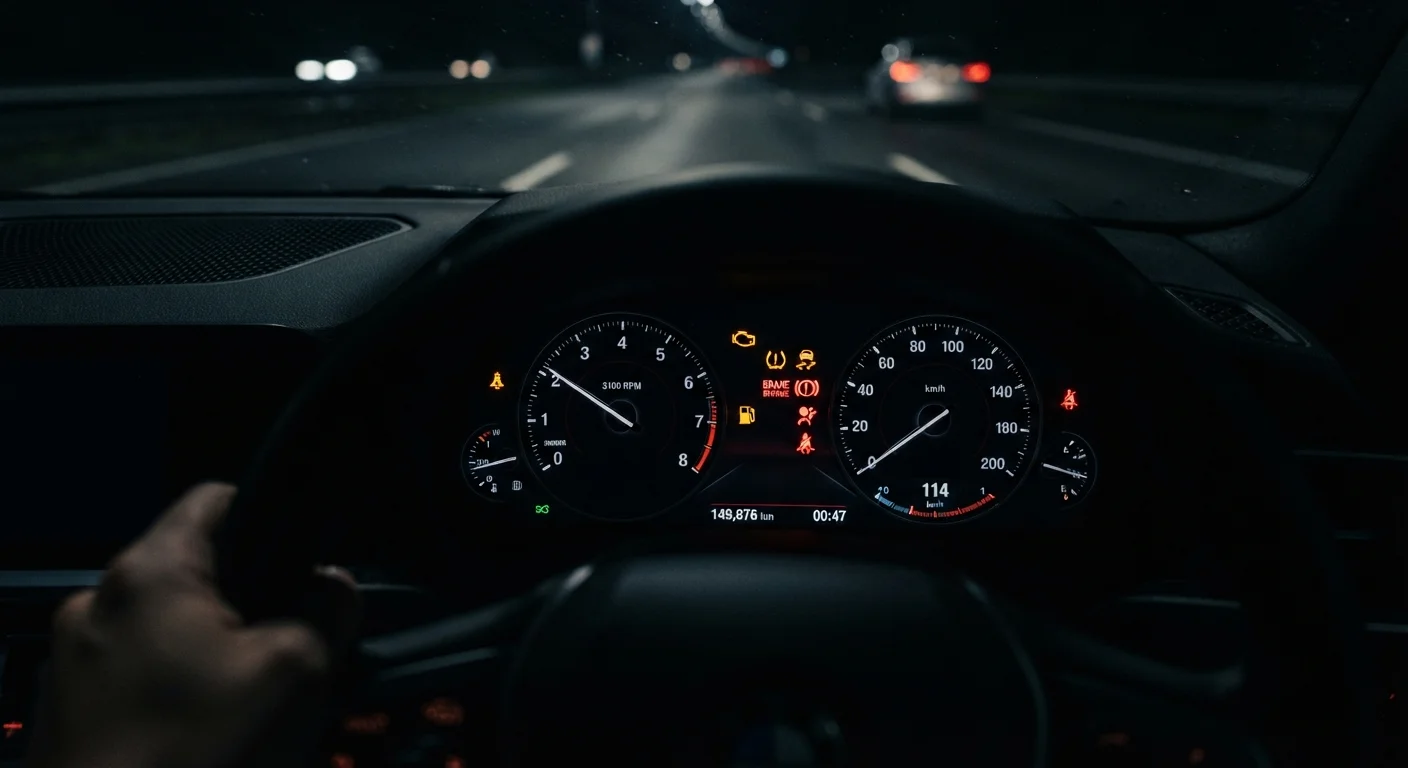
Modern vehicles use a standardized color system to communicate urgency. Red lights indicate a serious or potentially dangerous condition — stop driving as soon as it is safe to do so. Amber or yellow lights signal a caution or system fault that needs attention soon but is rarely an immediate emergency. Green and blue lights are simply status indicators — they confirm that a feature like your high beams or turn signal is active.
| Red light urgency | Stop driving as soon as safely possible |
| Amber light urgency | Schedule inspection soon; not an immediate stop |
| Flashing vs. solid CEL | Flashing = urgent; solid = schedule a diagnostic |
| OBD-II port location | Typically under the dashboard, driver's side |
| TPMS trigger threshold | Generally 25% below recommended tire pressure (U.S. NHTSA standard) |
| Best reference for your lights | Your vehicle's owner's manual |
Because symbol shapes and colors can vary slightly by manufacturer, your owner's manual is always the definitive reference for your specific vehicle. Keeping it in the glove box means you can look up an unfamiliar light before panicking — or before ignoring something you shouldn't.
Red Lights: Stop and Act
These lights demand immediate attention. Continuing to drive when one is active can cause serious engine or safety damage.
- Oil Pressure Warning — Usually an oil can icon. Low oil pressure means critical engine parts are not being lubricated. Pull over safely, shut off the engine, and check the oil level. Do not drive further until the cause is identified by a qualified mechanic.
- Engine Temperature Warning — A thermometer in liquid. The engine is overheating. Turn off the A/C, pull over, and allow the engine to cool before opening the hood. Driving through overheating can warp engine components.
- Battery / Charging System — A battery symbol. The vehicle's electrical system is not charging properly. You may have limited driving time before the engine stalls. Minimize electrical loads and head directly to a service location.
- Brake System Warning — An exclamation mark inside a circle with parentheses. If your parking brake is off and this appears, it can indicate low brake fluid or a hydraulic fault. Have it inspected immediately. For more on brake behavior, see why brakes squeal, grind, and pulse.
Amber Lights: Schedule Attention Soon
Amber lights don't usually require you to stop immediately, but they should not be ignored for long.
OBD-II
On-Board Diagnostics II — a standardized system built into most vehicles sold after 1996 in the U.S. that monitors engine and emissions performance and stores fault codes readable by a scanner.
Catalytic Converter
An emissions control device in the exhaust system that converts harmful pollutants into less harmful gases. Engine misfires can overheat and permanently damage it.
TPMS
Tire Pressure Monitoring System — a sensor-based system that alerts the driver when one or more tires drop significantly below the recommended inflation pressure.
Fault Code
A numeric code stored by the vehicle's onboard computer when a sensor detects an out-of-range reading. Codes help mechanics identify the source of a warning light.
ADAS
Advanced Driver Assistance Systems — electronic safety features such as lane-keep assist, automatic emergency braking, and adaptive cruise control built into many modern vehicles.
- Check Engine Light (CEL) — A solid amber engine outline means the onboard diagnostic system has logged a fault code. Causes range from a loose gas cap to a misfiring cylinder. A flashing CEL is more serious — it often indicates active misfires that can damage the catalytic converter. A flashing light warrants prompt inspection.
- Tire Pressure Monitoring System (TPMS) — An exclamation mark inside a flat tire profile. One or more tires are significantly underinflated. Check pressures before driving farther, especially before a long trip. Your pre-trip vehicle safety check should include tire pressure every time.
- Traction Control / Stability Control — A car with wavy lines beneath it. If this flashes briefly, the system is actively working to prevent a skid — normal on slippery roads. If it stays on, the system may be disabled or faulty.
- ADAS Warnings — Many newer vehicles display symbols for lane-keep assist, automatic emergency braking, or adaptive cruise faults. Understanding what these systems do is explained in detail in our guide to driver-assistance technology now standard on new vehicles.
1 in 4
Vehicles on U.S. roads with at least one unaddressed warning light
According to periodic surveys by automotive research organizations, a significant share of drivers are actively ignoring dashboard alerts.
~77%
Check engine light cases that are emissions-related
Studies of OBD-II diagnostic data suggest the majority of CEL triggers involve the emissions or fuel system, many of which are low-urgency but require attention.
When in Doubt, Don't Guess
A warning light you don't recognize is not a light to ignore. Most auto-parts retailers can read basic fault codes for free using an OBD-II scanner — a tool that connects to a port typically found under the dashboard on the driver's side. This gives you a starting point, though interpreting codes accurately often requires a mechanic's assessment.
Free Code Reads Have Limits
An OBD-II reader provides a fault code number, but a code alone doesn't pinpoint the exact failed component — it identifies the system or circuit involved. A P0420 code, for example, flags catalyst efficiency but could stem from multiple causes. Always treat a free code read as a starting point for a professional diagnosis, not a final answer.
Safe driving habits reduce the likelihood of being caught off guard by a sudden warning. Practicing defensive driving principles and running through a quick vehicle check before road trips keeps you ahead of potential problems. For a comprehensive look at every dashboard symbol your vehicle may display, see our full warning lights decoded guide.