

Key Takeaways
- Textiles control more than aesthetics — they soften acoustics and regulate perceived warmth.
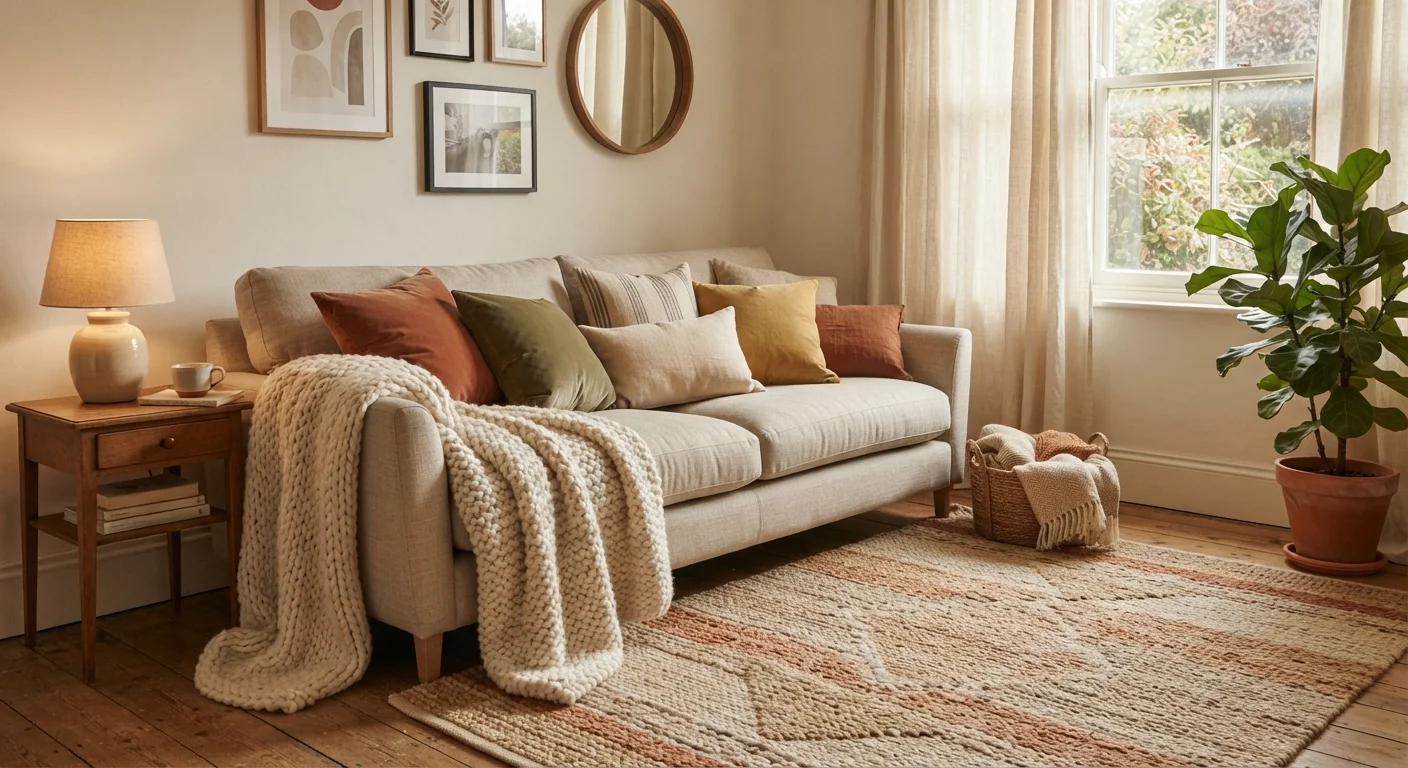
- Layering works by building from large-scale anchors like rugs up to smaller accent pieces.
- Mixing textures creates visual depth; matching tones keeps a layered look cohesive, not chaotic.
- Functional and decorative textiles can — and should — serve double duty in any room.
- Small additions like a single throw or runner can meaningfully shift a room's atmosphere.
Why Textiles Do More Than Decorate
Soft furnishings are often treated as an afterthought — something added once the furniture is placed and the paint has dried. In practice, they're among the most powerful tools available to anyone shaping a room. Throws, cushions, rugs, and curtains absorb sound, reduce echo, retain heat near living zones, and break up the hard reflective surfaces that make a room feel cold or sterile.
Rooms with hard floors, bare walls, and minimal fabric tend to feel acoustically bright and visually flat, even when the furniture is well chosen. Textiles interrupt that. They give the eye places to pause and give the ear softer reflections. This is why a room can look right in photographs but feel uncomfortable to spend time in — the subtle physical qualities that make it livable are missing.
Understanding what each textile layer contributes lets you make deliberate choices rather than decorating by instinct.
Building a Textile Layer: Start at the Floor
The most effective approach works from the largest scale down to the smallest detail. A large area rug is the natural starting point. It anchors the seating zone, defines the boundary of a space within an open plan, and provides the greatest acoustic absorption per square foot of any soft furnishing. On hard floors especially, a rug is rarely optional if comfort is the goal — it's worth noting that the underlayment beneath hard floors also contributes to acoustic softness, but the rug above it does considerably more.
From the floor, move to window treatments. Curtains and blinds serve a practical role — light filtering, insulation, privacy — but they also introduce a major vertical plane of texture and colour into the room. Linen and cotton weaves add softness without visual weight; heavier woven fabrics add warmth and help with heat retention near glass in colder months.
Finally, layer onto seating surfaces. Cushions and throws introduce colour, pattern, and tactile variation closest to the body, which is where comfort is most directly perceived.
Texture, Tone, and Scale: The Mixing Logic
A common hesitation with layering textiles is the fear of things clashing. The practical solution is to treat texture and tone as two separate variables and manage them independently.
Vary texture freely: smooth cotton, nubby boucle, chunky knit, and fine velvet can all coexist. Contrast in texture is what gives layered rooms their visual richness. What keeps them from feeling chaotic is tonal consistency — working within a shared colour palette, even a loose one. A neutral base of warm creams and stone tones, for example, will hold together linen, wool, and cotton regardless of their surface variation.
Scale matters too. A large geometric pattern on a rug reads well from a distance; it can be paired with a smaller repeat or plain fabric on cushions without competition. Mixing two large patterns of similar scale tends to fight for attention, while mixing a large pattern with a subtle texture alongside a plain tends to settle comfortably.
“Texture is the quiet variable in a room. Colour gets the credit, but it's the interplay of surfaces — rough against smooth, matte against sheen — that determines whether a space feels alive or inert.”
— Kelly Wearstler, Interior designer and author
These principles connect to broader ideas explored in the core design principles interior stylists rely on — proportion, visual balance, and the intentional use of contrast.
Quick Ways to Start Layering Today
You don't need to redecorate to apply these ideas. Small additions to an existing room can shift its atmosphere noticeably. Even a single well-chosen throw or a swap from a flat-woven rug to a pile rug can make a room feel warmer and quieter.
Layering textiles is also one of the most reversible forms of interior adjustment — nothing is fixed to the wall or the floor permanently. That makes it a low-risk place to experiment. For smaller rooms, scale and placement strategies apply here too: a rug that's too small for the seating group, for instance, will fragment the space rather than anchor it.
Start with what's underperforming in your room — an echo that bothers you, a sofa that looks bare, a window that makes the space feel exposed — and choose the textile that addresses it. Function and comfort, rather than decoration alone, are a reliable guide.