

Key Takeaways
- Companion planting has real scientific support for some combinations, but many popular claims are anecdotal.
- The main mechanisms include pest confusion, nutrient cycling, and pollinator attraction.
- The Three Sisters (corn, beans, squash) is one of the best-documented companion systems.
- Some plant pairings genuinely inhibit each other — spacing and selection matter.
- Keeping records of what works in your specific garden is the most reliable guide.
What Companion Planting Actually Is
Companion planting is the practice of growing different plants in close proximity so they benefit one another — or at least don't interfere. The concept spans centuries of agricultural tradition across many cultures, and today it sits at an interesting intersection of folk wisdom and emerging horticultural research.
It's important to distinguish what companion planting is from what it isn't. It's not a magic system that eliminates pests or maximizes every harvest. Think of it more like thoughtful plant community design — a way of reducing inputs, supporting soil health, and encouraging a more resilient garden over time. If you're just getting started with vegetables, incorporating a few companion pairings from the beginning is far easier than retrofitting them later.
What the Science Says
Peer-reviewed research on companion planting is more nuanced than gardening folklore suggests. Some combinations have solid experimental support; many others have been passed down without rigorous testing. A 2016 review published in Basic and Applied Ecology found that intercropping — the agricultural equivalent of companion planting — reliably increased biodiversity and reduced pest pressure in certain contexts, but results varied considerably by crop type, climate, and soil.
73%
Of intercropping studies showed pest reduction
A meta-analysis of intercropping experiments found that the majority of study cases reported lower pest incidence compared to monoculture plots.
3x
More beneficial insects in polyculture plots
Research in agricultural entomology has found that diverse plantings can support significantly higher beneficial insect populations than single-crop beds.
20–30%
Yield increase reported in Three Sisters systems
Traditional Three Sisters polyculture has been documented to produce higher total yields per unit of land compared to growing each crop separately.
The honest takeaway: companion planting is a real and useful tool, but it's not uniformly effective. It rewards observation and experimentation rather than blind adherence to any fixed planting chart. Our guide on common gardening advice myths explores a similar tension between tradition and evidence across the garden.
“The history of companion planting is largely a history of farmers paying close attention — and we're now in the process of understanding which observations were correct and why.”
— Dr. Katharina Körner, Agroecology researcher and author on polyculture systems
The Core Mechanisms
When companion planting works, it typically does so through one of several identifiable pathways:
- Pest confusion: Strong-scented plants like basil or strongly aromatic herbs can mask the chemical signals that attract insects to a target crop. This doesn't repel insects outright but makes it harder for them to locate a host plant.
- Trap cropping: Some plants preferentially attract pests away from a main crop. Nasturtiums, for instance, are famously attractive to aphids, drawing them away from neighboring vegetables.
- Nitrogen fixation: Legumes (beans, peas, clover) host soil bacteria that convert atmospheric nitrogen into plant-available forms, enriching the soil for neighboring heavy feeders like corn or squash.
- Pollinator attraction: Flowering companions like borage, phacelia, and calendula draw in bees and other beneficial insects, boosting pollination rates for fruiting crops nearby.
- Ground cover and moisture retention: Low-growing companions suppress weeds and reduce soil moisture loss, benefiting taller or slower-establishing plants.
When using trap crops like nasturtiums, plant them slightly before your main crop so they're established and attractive to pests by the time your vegetables are vulnerable.
Timing matters because trap crops need to be the most appealing option in the vicinity — an underdeveloped trap plant won't redirect pest pressure effectively.
Don't thin your companions too aggressively early in the season. Some protective effects — like scent masking — depend on density to work.
Sparse plantings of aromatic herbs may not produce enough volatile compounds to meaningfully confuse pest insects navigating by smell.
Reliable Combinations to Try
While hundreds of pairings appear in gardening literature, a smaller set has genuine research support or a very long track record of practical success:
- Three Sisters: Corn, Beans, and Squash
- One of the most thoroughly documented companion systems, originating with Indigenous peoples of the Americas. Corn provides a trellis for climbing beans; beans fix nitrogen; squash leaves shade the ground, suppressing weeds and retaining moisture. The synergy is structural, nutritional, and ecological.
- Tomatoes and Basil
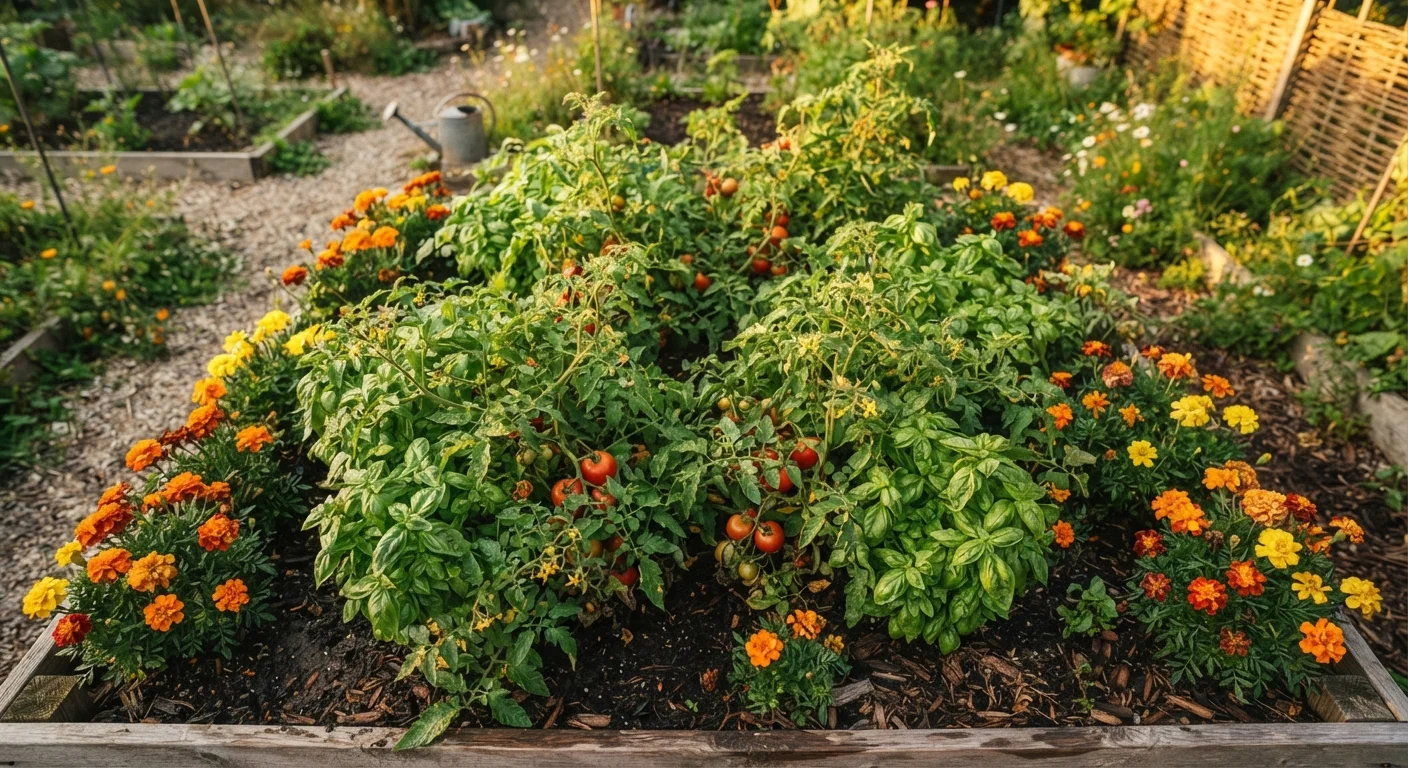
- The evidence for pest repulsion here is mixed, but basil attracts beneficial insects and makes efficient use of vertical space alongside tomatoes. Most gardeners find the combination at least neutral, and often practically beneficial.
- Brassicas and Dill or Fennel (carefully)
- Dill attracts parasitic wasps that prey on caterpillars — a real benefit near cabbages and kale. Note: mature fennel can inhibit many vegetables, so use dill instead for intercropping. Keep fennel at the garden's edge.
- Carrots and Onions
- Anecdotally, each is said to confuse the other's primary pest (carrot fly and onion fly). Evidence is limited but the combination is widely practiced and low-risk.
For small plots, see our guide on versatile plants for limited space to prioritize companions that pull double duty.
Pairs to Avoid
Allelopathy — the process by which one plant releases chemicals that inhibit another — is well-documented in some species. Knowing which plants to keep apart is as important as knowing which to combine.
Fennel Is a Garden Loner
Fennel is one of the most allelopathic plants commonly grown in home gardens. Its root exudates inhibit germination and growth in a wide range of neighboring plants, including tomatoes, peppers, and most herbs. Plant fennel well away from your main growing areas — ideally in its own dedicated spot at the garden perimeter.
- Fennel and almost everything: Fennel is allelopathic toward a wide range of vegetables and herbs. Plant it in isolation or a dedicated bed.
- Onions and beans or peas: Alliums appear to inhibit the growth of legumes in close proximity. Keep them separated.
- Brassicas and strawberries: These two compete for similar nutrients and tend to suppress each other's growth when planted side by side.
- Potatoes and tomatoes: Both are in the Solanaceae family and share diseases including blight. Proximity increases disease transmission risk.
Companion planting integrates naturally with crop rotation principles — rotating families each season reduces both disease risk and soil depletion simultaneously.
Putting It Into Practice
Start simple. Choose one or two companion combinations and observe how they perform in your specific conditions — your soil, microclimate, and local pest population all shape the outcome. A garden journal is invaluable: note what you planted, where, and what you observed each season.
Keep a Simple Garden Log
Even a basic notebook recording what you planted where, and what you observed, becomes enormously valuable after two or three seasons. Patterns in your own garden — which pairings thrived, which underperformed — will teach you more than any general chart. Photograph your beds at the start and end of each season for easy comparison.
Companion planting also adapts well to containers. Pairing herbs with vegetables in the same large planter can attract pollinators and make efficient use of space. Our article on container gardening realities covers what to expect when growing in pots.
The goal isn't a perfect system — it's a garden that works better over time. Companion planting rewards curiosity, patience, and attention. The best pairings you'll find are the ones that succeed repeatedly in your own garden, under your own conditions, season after season.
This article provides general gardening information for educational purposes. Results from companion planting vary by region, climate, soil type, and other local conditions. Always verify plant compatibility with local cooperative extension resources when in doubt.