

Key Takeaways
- Annuals complete their full life cycle in one season and must be replanted each year.
- Perennials return year after year from their roots, reducing long-term replanting effort.
- Annuals generally offer more continuous bloom color; perennials provide structural consistency.
- Mixing both types is often the most effective strategy for year-round garden interest.
- Your climate, budget, and time commitment should guide which plants you prioritize.
Our Verdict
Neither annuals nor perennials are universally better — they serve different purposes and work best in combination. Annuals reward you with season-long color and flexibility, while perennials build a reliable, lower-maintenance foundation over time. Most successful gardens use both strategically.
| Best for | Recommended |
|---|---|
| Gardeners who want maximum color with creative flexibility each season | Annuals |
| Those looking to reduce long-term replanting effort and cost | Perennials |
| New gardeners building a garden from scratch on a budget | Perennials with annual accents |
| Container gardeners or renters wanting seasonal impact | Annuals |
What Makes a Plant Annual or Perennial?
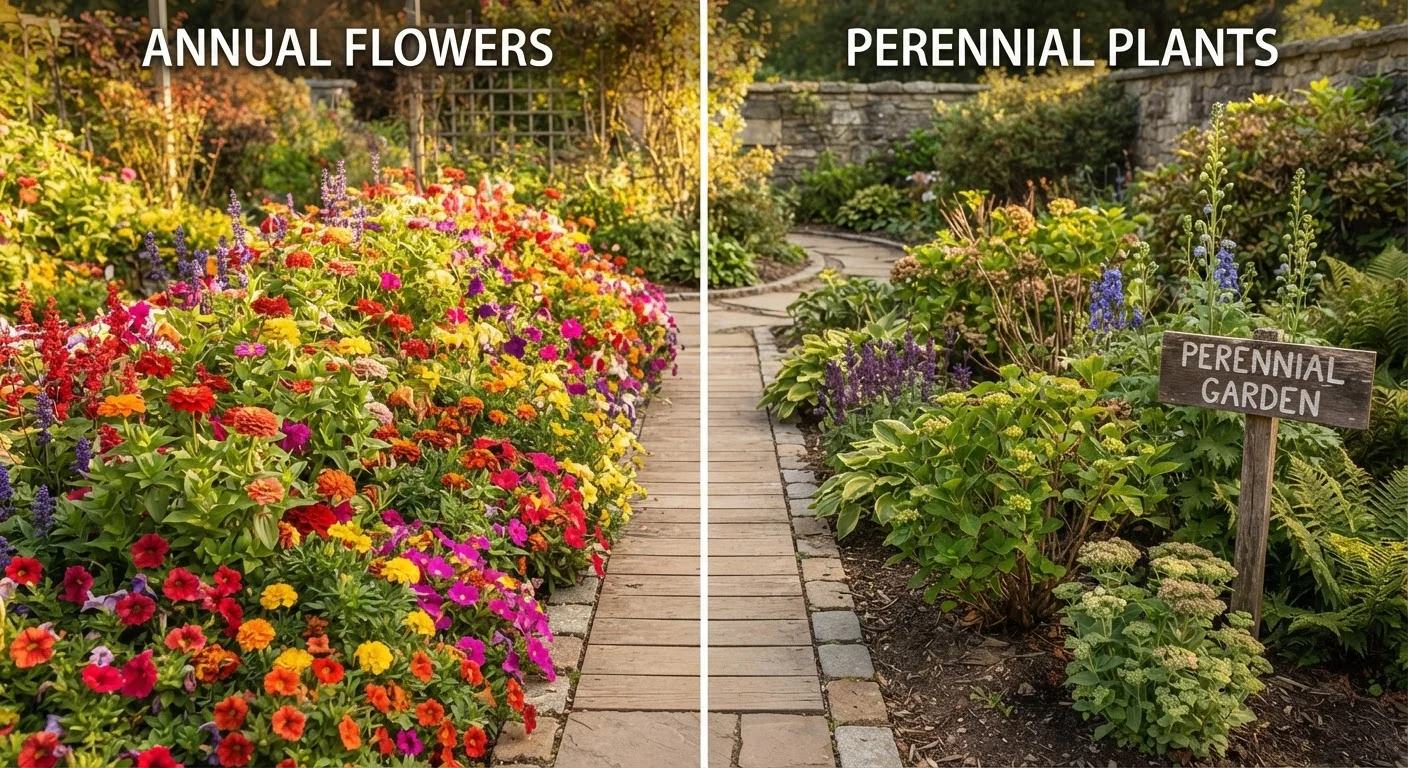
The distinction between annuals and perennials comes down to a plant's life cycle. Annuals germinate, flower, set seed, and die — all within a single growing season. They pour their energy into producing as much bloom as possible before their time is up, which is why they're known for prolific, long-lasting color. Common examples include marigolds, zinnias, and petunias.
Perennials, by contrast, die back to their roots at the end of the season but regrow from those same roots the following year. Their first-season performance can be modest as they establish underground systems, but they typically reward patience with stronger growth each successive year. Coneflowers, hostas, and black-eyed Susans are familiar perennial examples.
There's also a third category worth knowing: biennials, which complete their life cycle over two years, blooming in year two before dying. Foxgloves and hollyhocks fall into this group. For most planning purposes, though, the annual-vs.-perennial framework covers the majority of garden decisions.
How They Compare Across Key Garden Factors
Choosing between annuals and perennials — or finding the right balance of both — depends on what you value most in your garden. The table below breaks down how each type performs across the factors that matter most to everyday gardeners.
| Annuals | Perennials | |
|---|---|---|
| Life span | One growing season | Returns for many years |
| Bloom duration | Often all season long | Typically a defined bloom window |
| Upfront cost | Lower per plant | Higher per plant |
| Long-term cost | Higher (replant yearly) | Lower (established plants spread) |
| Maintenance level | Moderate (deadheading, replanting) | Low once established |
| Design flexibility | High — change each season | Lower — fixed locations |
| First-year performance | Strong bloom right away | Often modest; improves with time |
| Best suited for | Containers, seasonal color | Garden structure, long-term beds |
One factor not captured in a table is emotional satisfaction. Some gardeners love the ritual of planting fresh annuals every spring; others prefer watching perennials return like old friends. Both are valid reasons to make a choice.
Making Annuals Work for Your Garden
Annuals earn their place through sheer visual output. Because they won't survive the winter regardless, they channel all their energy into blooms rather than root development — which means you get more consistent color over more weeks. They're also forgiving for beginners: if a planting doesn't work out, you start fresh next season without a long-term commitment.
Annuals are especially well-suited to containers and window boxes, where you can swap them out seasonally for a completely different look. For more on how to get the most from this approach, see our container gardening guide.
Getting More from Your Annuals
To extend bloom time, deadhead annuals — remove spent flowers before they set seed — every week or two throughout the season. This signals the plant to keep producing new blooms rather than shifting energy toward seed production. A slow-release fertilizer at planting time can also sustain vigor without repeated feeding.
The main drawback is cost and effort: you're buying and planting every single year. Over time, that adds up. Deadheading spent flowers regularly also helps annuals keep blooming — it's a small but consistent time investment throughout the season.
Building a Garden Foundation with Perennials
Perennials are the backbone of a low-maintenance, long-lasting garden. Once established — typically after two to three growing seasons — many perennials need little more than occasional division and seasonal cleanup. Their root systems also tend to improve soil structure over time, and many attract pollinators reliably year after year.
The trade-off is patience and upfront cost. Perennials are generally more expensive per plant than annuals at the nursery, and their first-season bloom may be underwhelming. The gardening phrase "sleep, creep, leap" describes this well: year one the plant sleeps, year two it creeps, and year three it leaps into vigorous growth.
Because perennials go dormant in winter, late-season garden prep matters. Our guide on preparing your garden for winter walks through the end-of-season tasks that help perennials come back strong. Also consider how your planting bed type affects perennial performance — raised beds vs. in-ground planting covers the trade-offs worth weighing.
The Case for Mixing Both
Most experienced gardeners don't choose sides — they use annuals and perennials together. A common approach is to plant perennials as the structural core of a bed, then fill gaps with annuals to provide continuous color while the perennials mature. As perennials spread and fill in over the years, you gradually need fewer annuals to fill space.
If you're working with limited space, choosing plants that genuinely earn their keep becomes even more important. Our article on plants suited to small gardens offers practical guidance on high-value choices for compact yards.
Whatever combination you choose, consistent watering in the establishment phase is one of the biggest factors in success for both plant types. The watering habits that separate thriving plants from struggling ones is worth reading before your next planting season.