

Key Takeaways
- Your vehicle's service schedule lives in the owner's manual and specifies exactly when each maintenance task is due.
- Intervals are listed by mileage, elapsed time, or both — whichever comes first is the one that counts.
- Most common tasks involve replacing fluids or filters, rotating tires, or inspecting components for wear.
- Vehicles driven in stop-and-go traffic, extreme temperatures, or dusty conditions may need more frequent service.
- Staying on schedule generally prevents small issues from compounding into costly repairs.
Start here
What a Service Schedule Actually Is
Next
Decoding Mileage and Time Intervals
Then
Common Tasks and What They Involve
Dig deeper
Normal vs. Severe Driving Conditions
Finally
How to Keep Track Without Losing Your Mind
What a Service Schedule Actually Is
A service schedule is a manufacturer-created list of maintenance tasks paired with the specific mileage or time points at which each task should be performed. Think of it as a care calendar for your vehicle — one built by the engineers who designed the engine, transmission, and every system connected to them.
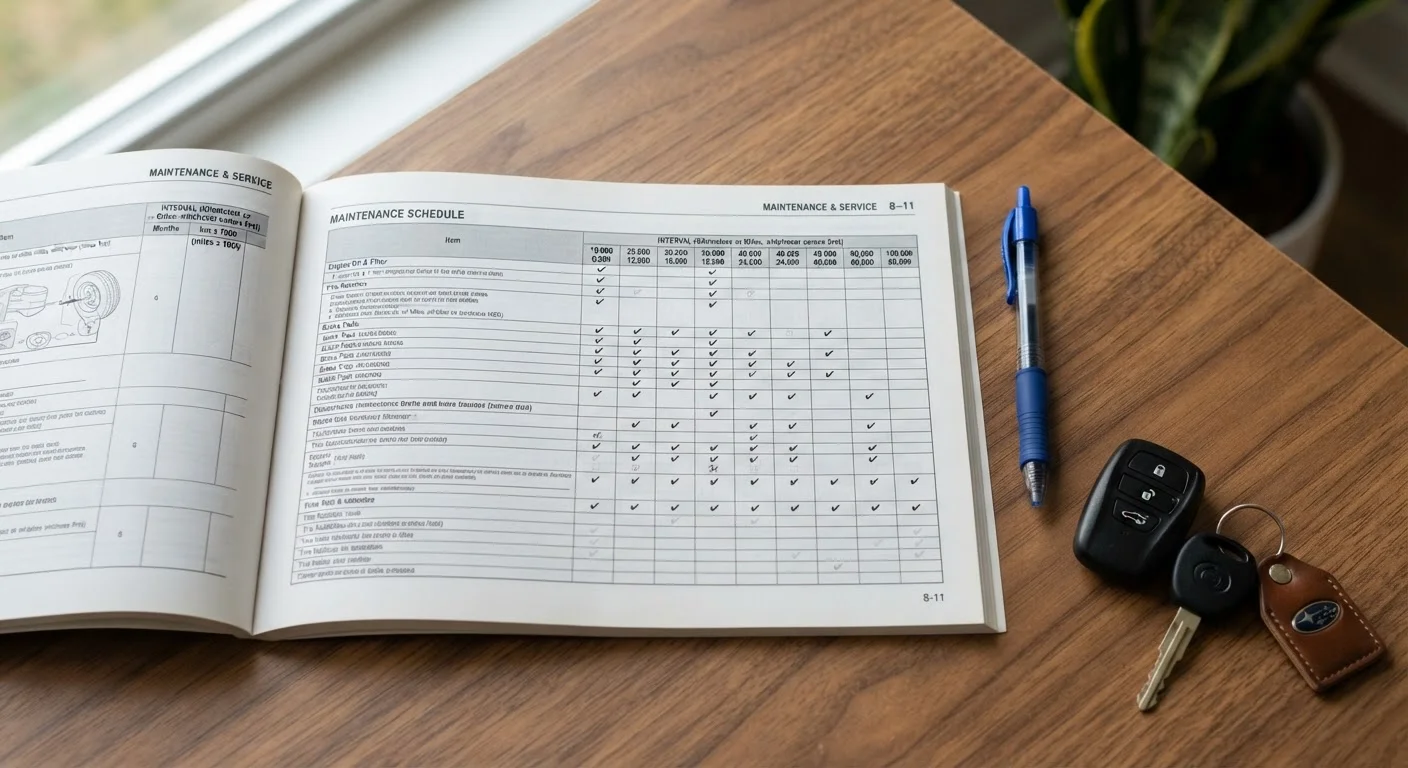
You will find it in your owner's manual, typically laid out as a table. Rows list individual tasks; columns show intervals such as 5,000 miles, 15,000 miles, 30,000 miles, and so on. Some schedules use a check-mark system; others spell out what to inspect, replace, or lubricate at each milestone.
The schedule is not a sales tool — it reflects genuine engineering knowledge about how long fluids stay effective, when belts begin to weaken, and how filters accumulate debris under typical use. For a deeper dive into everything else your manual contains, see what the owner's manual is actually trying to tell you.
Service interval
The prescribed mileage or time period between a specific maintenance task being performed. When either threshold is reached, the service is due.
Oil viscosity
A measure of how thick or thin an oil is and how it flows at different temperatures. Your owner's manual specifies the correct viscosity grade for your engine.
Coolant
A liquid (also called antifreeze) that circulates through your engine to regulate temperature and prevent overheating or freezing.
Severe driving conditions
Operating patterns — like frequent short trips, towing, or extreme temperatures — that cause vehicle components to wear faster than under average use.
Oil life monitoring system
A dashboard system that calculates when an oil change is needed based on engine data, rather than a fixed mileage trigger.
Transmission fluid
A specialized lubricant inside the transmission that helps gears shift smoothly and keeps internal components cool and protected.
Decoding Mileage and Time Intervals
Most schedules express intervals in two ways: miles driven and months elapsed. A typical entry might read every 7,500 miles or 12 months, whichever comes first. That last phrase matters. A driver who racks up only 3,000 miles per year still needs an oil change annually, because oil degrades through heat cycles and oxidation even when a car sits largely idle.
Some manufacturers use an oil life monitoring system — a dashboard indicator that calculates service need based on engine data rather than a fixed mileage figure. If your vehicle has one, it is worth understanding alongside the printed schedule, not as a replacement for it.
Use Both Indicators, Not Just One
If your schedule lists an interval as '7,500 miles or 12 months, whichever comes first,' set a calendar reminder for the time marker as well as tracking your odometer. Low-mileage drivers often miss time-based triggers because they are focused only on the mileage side.
Longer intervals listed further down the table — 30,000, 60,000, or 90,000 miles — signal bigger-ticket jobs such as coolant flushes or spark plug replacement. These are easy to overlook because they come around infrequently, but skipping them can have compounding effects. Skipping scheduled servicing costs more than most drivers expect.
Common Tasks and What They Involve
Service schedules use shorthand that can be confusing at first glance. Here is what the most common entries actually mean:
- Oil and filter change: Old engine oil is drained and replaced with fresh oil meeting the spec in your manual; the oil filter, which catches contaminants, is swapped out at the same time.
- Tire rotation: Tires are moved between positions (front to rear, side to side) so they wear evenly, extending their usable life.
- Air filter inspection/replacement: The engine air filter catches dust and debris before it enters the engine. A clogged filter reduces efficiency and can stress the engine over time.
- Cabin air filter replacement: A separate filter that cleans air flowing into the passenger compartment. This affects interior air quality, not engine performance.
- Brake inspection: A technician checks pad thickness, rotor condition, and brake fluid level — not necessarily a full replacement, just an assessment.
- Coolant flush: Old coolant (the fluid that regulates engine temperature) is drained and replaced. Degraded coolant loses its ability to prevent overheating and corrosion.
- Transmission fluid service: Fluid inside the transmission is checked or changed. The interval varies widely by manufacturer and transmission type.
- Spark plug replacement: Spark plugs ignite the air-fuel mixture in the engine. Worn plugs can cause rough starts, poor fuel economy, and misfires.
Before a long drive, many of these same items appear on a practical pre-trip checklist. See our pre-road-trip vehicle check for a focused walkthrough.
Normal vs. Severe Driving Conditions
Many service schedules include two tracks: one for normal driving and one for severe or special operating conditions. Severe does not mean dangerous — it refers to patterns that accelerate component wear.
Conditions typically classified as severe include:
- Frequent short trips under five miles, especially in cold weather
- Extensive idling (common in city driving or delivery routes)
- Towing or hauling heavy loads regularly
- Driving on unpaved or dusty roads
- Operating in extreme heat or cold
If your daily driving matches several of these, the shorter intervals under the severe-conditions column apply to you — even if the word "severe" sounds alarming. Many urban commuters actually fall into this category without realizing it.
Don't Rely on a Shop's Reminder Sticker Alone
The oil-change reminder sticker placed on your windshield by a service shop reflects that shop's recommendation, which may not match your manufacturer's specified interval. Always cross-reference with your owner's manual before deciding when to return.
As a vehicle ages and accumulates mileage, maintenance priorities can shift. Keeping a high-mileage car roadworthy explains which tasks deserve extra attention as components age.
How to Keep Track Without Losing Your Mind
Juggling multiple intervals across different mileage markers is the part that trips most people up. A few practical approaches help:
- Keep a simple log: A small notebook in the glove box, or a spreadsheet, recording each service with the date and odometer reading at the time.
- Use a maintenance app: Several free apps let you enter your vehicle details and track individual services, sending reminders when intervals approach.
- Ask for a printout: A good service center will note what was done and flag what is coming due. Learning to read that report is its own skill — our guide on reading a mechanic's service report without getting lost walks through the terminology.
- Group tasks when possible: Some intervals align conveniently — a tire rotation often pairs well with an oil change. Batching reduces trips and makes it easier to remember what has been done.
Once you understand the logic behind a service schedule, it stops feeling like a bureaucratic burden and starts feeling like exactly what it is: a straightforward plan for keeping your vehicle dependable for as many miles as possible. If you are weighing which tasks to handle yourself versus handing off to a professional, DIY car maintenance vs. taking it to a mechanic offers a balanced look at both approaches.