

Key Takeaways
- Notify your bank before travelling internationally to prevent your cards from being blocked.
- Airport and hotel currency exchanges typically offer the least favourable rates — compare alternatives.
- Carrying a small amount of local cash on arrival helps cover immediate expenses before finding an ATM.
- Foreign transaction fees and ATM surcharges can add up quickly — understanding them in advance helps.
- Splitting funds across multiple payment methods reduces risk if one card is lost or blocked.
Why Money Management Matters Before You Land
International travel introduces a layer of financial complexity that domestic trips rarely require. Exchange rates shift daily, payment infrastructure varies widely between countries, and fees that seem small individually can meaningfully inflate your overall spending. Understanding the basics before departure puts you in a far stronger position than figuring it out at the airport.
This guide covers the key areas every traveller should think through: currency exchange, card use abroad, cash access, and keeping your money secure. It is general financial education — not personalised advice. For decisions specific to your accounts or financial situation, speak with your bank or a qualified financial adviser.
For a broader look at preparing for your first trip overseas, see Planning Your First International Trip — it covers documents, cultural norms, and entry requirements alongside the financial basics covered here.
Understanding Currency Exchange
The exchange rate is the price at which one currency converts to another. It fluctuates constantly based on global market conditions. The rate you see quoted on financial news sites is called the interbank rate — this is the wholesale rate banks use with each other, and it is almost never available to individual consumers. The rate you receive as a traveller will typically be less favourable, with a margin built in by whoever is handling the exchange.
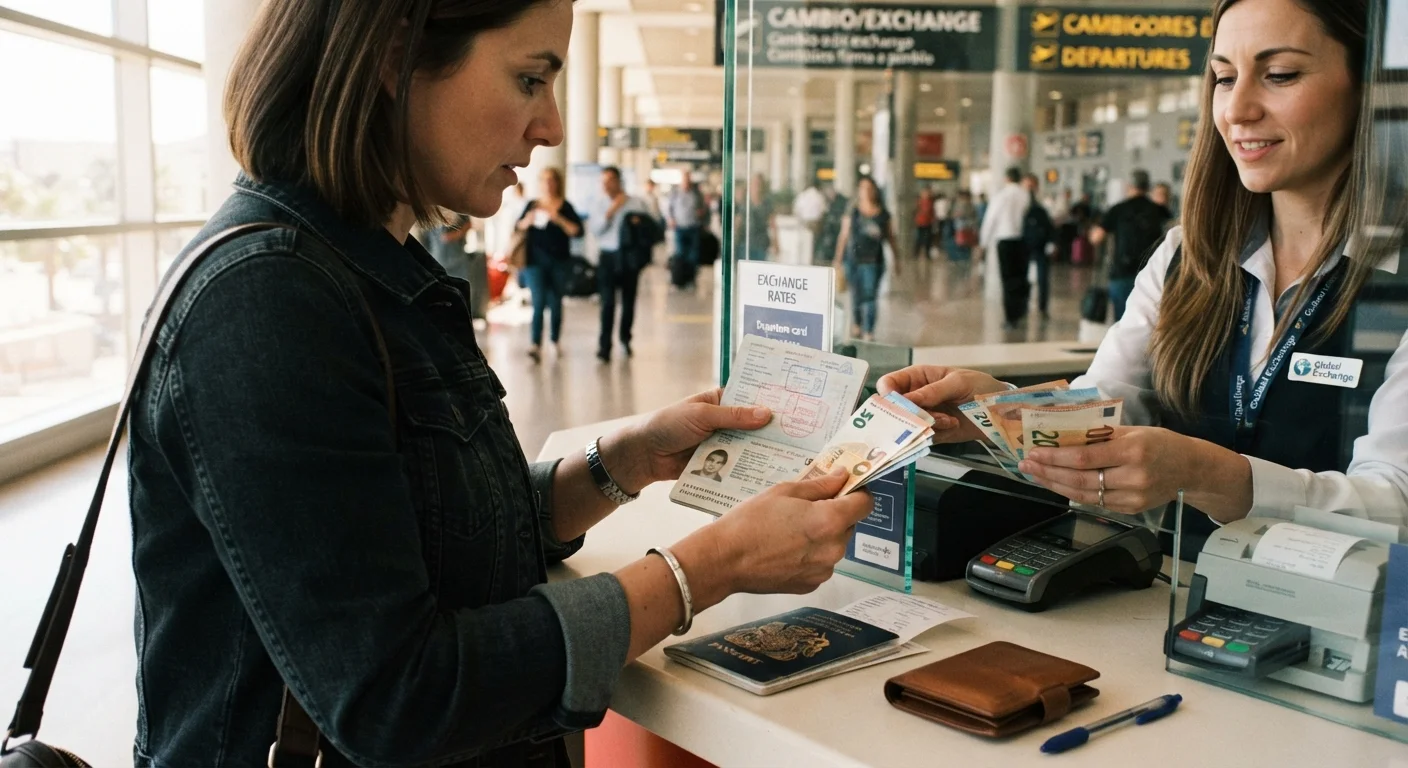
Where you exchange money matters considerably. Common options include:
- Airport exchange kiosks — convenient but usually carry high margins and additional flat fees.
- Hotel front desks — similarly convenient, similarly costly in most cases.
- Bank branches or credit unions — often offer more competitive rates, especially for account holders; availability and lead times vary.
- ATMs abroad — frequently provide rates close to the interbank rate, though fees from your home bank and the local ATM operator may apply.
Dynamic Currency Conversion (DCC) is a practice worth knowing about. When paying by card abroad, a merchant or ATM may offer to charge you in your home currency rather than the local one. While this seems convenient, the conversion rate applied is typically set by the merchant and is generally less favourable than your card's rate. Choosing to pay in the local currency is usually the wiser option — but verify with your card issuer what rate they apply.
1%–3%
Typical foreign transaction fee range per purchase
Foreign transaction fees vary by card issuer and account type; always confirm your specific rate before travelling.
3%–8%
Common exchange rate margin at airport kiosks
Airport and hotel exchange services often apply margins well above interbank rates, according to general consumer finance guidance.
Using Cards Abroad: Fees to Watch For
Debit and credit cards are widely accepted in most urban areas worldwide, but using them internationally can trigger fees you may not expect. The most common ones include:
- Foreign transaction fees — a percentage charged on purchases made in a foreign currency, typically ranging from 1% to 3% per transaction depending on the card issuer.
- ATM withdrawal fees — your home bank may charge a flat fee per overseas withdrawal, and the local ATM operator may add its own surcharge on top.
- Cash advance fees — if you use a credit card at an ATM, most issuers treat this as a cash advance, which often carries a higher fee and may begin accruing interest immediately.
Before travelling, contact your bank or card issuer to confirm which fees apply to your specific account. Some accounts are structured to waive or reimburse international fees — knowing this in advance helps you decide which cards to prioritise. Our overview of hidden travel costs explores how these charges accumulate alongside other overlooked expenses.
Always Choose Local Currency When Asked
When a card terminal or ATM abroad asks whether you want to pay in your home currency or the local currency, select the local currency. Dynamic Currency Conversion — the home-currency option — almost always applies a less favourable rate set by the merchant. Your card issuer's rate is typically more competitive, though you should confirm this with your bank before travelling.
Best Practices for Safe and Smart Money Handling
A few straightforward habits can make a significant difference in how smoothly your finances function during an international trip.
Notify your bank and card issuers before departure.
Banks monitor for unusual activity and may block foreign transactions flagged as potentially fraudulent. A travel notice tells them to expect international charges, reducing the chance of your card being frozen mid-trip.
Carry multiple payment methods and keep them in separate locations.
Relying on a single card creates a single point of failure. If it is lost, stolen, or blocked, having a backup prevents a minor inconvenience from becoming a serious problem.
Research local cash norms for your destination before you leave.
Some destinations — particularly rural areas, markets, and smaller businesses in many countries — operate predominantly on cash. Others are nearly cashless. Arriving unprepared for either extreme creates friction.
Withdraw larger amounts less frequently rather than small amounts often.
When ATM fees apply, each withdrawal incurs the charge regardless of the amount taken out. Fewer, larger withdrawals can reduce the cumulative fee burden over a trip.
Avoid exchanging currency at airports or hotels unless absolutely necessary.
These locations typically apply the least competitive exchange rates and may add flat-fee charges on top. The convenience premium is real and measurable.
Keeping a record of your spending in real time can also help you stay within budget. Digital budgeting and expense-tracking tools can simplify this, allowing you to log transactions in multiple currencies as you go. For foundational budgeting strategies that apply before and after travel, the Budgeting Basics hub is a useful reference.
Keeping Your Money Secure While Travelling
Financial security abroad involves both physical and digital awareness. Pickpocketing in crowded tourist areas is a real risk in many destinations, but so is digital skimming — where card details are captured by tampered ATM machines or payment terminals.
To reduce exposure, use ATMs attached to reputable bank branches rather than standalone machines in low-traffic areas. Shield your PIN when entering it, and inspect the card reader briefly for anything that looks loose or unusual. Our companion guide on staying safe abroad covers physical security, situational awareness, and safeguarding your valuables in more depth.
ATM Safety: A Quick Check
Before inserting your card at any ATM, take a moment to check that the card slot does not feel loose, sticky, or different from the surrounding panel — these can be signs of a skimming device. Bank-branch ATMs in well-lit, monitored locations are generally lower risk than standalone machines in tourist-heavy or low-traffic spots. If anything looks off, use a different machine.
Finally, keep emergency contact numbers for your card issuers saved somewhere accessible — not only on your phone. If a card is lost or blocked, being able to reach your bank quickly can minimise disruption. This pairs well with the broader document preparation advice in our Travel Document Essentials guide.