

Key Takeaways
- Interstates save significant time but often bypass the most memorable parts of a destination.
- Scenic routes can add hours and fuel costs, so realistic trip planning matters.
- Safety profiles differ: interstates have lower fatality rates per mile than two-lane rural roads.
- A hybrid approach — mixing both road types — suits most everyday road trippers well.
- Your vehicle's condition, travel companions, and schedule should all factor into the decision.
Our Verdict
Neither scenic routes nor interstates are universally superior — the right choice depends on your priorities. Interstates win on efficiency, predictability, and safety statistics. Scenic roads win on experience, discovery, and the joy of the drive itself. Most road trippers benefit from using both strategically rather than committing to one exclusively.
| Best for | Recommended |
|---|---|
| Travelers with tight schedules or long distances to cover | Interstate Highways |
| Those prioritizing experience, scenery, and local discovery | Scenic Routes |
| Most everyday road trippers seeking balance | A hybrid of both |
| Drivers with limited vehicle reliability or road-service access | Interstate Highways |
What You're Actually Choosing Between
When road trippers debate scenic routes versus interstates, the conversation often gets reduced to "boring but fast" versus "beautiful but slow." The real trade-offs are more nuanced than that. Interstate highways — the numbered, divided, limited-access roads that form the federal system — are engineered for throughput. Scenic byways and two-lane state roads are built around geography, history, and local character.
Choosing between them affects not just how long you drive, but how much fuel you use, how fatigued you feel, how easy it is to find services, and frankly, how much you enjoy the trip. See our route planning guide for a broader framework on balancing detours with realistic daily distances.
| Scenic Routes | Interstate Highways | |
|---|---|---|
| Travel Time | Significantly longer | Faster, more predictable |
| Fuel Efficiency | Lower on hilly or winding roads | Generally better at steady speed |
| Safety Profile | Higher risk on undivided two-lane roads | Lower fatality rate per mile overall |
| Services & Amenities | Sparse; plan ahead | Frequent rest stops, gas, food |
| Scenic & Cultural Value | High; local character throughout | Minimal; designed for efficiency |
| Cell Coverage | Often limited in rural areas | Generally reliable in most regions |
| Driver Fatigue | Engaged but physically demanding | Monotony can cause drowsiness |
Time and Distance: The Math Most Drivers Underestimate
Interstates allow higher legal speeds — typically 65–80 mph depending on the state — and eliminate the stop signs, traffic lights, and sharp curves that slow rural roads. A 200-mile stretch that takes roughly three hours on an interstate might take four and a half to five hours on a two-lane scenic route through rolling terrain.
That extra time compounds quickly on multi-day trips. If you're covering 1,500 miles in five days, choosing scenic roads throughout could add six or more driving hours to your total — time that either eats into your stops or extends your days behind the wheel.
Build Buffer Time for Scenic Stretches
When planning a scenic route segment, add at least 50% more time than a mapping app estimates. Apps often undercount stops, slower terrain speeds, and the simple reality that you'll want to pull over. Building in this buffer prevents the frustrating experience of rushing through scenery you came to enjoy.
For trips where the driving itself is the goal, the extra time is often the point. For trips where you have a destination, event, or deadline, the math deserves honest attention before you commit to a route.
Fuel, Wear, and Vehicle Considerations
Fuel economy tends to be better on interstates at steady highway speeds than on mountain or rural roads with constant elevation changes, braking, and acceleration. However, construction zones and heavy interstate traffic can erode that advantage significantly.
Scenic routes can be harder on vehicles in other ways: potholes, unpaved shoulders, steep grades, and limited cell coverage mean that a minor breakdown becomes a bigger problem. If your vehicle is older, overdue for maintenance, or you're driving without roadside assistance coverage, staying closer to interstate services is a practical safety consideration — not just a preference. Make sure your packing decisions account for emergency supplies if you're venturing far from services.
Safety: What the Data Suggests
Interstate highways generally have lower fatality rates per mile traveled than undivided two-lane rural roads, according to long-standing federal highway safety data. This is largely by design: divided lanes, controlled access points, wider shoulders, and consistent signage reduce certain collision types.
That said, interstates carry their own risks — higher speeds mean less reaction time, drowsy driving is more common on monotonous stretches, and merging in heavy traffic creates pressure. Rural scenic roads introduce different hazards: wildlife crossings, narrow lanes, blind curves, and limited guardrails. Understanding how road design affects safety can help you read unfamiliar road types more confidently.
Remote Roads Require Extra Preparation
On scenic rural roads, help can be an hour or more away. Before heading into remote stretches, verify your spare tire is in good condition, carry water and basic emergency supplies, and inform someone of your planned route. Relying solely on a smartphone for navigation and emergency contact in areas with spotty coverage is a genuine risk worth mitigating before you leave.
The Experience Factor and How to Use Both
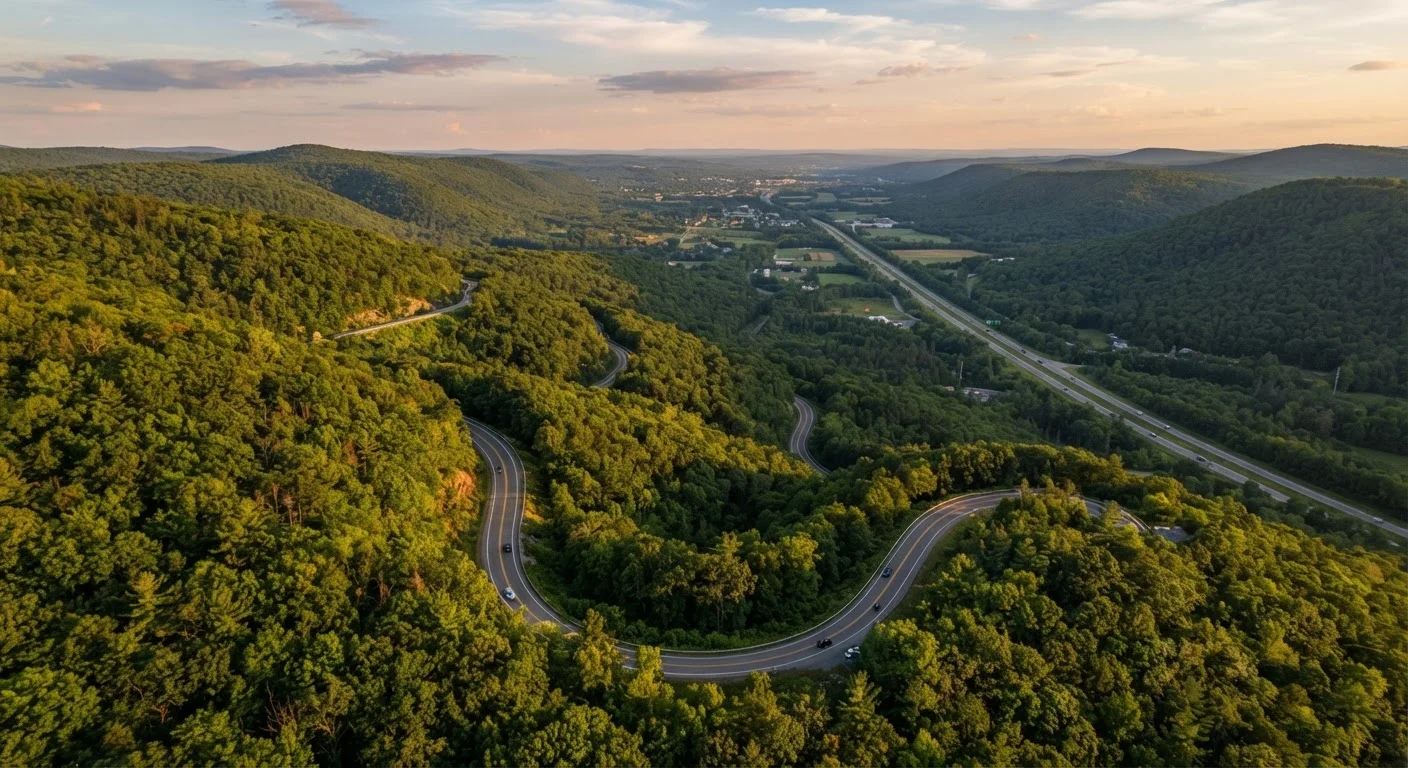
The scenic route case is strongest when the drive itself is part of the destination. Coastal highways, mountain passes, and river valley roads offer views, stops, and spontaneous moments that no interstate can replicate. Local diners, roadside produce stands, and small-town main streets are accessed via these roads — not off-ramps.
A practical approach many experienced road trippers use: cover long, featureless miles on the interstate, then exit onto scenic byways when you're passing through areas worth exploring. Planning ahead helps — navigation tools vary in their rural coverage, so downloading offline maps before you leave a cell coverage area is worth the few minutes it takes.
Whether you're traveling alone or with others also shapes the equation — see how solo and group road trips differ in decision-making and logistics. And if you're planning overnight stops along the way, accommodation options vary significantly between interstate corridors and remote scenic areas.