

Key Takeaways
- Roundabouts significantly reduce fatal and injury-causing crashes compared to signalized intersections.
- Traditional intersections handle high-volume, complex traffic patterns more predictably for drivers.
- Roundabouts eliminate the most dangerous conflict points — the right-angle and head-on collisions.
- Signalized intersections offer clearer pedestrian crossing phases, especially for visually impaired users.
- Roundabouts often reduce fuel consumption and emissions by eliminating stop-and-go cycles.
- Neither design is universally superior — the best choice depends on location, volume, and road geometry.
Option A
Roundabouts
The continuous-flow, yield-based alternative.
Best for: Intersections where reducing severe crashes and improving steady traffic flow are the primary goals.
Option B
Traditional Signalized Intersections
The familiar, signal-controlled standard.
Best for: High-volume corridors, complex multi-lane crossings, and locations requiring precise pedestrian signal timing.
If reducing severe injury and fatal crashes is the top priority
Roundabouts
Research consistently shows roundabouts eliminate the highest-severity conflict points, cutting fatal crashes by up to 90% at converted intersections.
If managing very high traffic volumes on a busy urban corridor
Traditional Signalized Intersections
Coordinated signal timing can be optimized across multiple intersections to move high volumes efficiently in a way roundabouts cannot match.
If pedestrian and cyclist accessibility is the primary concern
Traditional Signalized Intersections
Dedicated signal phases give pedestrians and cyclists clearly protected crossing times, which is especially critical for people with visual impairments.
If fuel efficiency and emissions reduction matter
Roundabouts
Continuous-flow design eliminates prolonged idling at red lights, reducing per-vehicle fuel use and local emissions at the intersection.
How Each Intersection Type Works
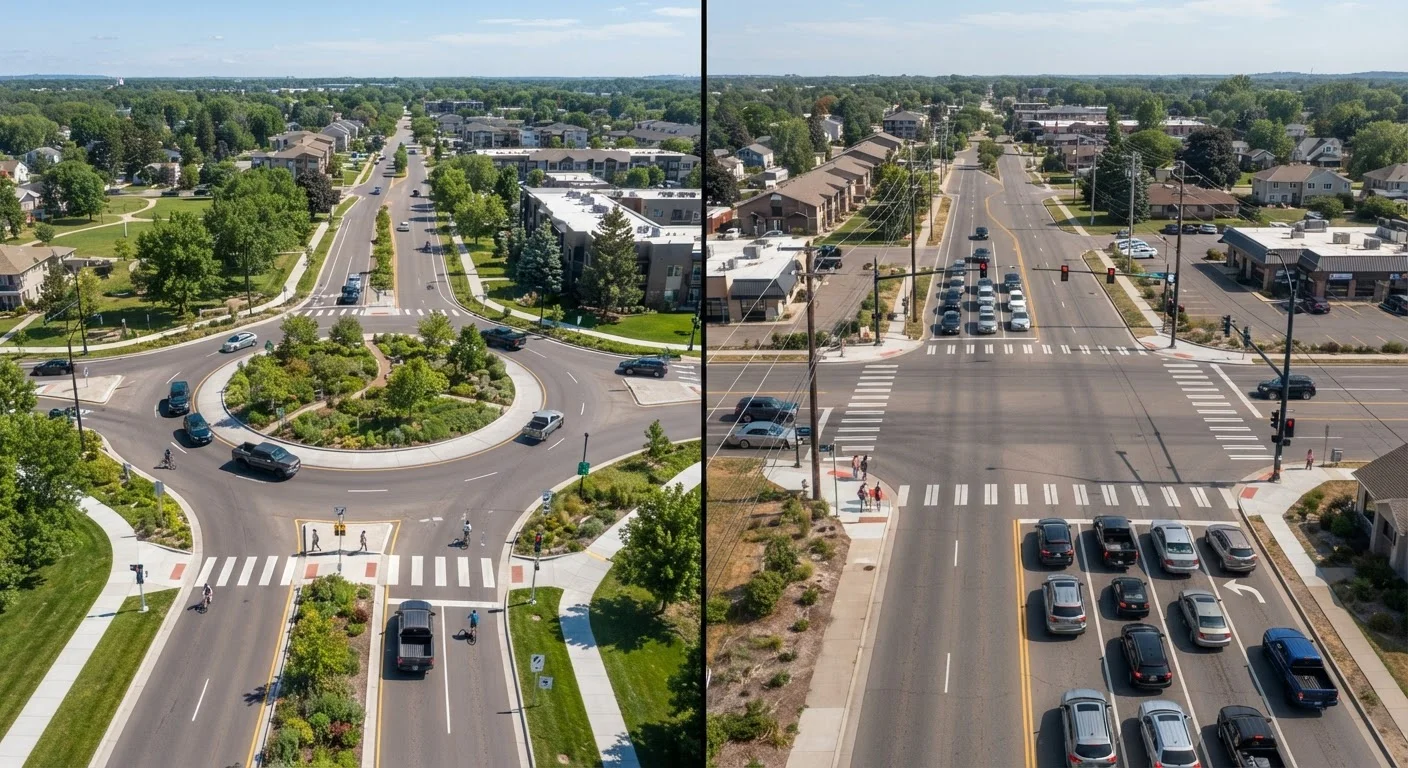
A roundabout is a circular junction where traffic flows counterclockwise around a central island. Drivers entering yield to circulating traffic, then exit at their desired street. There are no traffic signals and no left-turn conflicts across oncoming lanes — the two factors responsible for the most severe crashes at conventional intersections.
A traditional signalized intersection uses traffic signals and lane markings to assign right-of-way. Drivers stop on red, proceed on green, and make direct left turns across opposing traffic. This familiar structure works well when signal timing is properly calibrated, but it creates multiple high-speed conflict points where vehicles can collide at perpendicular or opposing angles.
Understanding these structural differences is the foundation for comparing safety and traffic performance. For a broader look at how right-of-way rules apply across US roads, see right-of-way and lane rules every US driver should know.
Safety: Where the Data Points
Safety research on roundabouts is among the most consistent in traffic engineering. The Federal Highway Administration (FHWA) has documented that converting traditional stop-controlled or signalized intersections to roundabouts typically results in substantial reductions in injury crashes and fatal crashes. The primary reason is physics and geometry: vehicles in a roundabout travel at lower speeds and can only collide at shallow angles — called sideswipe or merging conflicts — rather than the devastating T-bone and head-on collisions possible at signalized intersections.
~75%
Reduction in injury crashes
The FHWA estimates roundabouts reduce injury crashes by approximately 75% compared to stop-controlled intersections.
~90%
Reduction in fatal crashes
Studies cited by the Insurance Institute for Highway Safety (IIHS) indicate fatal crash reductions of up to 90% at roundabout conversions.
700+
New roundabouts built annually in the US
The number of roundabouts in the US has grown from fewer than 1,000 in 2000 to tens of thousands, with hundreds added each year.
Traditional intersections are not inherently unsafe, but the presence of high-speed perpendicular movements creates real risk when signals are misread, run, or timed poorly. Red-light running remains a significant cause of intersection fatalities in the US. Roundabouts structurally prevent this failure mode because there is no red light to run.
Pedestrian safety is more nuanced. Roundabouts require pedestrians to cross one direction of traffic at a time at marked splitter islands, which can actually be safer in terms of conflict speed — but the continuous vehicle movement and lack of a protected signal phase can be disorienting, particularly for people with visual impairments. Signalized intersections with accessible pedestrian signals (APS) provide clearer, audible crossing guidance.
Pairing good intersection design with defensive driving principles remains essential regardless of which intersection type a driver encounters.
Traffic Flow and Efficiency
Roundabouts excel at keeping traffic moving. Because vehicles yield and enter gaps rather than waiting for a full signal cycle, delays are shorter under low-to-moderate traffic conditions. There is no all-red phase wasting green time, and no queue of idling vehicles burning fuel through a two-minute cycle.
| Criterion | Roundabouts | Traditional Signalized Intersections |
|---|---|---|
| Fatal crash risk | Substantially lower | Higher (T-bone, head-on risk) |
| Injury crash risk | Lower | Moderate to higher |
| Pedestrian signal clarity | Less defined, continuous flow | Clear dedicated crossing phases |
| Low-volume traffic delay | Minimal — no full signal cycle | Moderate — fixed cycle wait |
| High-volume throughput | Capacity limited under heavy load | Can be coordinated for high volume |
| Fuel use and emissions | Lower — minimal idling | Higher — stop-and-go cycles |
| Driver familiarity (US) | Lower — still unfamiliar to many | High — widely understood |
| Construction footprint | Requires more right-of-way | Fits standard road grid |
However, roundabouts have a capacity ceiling. Under very high traffic volumes — particularly when multiple heavy approaches compete for the same circulating lane — they can back up significantly. Signalized intersections can be coordinated in signal progression networks along arterials, a capability roundabouts cannot replicate. For high-density urban corridors moving thousands of vehicles per hour, coordinated signals often provide more predictable throughput.
Multi-lane roundabouts introduce additional complexity. Lane choice errors and weaving conflicts increase, which is why driver education about roundabout navigation is important as these intersections become more common. If your travels frequently involve route decisions, understanding road trade-offs on longer trips can also inform how intersection design affects travel time.
Choosing the Right Design for the Right Location
Traffic engineers evaluate several factors when deciding between intersection types: crash history, approach speeds, pedestrian and bicycle volumes, nearby land uses, available right-of-way, and projected traffic growth. There is no single correct answer.
Roundabouts tend to be preferred where crash severity is a documented concern, at rural highway intersections where approach speeds are high, and at locations where stop-and-go delay causes significant emissions impact. Signalized intersections remain the default where pedestrian volumes are high, where signal coordination across a corridor is necessary, or where geometric constraints prevent a roundabout's footprint.
State and Local Standards Vary
Intersection design decisions are made at the state and local level by transportation departments, not a single federal mandate. Some states have adopted roundabout-first policies for certain road classifications, while others still default to signals. If you encounter an unfamiliar intersection type, local department of transportation websites often publish guidance on how to navigate it safely.
As a driver, knowing how to navigate both types confidently is the practical takeaway. For roundabouts: slow on approach, yield to circulating traffic, signal your exit, and watch for pedestrians at crosswalks. For traditional intersections: respect signal phases, anticipate red-light runners from cross-traffic, and treat green lights as permission to proceed — not a guarantee of safety. Both skills fall squarely within what defensive driving actually means on today's roads.