

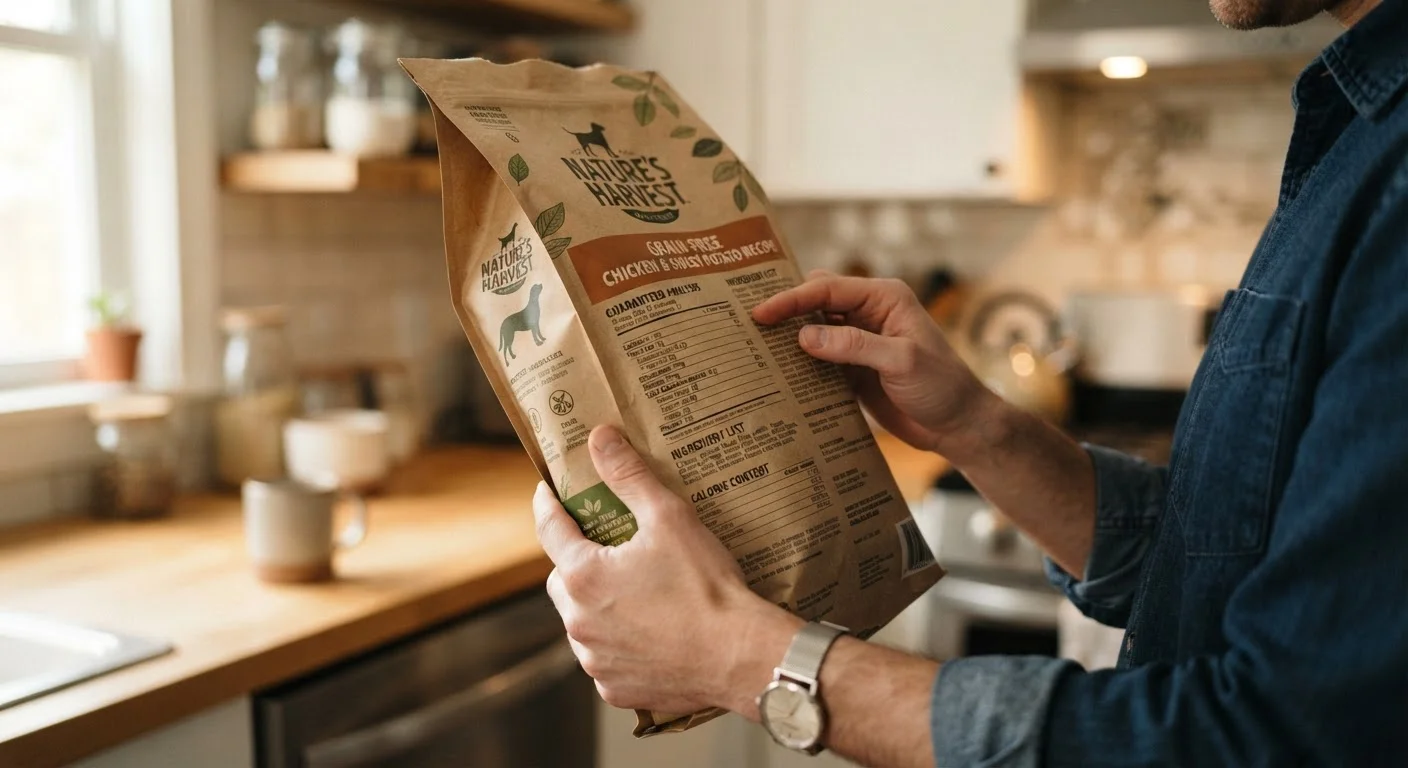
Key Takeaways
- The guaranteed analysis shows minimum and maximum nutrient levels, not exact amounts.
- Ingredients are listed by pre-cooking weight — moisture content can be misleading.
- Cats and dogs have fundamentally different nutritional requirements by species.
- Life stage labeling (puppy, adult, senior) reflects real differences in nutrient formulation.
- Marketing terms like 'natural' and 'holistic' have little regulatory meaning on pet food labels.
- A veterinarian is the best resource for tailoring food choices to your specific animal.
Start here
Why Pet Food Labels Are Worth Your Attention
Next
The Guaranteed Analysis: What Those Percentages Actually Mean
Then
Reading the Ingredient List the Right Way
Apply it
Species-Specific and Life Stage Considerations
Stay critical
Marketing Claims vs. Meaningful Information
Why Pet Food Labels Are Worth Your Attention
Most pet owners spend more time reading restaurant menus than pet food labels — and it's understandable. The labels are dense, the terminology is unfamiliar, and the marketing language is designed to reassure rather than inform. But learning to read a pet food label is one of the most practical skills an owner can develop.
In the United States, pet food is regulated at both the federal level (by the FDA) and at the state level, with most states adopting guidelines developed by AAFCO — the Association of American Feed Control Officials. These rules determine what information must appear on a label, how nutrients are measured, and what claims manufacturers are allowed to make. Understanding the framework helps you distinguish what's legally meaningful from what's purely promotional.
Labels won't tell you everything about a food's quality, but they do provide a standardized starting point. Paired with physical observation of your pet — think coat condition, energy level, and digestion — label literacy becomes a genuinely useful tool. For a broader look at the physical markers of a thriving animal, see what a healthy pet actually looks like.
Labels Are One Piece of the Picture
A pet food label tells you what's in the bag, but it can't tell you how your individual animal will respond to that food. Body condition, coat quality, digestive health, and energy levels are equally important signals. Regular veterinary checkups remain the most reliable way to assess whether a diet is actually working for your pet.
The Guaranteed Analysis: What Those Percentages Actually Mean
The guaranteed analysis panel lists minimum and maximum percentages for key nutrients — typically crude protein, crude fat, crude fiber, and moisture. A few things are worth understanding about how to interpret these numbers.
First, these are guarantees of threshold levels, not exact amounts. A food guaranteed to contain at least 26% crude protein may contain more — you're reading a floor, not a precise measure. Second, the percentages are based on the food as-sold, meaning moisture is included. This makes wet and dry foods difficult to compare directly without converting both to a dry matter basis (dividing each nutrient percentage by the percentage of dry matter in the food).
Crude protein and crude fat are the figures most owners focus on, but they don't tell you about the source or digestibility of those nutrients. A food can meet its protein guarantee using lower-quality protein sources that your pet absorbs less efficiently. That's why the guaranteed analysis should be read alongside the ingredient list, not instead of it.
Use the Guaranteed Analysis as a Starting Point
When comparing two foods, convert both to a dry matter basis before drawing conclusions — especially if one is wet and one is dry. Once you've done that, a higher protein percentage on paper is more meaningful, though it still doesn't tell you everything about digestibility or ingredient quality. Your vet can help you interpret these numbers in the context of your pet's health.
Reading the Ingredient List the Right Way
Ingredients are listed in descending order by pre-cooking weight — so whatever appears first is present in the greatest quantity before processing. Meat is high in moisture, so a food listing chicken first may contain less chicken by dry weight than it appears. This isn't inherently deceptive, but it's worth understanding.
Look at the first five to eight ingredients as a group, since they represent the bulk of the food's composition. Specific named protein sources — like chicken, salmon, or beef — are generally more informative than vague terms like meat by-products or animal digest, though by-products are not automatically inferior; they include organ meats that can be nutritionally dense.
Ingredient splitting is another practice to recognize: a manufacturer might list several forms of a single ingredient separately (e.g., corn flour, corn gluten, corn starch) so that each appears lower on the list individually, even if combined they'd rank higher. Our label-reading primer covers ingredient ordering rules in greater depth.
Guaranteed Analysis
The panel on a pet food label that lists minimum and maximum percentages of key nutrients like protein, fat, fiber, and moisture. These are threshold guarantees, not exact measurements.
AAFCO
The Association of American Feed Control Officials — the organization that establishes nutritional standards and labeling guidelines for pet food sold in the U.S.
Dry Matter Basis
A method of comparing nutrient levels across foods with different moisture contents by removing the water weight from the calculation, allowing wet and dry foods to be evaluated on equal terms.
Obligate Carnivore
An animal that must eat meat to survive because it cannot synthesize certain essential nutrients from plant sources. Cats are a classic example.
Ingredient Splitting
A labeling practice where a single ingredient is listed in multiple forms so each appears lower on the ingredient list, obscuring how much of that ingredient is actually present.
Crude Protein
A measurement of the total nitrogen content in a food, used to estimate protein levels. It doesn't reveal protein quality or how digestible that protein is for your pet.
Complete and Balanced
A regulated phrase indicating a pet food meets AAFCO's minimum nutritional requirements for a specific life stage — one of the most meaningful statements on a pet food label.
Life Stage
A category — such as growth, adult maintenance, or all life stages — that reflects the nutritional needs appropriate to an animal's age and development phase.
Species-Specific and Life Stage Considerations
Cats and dogs are not nutritionally interchangeable. Cats are obligate carnivores, meaning they require nutrients — including taurine, arachidonic acid, and preformed vitamin A — that dogs can synthesize from plant precursors. Feeding a cat dog food, even occasionally, can lead to serious deficiencies over time. The reverse is less immediately dangerous but still not appropriate as a regular diet.
Life stage labeling matters too. AAFCO defines nutrient profiles for growth (puppies and kittens), adult maintenance, and all life stages. A food labeled for growth will typically have higher protein, calcium, and phosphorus levels than an adult maintenance formula. Senior formulas vary more widely — there's no single AAFCO standard for senior pets — so it's worth scrutinizing those labels carefully and discussing them with your veterinarian.
For working or highly active animals, energy density (calories per cup or can) matters as much as nutrient percentages. Calorie content is now required on pet food labels in kcal per kilogram and per common serving unit, making it easier to assess whether a food suits your pet's lifestyle. Consider pairing this with the insights in why portion size matters more than ingredient labels.
Marketing Claims vs. Meaningful Information
Pet food packaging is rich with language designed to appeal to owners: natural, holistic, human-grade, premium. Some of these terms have limited regulatory definitions; others have none at all when applied to pet food.
'Natural' has a loose AAFCO definition — essentially meaning the ingredients aren't chemically synthesized — but it says nothing about nutritional quality. 'Holistic' and 'premium' have no regulatory meaning on pet food labels whatsoever. 'Human-grade' is a claim that requires specific handling and manufacturing standards, but it's not routinely verified on the label alone.
The most meaningful phrases on any pet food label are: 'complete and balanced' (meets AAFCO nutritional standards for a stated life stage) and whether the food was substantiated by feeding trials or by nutrient profile formulation. Feeding trial language typically reads: 'Animal feeding tests using AAFCO procedures substantiate that provides complete and balanced nutrition.' This is a higher bar than formulation alone.
When in doubt, a board-certified veterinary nutritionist is the most reliable resource for evaluating a specific food for your specific pet. No label, however well-designed, replaces individualized professional guidance. For more on separating meaningful label data from marketing noise, see how packaging claims are constructed.
Grain-Free Diets: Talk to Your Vet First
The FDA has been investigating a potential link between certain grain-free diets — particularly those high in legumes and potatoes — and dilated cardiomyopathy (DCM), a serious heart condition in dogs. Research is ongoing and causation has not been definitively established, but veterinary cardiologists recommend discussing this risk with your vet before choosing a grain-free formula, especially for breeds already predisposed to heart disease.