

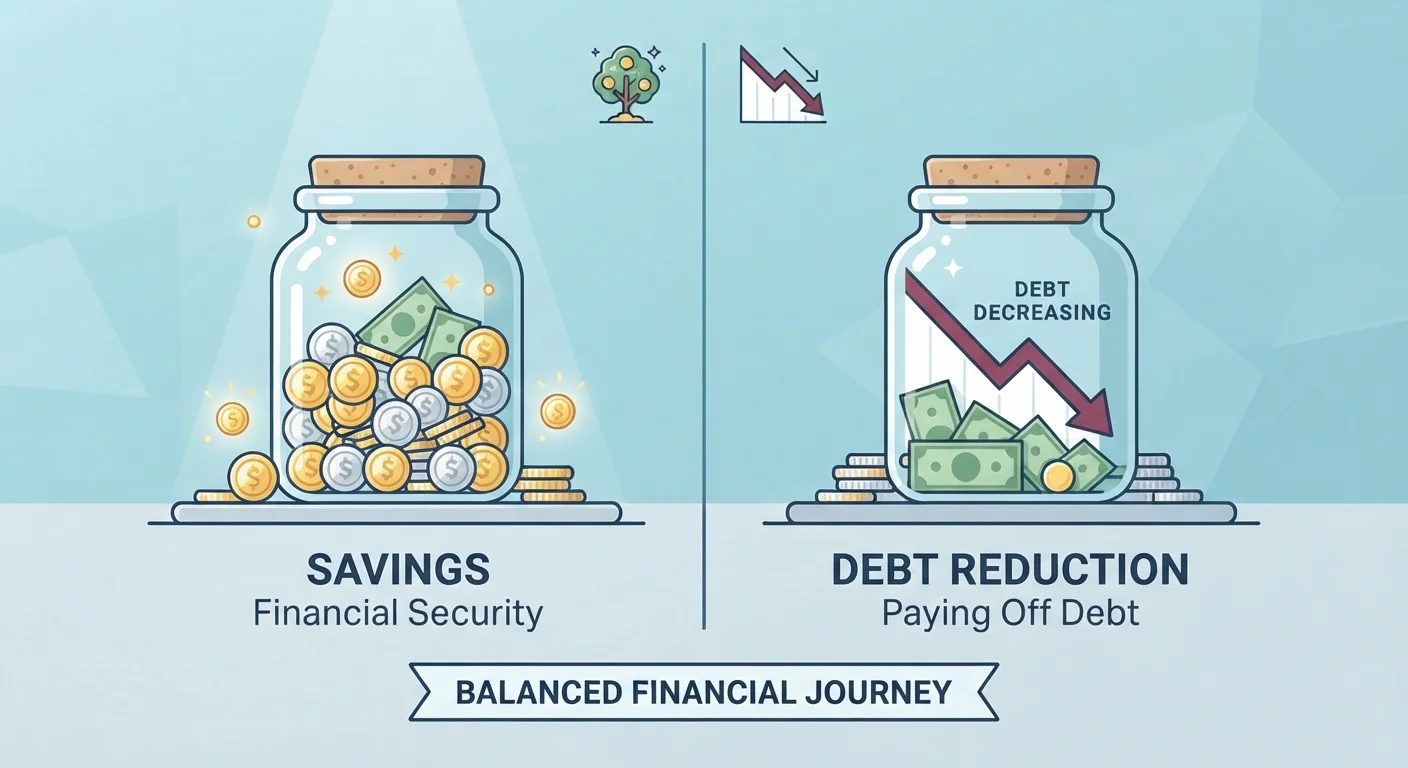
Key Takeaways
- Paying off debt and saving at the same time is possible and often recommended by financial educators.
- A small emergency fund should generally be established before accelerating debt repayment.
- Employer 401(k) matches are essentially free money — capture them even while carrying debt.
- High-interest debt (typically above 7–8%) usually warrants more aggressive repayment over additional saving.
- The right balance depends on your interest rates, income stability, and specific financial goals.
- This article is general financial education, not personalised advice — consult a licensed professional for your situation.
Saving While Repaying Debt
Saving while repaying debt means actively setting money aside — whether in an emergency fund, retirement account, or other savings vehicle — at the same time as making debt payments. Rather than treating the two goals as opposites, this approach treats them as parallel financial priorities. Most personal finance guidance supports some version of doing both simultaneously, though the right balance depends heavily on interest rates, income, and individual circumstances.
The key mathematical tension is the spread between the interest rate on your debt and the return you could earn on saved or invested funds. When debt interest rates exceed potential savings returns, aggressive debt payoff is mathematically advantageous — but ignoring savings entirely can introduce significant financial risk.
The False Choice Between Debt and Savings
Many people feel stuck in a mental trap: every dollar sent to savings feels like a dollar that could be eliminating debt, and vice versa. This all-or-nothing framing is understandable, but it can lead to poor outcomes. Ignoring savings while paying off debt leaves you financially fragile — one car repair or medical bill away from borrowing again. Ignoring debt while saving aggressively means interest charges erode your progress every single month.
The reality is that most households benefit from doing both, in proportions that shift based on circumstances. Understanding how to calibrate that balance — rather than treating it as a binary choice — is one of the most practical financial skills you can develop. For a deeper look at how this balance plays out across life stages, see the complete guide to managing saving and debt repayment.
57%
Americans with less than $1,000 in emergency savings
According to survey data from Bankrate, a significant share of U.S. adults lack basic financial buffers, underscoring why building even modest savings matters alongside debt repayment.
20%+
Average APR on credit card accounts
Federal Reserve consumer credit data has shown average credit card interest rates consistently exceeding 20%, making high-interest debt repayment a high-priority financial goal for many households.
~40%
Workers not capturing full employer 401(k) match
Research from Vanguard and similar plan providers has found a substantial portion of eligible employees do not contribute enough to receive their full employer match, leaving significant compensation unclaimed.
Why an Emergency Fund Comes First
Before accelerating debt repayment, most financial educators recommend establishing at least a minimal emergency fund. The Consumer Financial Protection Bureau and many personal finance researchers suggest a starting target of $1,000, with a longer-term goal of three to six months of essential expenses.
The reason is straightforward: without a cash cushion, any unexpected expense — a job disruption, a medical bill, a home repair — pushes you back toward credit. Debt repayment progress is quickly undone when you're forced to carry a new balance. A modest emergency fund breaks that cycle.
Once your basic safety net is in place, you can redirect more cash flow toward debt while continuing to make small, regular contributions to savings. The pre-repayment checklist outlines additional groundwork worth completing before you accelerate payoff.
Start Small If Budget Is Tight
If your budget feels stretched, even transferring $25–$50 per paycheck to a dedicated savings account establishes the habit and builds a buffer over time. Similarly, paying slightly more than the minimum on one debt — even $10 to $20 extra — accelerates payoff without requiring a dramatic lifestyle change. Small, consistent actions compound meaningfully over months and years.
The Role of Interest Rates in the Decision
Interest rates are the clearest guide to how aggressively you should split resources between debt payoff and savings. The core logic: if your debt charges more interest than your savings or investments are likely to earn, eliminating that debt first generates the better financial outcome.
High-interest debt — credit cards, for instance, often carry rates well above 15% — generally warrants a more aggressive repayment posture. Lower-interest debt, such as federal student loans or a fixed-rate mortgage, may allow for a more balanced approach where meaningful saving happens in parallel.
One widely noted exception is an employer-sponsored retirement match. If your employer matches 401(k) contributions up to a certain percentage, declining to contribute enough to capture that match is, in effect, declining free compensation. Most financial educators recommend capturing the full employer match regardless of debt level, then assessing how to split remaining resources. For a structured approach to this decision, see a practical framework for deciding whether to pay down debt or save first.
Making It Work in Practice
Doing both debt repayment and saving simultaneously requires intentional cash-flow management. A few principles help:
- Automate both actions. Set up automatic transfers to savings and automatic debt payments on payday. The paying yourself first principle — directing money to goals before it reaches your spending account — reduces the temptation to spend what you intended to save or apply to debt.
- Choose a debt repayment method. Whether you prefer the mathematical efficiency of the avalanche method or the motivational momentum of the snowball, having a clear system prevents debt payments from feeling arbitrary.
- Revisit the balance regularly. As interest rates change, debts are paid off, or income shifts, your optimal split between saving and repayment will change. A quarterly review keeps your approach calibrated.
No approach eliminates trade-offs entirely, but a clear-eyed, consistent system gets better results than either extreme. For broader budgeting strategies that support these goals, explore budgeting basics.
This article is for general informational and educational purposes only and does not constitute personalised financial, investment, or tax advice. Readers should consult a qualified financial professional before making decisions about their own financial circumstances.