

Key Takeaways
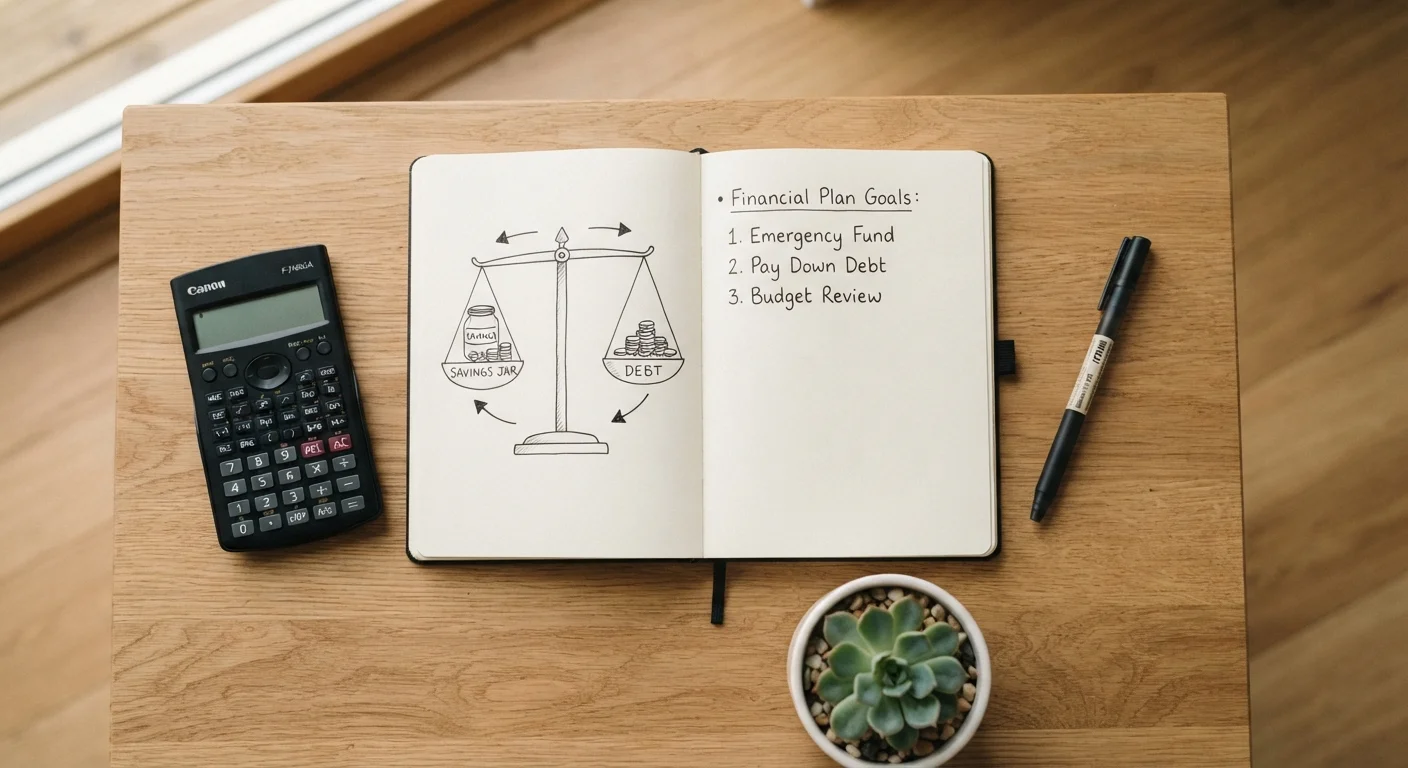
- Saving and debt repayment are not mutually exclusive — most people need to pursue both at the same time.
- A small emergency fund should be in place before aggressively paying down debt.
- High-interest debt, especially above 7–8%, usually warrants faster repayment than investing.
- Employer retirement match is effectively a guaranteed return — capture it before extra debt payments.
- Your strategy should shift across life stages: early career, family formation, pre-retirement, and beyond.
- Consistent, automated behaviors — not windfalls — drive lasting financial progress.
Why You Can't Fully Separate Saving from Debt
Most personal finance advice frames saving and debt repayment as competing priorities, as if you must choose one or the other. In practice, they interact constantly throughout your financial life. The interest you pay on debt reduces money available for saving; the savings you build reduce your need to borrow in the future.
Understanding this relationship — rather than trying to isolate the two — is what separates reactive financial management from deliberate financial planning. See our complete guide to personal budgeting for the foundational framework that makes managing both possible.
The goal of this guide is to walk through every major decision point across a lifetime: when to lean harder on debt repayment, when saving deserves more of your attention, and how to pursue both at once without losing ground on either front.
77%
Americans carrying some form of debt
According to Experian's State of Credit report, the vast majority of U.S. adults carry at least one debt obligation.
$8,000+
Average U.S. credit card balance per holder
Federal Reserve data consistently shows the average revolving credit card balance held by indebted Americans exceeds $8,000.
3–6 months
Recommended emergency fund coverage
The Consumer Financial Protection Bureau advises holding three to six months of essential expenses in a liquid emergency reserve.
The Emergency Fund First Principle
Before directing extra dollars toward debt payoff or investment accounts, financial educators broadly agree on one foundational step: build a small emergency reserve. The Consumer Financial Protection Bureau and many financial counselors recommend starting with a target of $1,000 to one month of essential expenses before shifting focus elsewhere.
Here's why this matters: without any liquid savings, an unexpected car repair or medical bill forces you back into debt — often high-interest debt — erasing progress you've already made. A starter emergency fund breaks that cycle.
Once higher-interest debt is paid down, the conventional target expands to three to six months of essential living expenses, held in a liquid, accessible account separate from checking. This is not an investment — it's insurance against disruption.
Start With a Specific Dollar Target
Rather than aiming abstractly to 'build an emergency fund,' set a concrete initial target — such as $1,000 — and open a separate savings account dedicated solely to that purpose. Naming the account 'Emergency Fund' in your bank's interface has been shown to improve savings follow-through by making the goal feel more concrete and protected.
When Debt Repayment Should Take Priority
Not all debt is equally urgent. The key variable is the interest rate relative to the expected return on savings or investment alternatives.
- High-interest consumer debt (credit cards, personal loans above roughly 8–10% APR): Paying these down is one of the highest guaranteed-return actions available. No savings account or conservative investment reliably beats a 20% APR.
- Debt causing psychological stress: Research in behavioral economics suggests that carrying significant debt impairs decision-making and well-being. Prioritizing elimination of certain debts — even if not mathematically optimal — can free up mental bandwidth.
- Variable-rate debt in a rising-rate environment: When interest rates are climbing, the cost of carrying variable-rate balances grows over time, making earlier payoff more valuable.
For a detailed decision framework, see our practical framework for deciding whether to pay down debt or save first.
High-Interest Debt Is a Financial Emergency
Credit card debt above 15–20% APR should be treated with the same urgency as a financial crisis — because it is one. Every month a high-interest balance persists, it compounds against you. Address it aggressively before making investment contributions beyond any employer match.
When Saving Should Take Priority
There are several situations where saving — even while carrying debt — is the smarter financial move:
- Employer retirement match: If your employer matches contributions to a 401(k) or similar plan, contributing enough to capture that match is typically a higher financial priority than extra debt payments. A 50% or 100% match is a guaranteed return that debt payoff cannot replicate.
- Low-interest debt: A mortgage or subsidized student loan at 3–5% may cost less in interest than you could reasonably expect to grow through long-term investing. In these cases, minimum payments and redirecting surplus to savings often makes mathematical sense.
- Major upcoming expenses: If a necessary purchase — a vehicle, medical procedure, home repair — is foreseeable, saving proactively avoids adding new debt later.
Treat your employer's retirement match as part of your compensation — not a bonus. Failing to capture it is the equivalent of voluntarily accepting a pay cut.
Employer matches are immediate, risk-free returns that typically range from 50% to 100% on contributions up to a set threshold, making them almost always worth prioritizing over extra debt payments.
When paying off multiple debts, don't close paid accounts immediately. Keeping them open (with zero balances) helps maintain your credit utilization ratio and credit history length.
Credit utilization — the share of available credit you're using — is a significant factor in credit scoring models. A paid-off card with a zero balance can actively help your score.
Managing Both Simultaneously: Life-Stage Strategies
The right balance between saving and debt repayment shifts as your life changes. Here is a general framework by stage:
- Early Career (20s–early 30s)
- Focus on building the starter emergency fund, capturing any employer match, and aggressively paying high-interest debt. Time is your most valuable asset for long-term savings — even small contributions compound meaningfully over decades.
- Family Formation (late 20s–40s)
- Competing priorities intensify: mortgage, childcare, education saving, and retirement all vie for the same dollars. See how to navigate joint and separate finances as a couple for strategies specific to shared financial lives. Automating both retirement contributions and debt payments reduces the decision fatigue of managing multiple goals.
- Peak Earning Years (40s–50s)
- With higher income and (ideally) reduced consumer debt, the focus often shifts toward accelerating retirement savings and eliminating mortgage debt ahead of a fixed-income phase.
- Pre- and Post-Retirement (60s+)
- Carrying debt into retirement on a fixed income is riskier than during working years. Strategies should favor debt elimination and building income-generating savings over growth-oriented investment risk.
Debt Repayment Methods Explained
Two evidence-backed strategies dominate personal finance guidance for structured debt payoff:
- Debt Avalanche: Direct all extra payments to the highest-interest-rate debt first while maintaining minimums on others. Mathematically, this minimizes total interest paid over time.
- Debt Snowball: Pay off the smallest balance first, regardless of rate, then roll that payment to the next smallest. Research published in the Journal of Marketing Research has found that the psychological momentum of eliminating individual accounts can improve follow-through for some people.
Neither method is universally superior — the best one is the one you can sustain. A hybrid approach (targeting a small balance first for momentum, then switching to the avalanche for larger debts) is also reasonable. For broader context on managing everyday spending that supports either method, explore everyday money tips and budgeting basics.
Minimum Payments Are a Trap
Paying only the minimum on high-interest credit card debt can stretch repayment out by a decade or more and multiply the total amount paid significantly. A $5,000 balance at 20% APR paid at minimum rates can take over 15 years to eliminate. Always calculate the full repayment timeline before settling for minimums as a long-term strategy.
Long-Term Habits That Make Both Goals Achievable
Systems matter more than willpower. A few consistent behaviors support both debt repayment and saving over a lifetime:
- Automate first: Set up automatic transfers to savings and automatic debt payments on payday. What you never see in checking, you rarely miss.
- Apply windfalls strategically: Tax refunds, bonuses, or inheritance present an opportunity to make disproportionate progress. A simple rule — half to debt, half to savings — avoids both extremes.
- Review annually: Life circumstances change. An annual review of interest rates, account balances, and goals ensures your allocation remains aligned with current reality, not last year's assumptions.
- Avoid lifestyle inflation: As income rises, maintaining (rather than expanding) spending creates surplus that can accelerate both goals simultaneously.
This article is intended for general informational and educational purposes only. It does not constitute personalized financial, tax, investment, or legal advice. Please consult a qualified, licensed financial professional before making decisions specific to your own financial situation.