
Avalanche vs. Snowball: Two Debt Repayment Methods and the Psychology Behind Each

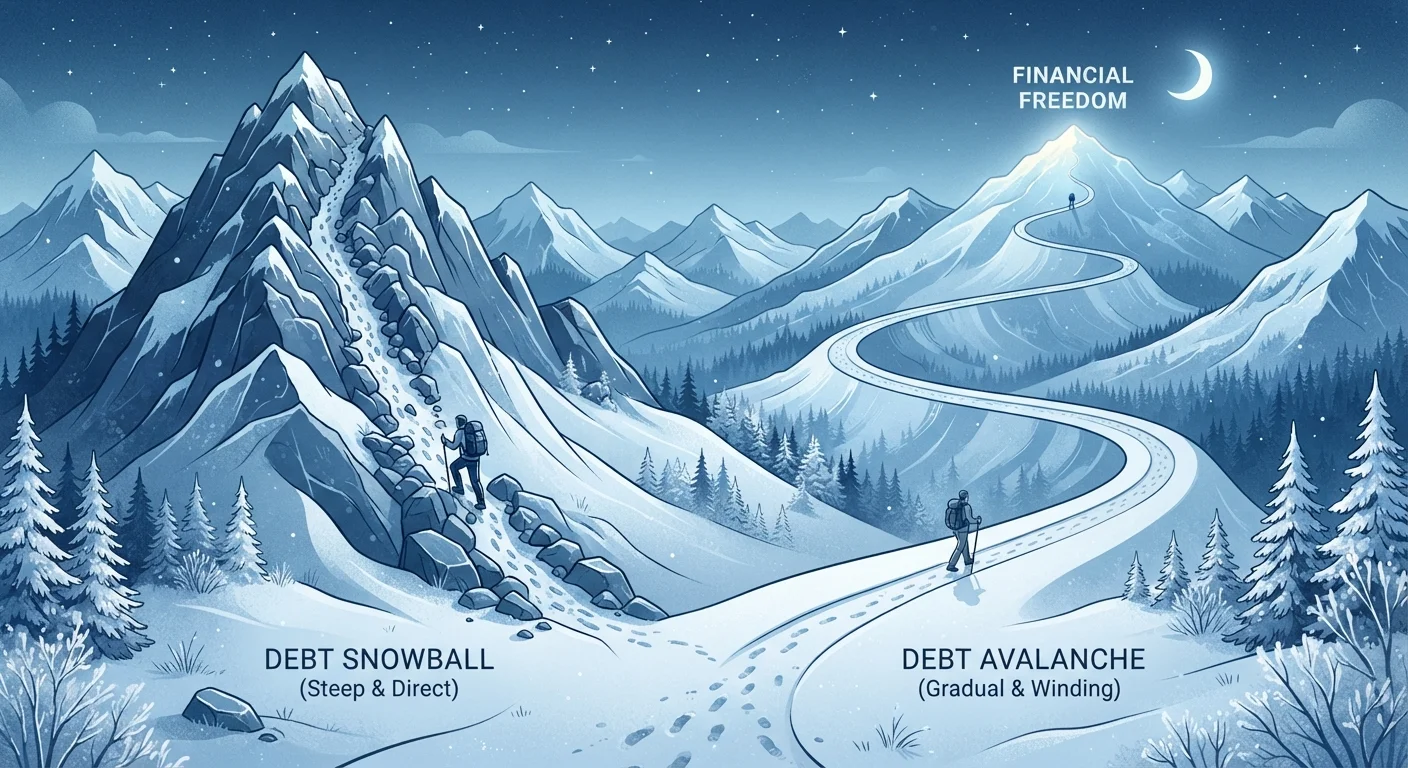
Key Takeaways
- The avalanche method targets high-interest debt first, reducing the total interest you pay over time.
- The snowball method eliminates smallest balances first, generating psychological momentum through quick wins.
- Neither method works unless you stick to it — behavioral fit matters as much as math.
- Both methods require making minimum payments on all debts while putting extra money toward one priority.
- Hybrid approaches are possible: some people start with snowball to build confidence, then shift to avalanche.
Option A
The Avalanche Method
The mathematically optimal, interest-minimizing approach.
Best for: Disciplined savers who stay motivated by long-term financial efficiency and want to minimize total interest paid.
Option B
The Snowball Method
The motivationally powerful, momentum-building approach.
Best for: People who need visible, frequent wins to stay engaged and on track with their debt repayment plan.
If you carry high-interest debt like credit cards and want to minimize total cost
The Avalanche Method
Targeting the highest interest rate first reduces the total amount you'll pay before becoming debt-free, which can add up to meaningful savings over time.
If you've struggled to stick with repayment plans in the past
The Snowball Method
Eliminating smaller balances quickly delivers concrete milestones that reinforce the habit of repayment and reduce the risk of giving up.
If your debts carry similar interest rates but vary widely in balance size
The Snowball Method
When interest rates are close, the mathematical difference narrows — and the motivational lift of clearing accounts becomes the more meaningful variable.
If you are analytically motivated and track your finances closely
The Avalanche Method
Seeing your projected interest savings shrink month by month can serve as its own form of motivation for detail-oriented planners.
If you are new to structured debt repayment and unsure where to start
The Snowball Method
The snowball's early wins help build confidence and establish the repayment habit before tackling larger, more complex balances.
How Both Methods Actually Work
Both the avalanche and snowball methods share the same core mechanic: you make minimum payments on every debt you owe, then direct any additional money toward one specific target account. The difference is simply which debt you prioritize.
With the avalanche method, you rank your debts by interest rate — highest to lowest — and throw every extra dollar at the debt charging you the most. Once that balance reaches zero, you roll that payment amount into attacking the next highest-rate debt, and so on.
With the snowball method, you rank debts by balance — smallest to largest — regardless of interest rate. You pay off the smallest balance first, then redirect that freed-up payment toward the next smallest. The payment you apply to each successive debt grows, like a snowball rolling downhill.
Before committing to either strategy, it's worth reviewing our pre-repayment checklist to ensure your financial foundations — like a basic emergency fund — are in place first.
| Criterion | Avalanche Method | Snowball Method |
|---|---|---|
| Priority order | Highest interest rate first | Smallest balance first |
| Total interest paid | Lower (mathematically optimal) | Potentially higher |
| Time to first payoff | Often longer | Faster early wins |
| Motivational structure | Long-term efficiency focus | Frequent milestone rewards |
| Best suited for | Analytically motivated planners | Those needing behavioral momentum |
| Risk of abandonment | Higher if progress feels slow | Lower due to early wins |
The Math: Why Avalanche Costs Less
The avalanche method wins on a purely numerical basis. Interest compounds continuously on outstanding balances, meaning high-rate debt grows fastest if left unattended. By eliminating the most expensive debt first, you slow that compounding effect sooner, which reduces the total amount you'll repay across all accounts.
The difference in savings depends on your specific balances and rates, but the principle is consistent: every month a high-interest balance sits untouched, it generates charges that a lower-rate balance would not. Redirecting extra payments to the costliest debt first interrupts that cycle at its source.
20%+
Typical APR on credit card debt
The Federal Reserve reports average credit card interest rates have frequently exceeded 20% APR in recent years, making high-rate targeting especially impactful.
$6,000+
Average US credit card balance per holder
The Consumer Financial Protection Bureau has documented that many US cardholders carry revolving balances, making repayment method choice consequential.
This is general educational information, not personalized financial advice. For guidance tailored to your specific debts and income, consulting a nonprofit credit counselor or a licensed financial professional is a worthwhile step.
The Psychology: Why Snowball Works for More People
Research in behavioral economics consistently shows that humans respond powerfully to visible progress and intermediate rewards. The snowball method is built on this insight. Paying off a small balance — even one with a low interest rate — delivers a tangible sense of achievement that high-rate payoffs, which may take years, cannot match early on.
This matters practically: a debt repayment plan you abandon after three months is far less effective than a slower plan you sustain for three years. Motivation is not a luxury in debt repayment — it's infrastructure.
For readers who have found debt management confusing or discouraging, our starter guide to debt explains how balances accumulate and why interest rates affect total cost so significantly.
What About Hybrid Approaches?
Nothing requires you to commit permanently to one method. Some people pay off one or two small balances using the snowball to build momentum, then switch to avalanche ordering for the remainder. What matters most is consistency: maintaining minimum payments on all accounts and directing surplus funds toward your chosen priority every month. Changing strategy mid-course is fine; stopping entirely is costly.
Choosing the Right Method — and Staying the Course
The honest answer is that the best debt repayment method is the one you'll actually follow. If you're naturally driven by data and long-term efficiency, the avalanche may keep you engaged. If you need momentum and closure to stay motivated, the snowball gives you that structure.
Some people use a hybrid: they start with the snowball to eliminate one or two small balances and build confidence, then switch to avalanche once the habit feels established. This isn't a compromise — it's a pragmatic recognition that behavioral readiness affects financial outcomes.
Whichever approach you choose, the underlying discipline is the same: make minimum payments everywhere, direct extra funds consistently toward your priority debt, and avoid adding new high-interest balances while you repay. The framework for balancing debt payoff and saving can also help you decide how aggressively to repay versus building other financial buffers simultaneously.
For a broader view of how debt repayment fits into your overall financial life, see the complete guide to saving and debt repayment, which covers every major stage from early career to retirement.
This article is for general informational and educational purposes only and does not constitute personalized financial, legal, or tax advice. Consult a qualified financial professional for guidance specific to your situation.