

Key Takeaways
- Saving before spending flips the default sequence that causes most people to under-save.
- Automating transfers eliminates willpower as a dependency in your savings habit.
- Even small first-priority amounts build meaningful momentum through compounding over time.
- The strategy works alongside — not instead of — a broader budget.
- Employer-matched retirement accounts are a natural starting point for paying yourself first.
Pay Yourself First
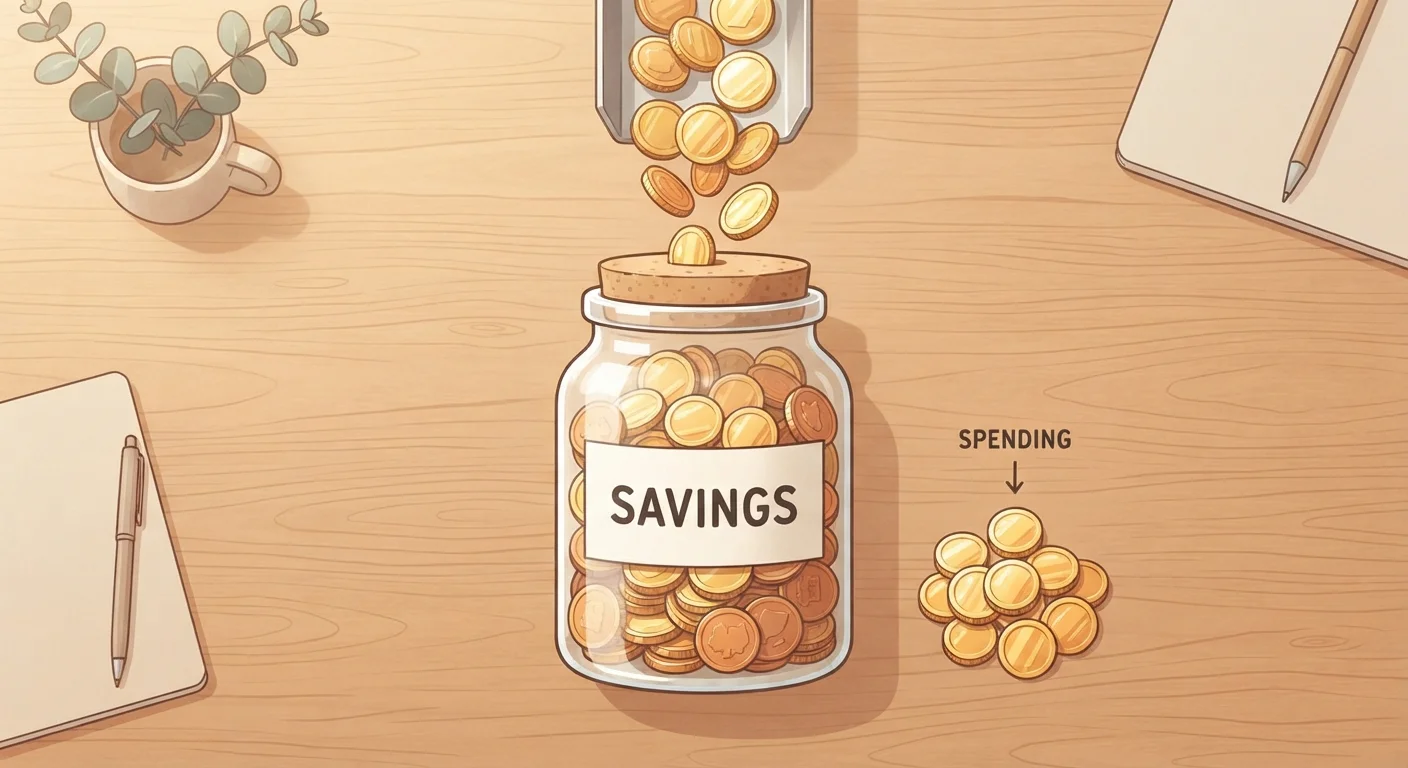
"Pay yourself first" is a savings strategy where you direct a set portion of your income to savings or investments immediately when you get paid — before covering any other expenses. Rather than saving whatever is left over at the end of the month, you treat savings as a non-negotiable bill due to yourself. The logic is simple: spending tends to expand to fill whatever money is available, so moving savings first removes them from the pool before that happens.
In practice, this is often implemented through automatic transfers or payroll deductions (such as 401(k) contributions), which reduce the behavioral friction of the decision by removing it entirely.
Why Sequence Changes Everything
Most people approach saving with the best of intentions: spend what you need to, then save whatever remains. The problem is that, in practice, the remainder is often close to zero. Lifestyle costs tend to rise gradually, subscriptions accumulate, and small discretionary purchases fill the gaps. By the time the end of the month arrives, the budget is spent.
Paying yourself first inverts this sequence. Savings are allocated the moment income arrives — not after every other obligation has been met. What changes isn't the amount you earn; it's the order in which money moves. And that order turns out to matter enormously.
Think of it as a hierarchy of financial claims on your paycheck. In the traditional approach, savings sit at the bottom of that hierarchy. In the pay-yourself-first model, they move to the top — treated with the same non-negotiable weight as rent or a utility bill. This reframing is psychologically and practically significant.
Treat Your Savings Like a Fixed Bill
Renaming your savings transfer in your bank app — something like 'Future Me' or 'Emergency Fund' — can reinforce the psychological commitment to leaving those funds untouched. The more mentally distinct it feels from your spending money, the less tempting it becomes to dip into it.
This principle fits within broader budgeting basics — it doesn't replace a spending plan but gives it a stronger structural foundation.
How the Mechanism Actually Works
The most reliable version of this strategy removes human decision-making from the equation. Automation does the heavy lifting. Common implementations include:
- Payroll deductions: Pre-tax contributions to a workplace retirement plan (like a 401(k)) are deducted before the paycheck lands in your account. You never see the money — and you don't miss what you never had access to.
- Automatic bank transfers: A recurring transfer from checking to a dedicated savings account, scheduled for the same day your paycheck deposits. The window for spending that money closes immediately.
- Split direct deposit: Many employers allow paychecks to be split between accounts, directing a fixed dollar amount or percentage straight to savings.
Each approach achieves the same thing: it makes saving the default, and spending the residual. The compound effect of consistent small choices over time is what turns this structural habit into long-term financial change.
57%
Americans unable to cover a $1,000 emergency
According to a Bankrate survey, a majority of U.S. adults would struggle to pay for an unexpected $1,000 expense from savings, highlighting the gap between saving intentions and outcomes.
36%
Private-sector workers who don't participate in a workplace retirement plan
Bureau of Labor Statistics data shows that a significant share of eligible workers do not participate in an available employer-sponsored plan, often citing difficulty saving.
Starting Small Without Losing Momentum
One barrier to adopting this strategy is the belief that the amount needs to be significant to matter. It doesn't. A $25-per-paycheck automated transfer matters less for the dollar amount and more for what it establishes: a habit, a structure, and a savings account that is growing rather than static.
Over time, most people find it natural to increase the amount — often when they receive a raise, pay off a debt, or cut a recurring expense. Because the transfer is automatic, increasing it requires only a single change to a standing instruction, not a new monthly decision.
It's also worth noting what this strategy does not require: perfect spending discipline, a detailed budget maintained every week, or a high income. It requires only that you act before the money is available to spend. That small shift in timing is the entire mechanism.
For those juggling savings goals alongside debt, the framework for prioritising debt versus savings can help determine where first-priority dollars should go given your specific interest rates and circumstances.
Habits that undercut savings — often without you noticing — are explored in detail in financial habits that quietly erode savings. Paying yourself first is, in many ways, the structural antidote to those patterns.
This article provides general financial information for educational purposes only and is not personalised financial advice. Consider speaking with a qualified financial adviser about decisions that affect your individual circumstances.