

Key Takeaways
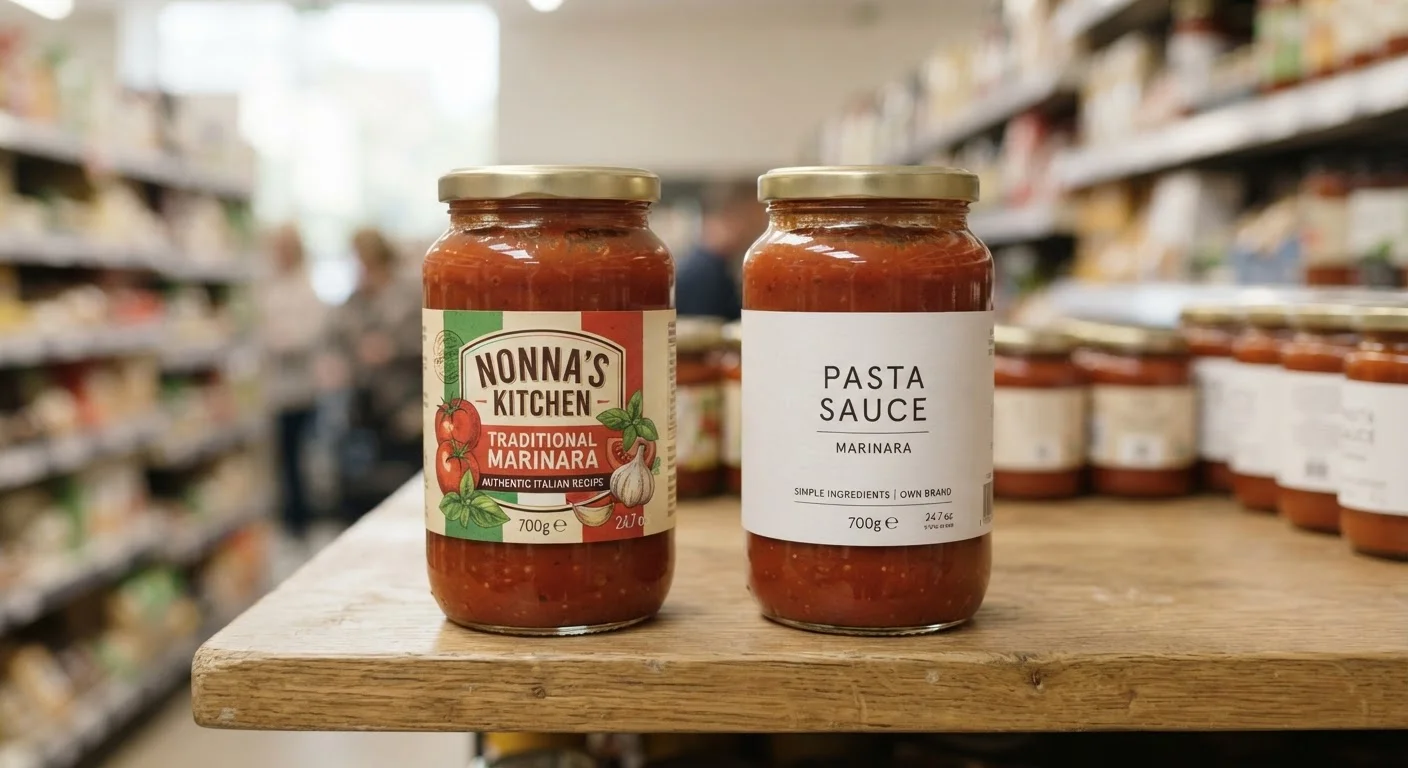
- Many own-label products are manufactured in the same facilities as their branded counterparts.
- A higher price does not reliably signal higher quality — branding and marketing costs are baked into brand premiums.
- Ingredient lists and unit pricing are more reliable quality signals than packaging design or shelf position.
- Own-label quality varies significantly by category and retailer — it rewards selective, informed comparison.
- Some branded products do hold genuine formulation or ingredient advantages worth investigating.
Option A
Branded Products
The name you recognize, backed by marketing investment.
Best for: Shoppers who value brand consistency, specific formulations, or categories where quality variation is proven to matter.
Option B
Own-Label Products
The retailer's version — often made in the same facilities.
Best for: Value-focused shoppers willing to evaluate products on ingredients and performance rather than packaging.
If you want reliable everyday grocery staples at lower cost
Own-Label Products
Staples like canned goods, dried pasta, flour, and cleaning products frequently share formulations with name brands. Comparing ingredient lists often confirms near-identical composition at a lower price.
If consistent formulation matters for health, dietary, or skincare needs
Branded Products
When a specific tested formulation is critical — such as certain over-the-counter medications with active ingredient standards, or clinically tested skincare — staying with the brand that published the evidence is a reasonable choice.
If you shop across multiple retailers and categories
Own-Label Products
Developing the habit of checking ingredient lists and unit prices allows you to buy own-label selectively where it genuinely matches branded quality, and choose branded only when justified.
If you're uncertain about a new product category
Branded Products
In unfamiliar territory, branded products with established track records can serve as a useful quality benchmark before comparing own-label alternatives.
The Factory Behind the Label
One of the least-discussed realities of modern retail is that own-label products — also called store brands or private-label goods — are frequently produced by the same manufacturers that supply name-brand products. A dairy that fills jars under a well-known jam brand may simultaneously fill near-identical jars for a supermarket's own range. The formulations may differ slightly, or not at all.
This arrangement benefits manufacturers, who fill excess production capacity, and retailers, who earn higher margins on own-label lines. For shoppers, it means the price difference you pay is often covering marketing budgets, national advertising, and brand-building investment rather than fundamentally different ingredients or manufacturing standards.
That said, "often" is not "always." Some branded products do maintain proprietary formulations, unique ingredient sourcing, or tighter quality controls. The skill is in knowing which category you're dealing with. As part of a broader approach to making informed everyday purchases, learning to interrogate the label itself is more useful than trusting the price tag.
| Criterion | Branded Products | Own-Label Products |
|---|---|---|
| Price point | Generally higher | Generally lower |
| Marketing & advertising cost included | Yes — baked into price | Minimal or none |
| Formulation transparency | Varies; sometimes proprietary | Ingredient list usually comparable |
| Manufacturing origin | Dedicated or shared facilities | Often same facilities as brands |
| Quality consistency | Generally consistent across retailers | Varies significantly by retailer |
| Clinical/efficacy evidence | More common for health products | Less frequently published |
| Best evaluated by | Brand reputation and published data | Ingredient list and unit price |
How to Judge Quality Without the Packaging
Marketing language is designed to create perceived value — phrases like "premium," "artisan," or "new and improved" carry emotional weight without legal obligation. For a closer look at how those claims function, see our piece on decoding packaging claims.
More useful tools are available directly on the product itself:
- Ingredient lists: Ingredients are listed in descending order by weight. Comparing the ingredient list of a branded product to its own-label counterpart is often the fastest way to identify genuine differences — or confirm they're essentially the same.
- Unit pricing: Supermarkets are generally required to display unit prices (per 100g, per litre, etc.), which strip away misleading pack sizes and make true cost comparisons straightforward. Our guide to unit pricing explains how to use these figures effectively.
- Nutritional panels: For food products, the nutrition label provides an objective comparison point. Learning to read one fluently — covered in detail in our nutrition label guide — helps cut through front-of-pack marketing.
Own-Label Isn't One Single Standard
Retailers often operate multiple own-label tiers — an entry-level range, a mid-tier, and a premium own-label line — each with different sourcing and quality targets. Comparing the right tier to a branded product is important for a fair assessment. A retailer's premium own-label may actually be positioned above certain mid-market brands in terms of ingredient quality and price.
Own-label quality is not uniform across retailers. A premium supermarket's own-label line may consistently outperform a budget retailer's branded offering. The retailer's positioning matters as much as the branded-vs-own-label distinction itself.
Categories Where the Choice Matters Most
Not every product category is equal when it comes to branded vs. own-label decisions. In some areas, the differences are negligible; in others, they can be meaningful.
Where own-label tends to perform comparably: Pantry staples (tinned tomatoes, dried pulses, flour, sugar), cleaning products, basic paper goods, and many dairy commodities. These are often commodity products where the raw material and process are broadly standardized.
Where branded products may hold genuine advantages: Over-the-counter medications (where active ingredient concentrations are regulated but inactive ingredients and delivery formats may differ), certain skincare products with published clinical data, and specialty food items where provenance or a specific production method is independently verifiable.
Pet food is another area where label literacy pays off. Ingredient order, guaranteed analysis figures, and feeding trial evidence matter more than brand recognition — a topic covered directly in our pet food label primer.
~40%
Share of US grocery sales from private-label products
Private Label Manufacturers Association data has consistently shown own-label products account for a substantial share of total US grocery unit sales, with growth tracked across multiple years.
20–30%
Typical price gap between branded and own-label equivalents
Consumer research organizations and grocery analysts have broadly observed that own-label products are priced 20 to 30 percent lower on average than branded equivalents in the same category.
It's also worth noting that bulk buying branded products isn't automatically the smart play it appears to be. Buying in bulk doesn't always save money — spoilage, storage limitations, and upfront cash flow all complicate the apparent discount.