

Key Takeaways
- Unit prices let you compare any two products regardless of package size or format.
- Larger packages do not automatically offer a better unit price — always verify.
- Sale prices and multi-buy deals can sometimes make smaller sizes cheaper per unit.
- Inconsistent unit-of-measure labeling (ounces vs. grams) can make direct comparisons harder.
- Unit pricing is one of the most reliable tools for making informed grocery decisions.
Unit Pricing
Unit pricing is the cost of a product expressed per standard unit of measurement — such as per ounce, per liter, per 100 grams, or per individual item. Rather than telling you what a package costs overall, a unit price tells you how much you're paying for a consistent, comparable quantity. This makes it possible to compare products of different sizes, brands, or formats on equal footing.
Retailers are required to display unit prices in many US states under state-level weights and measures regulations, though the specific rules — including which products are covered and how prominently the price must be displayed — vary by jurisdiction.
What Unit Pricing Actually Shows You
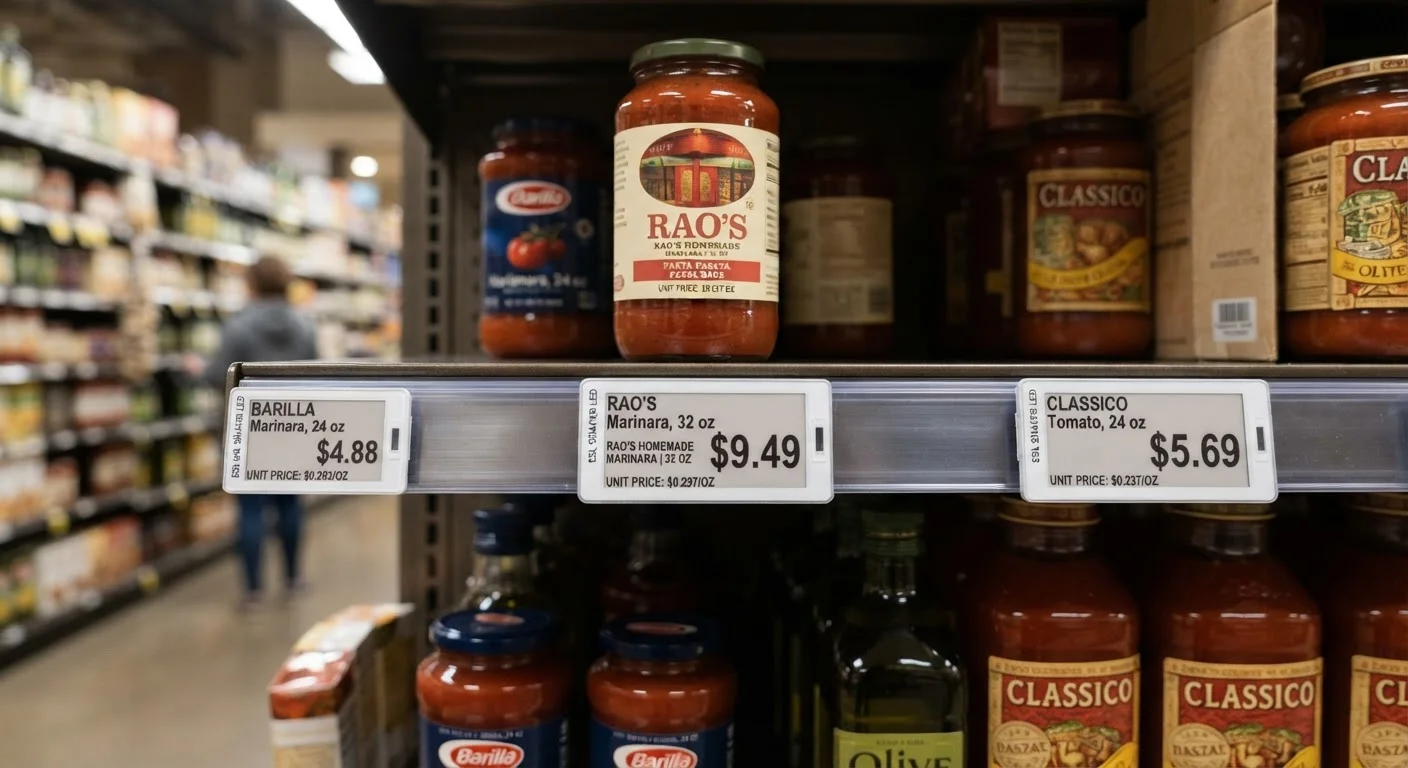
Every supermarket shelf label carries two numbers: the total retail price for that specific package, and — usually printed in much smaller type — the unit price. The unit price is the one that does the real work. It converts whatever is in the package into a standardized cost, expressed as price per ounce, per 100 grams, per liter, or per individual item depending on the product category.
The reason this matters becomes clear the moment you try to compare, say, a 12-oz jar of peanut butter with a 28-oz jar. The total prices tell you almost nothing useful. The unit prices — both expressed in cost per ounce — immediately tell you which is the better value for the quantity you're buying.
Unit pricing strips away the packaging and the marketing and leaves you with a single comparable number. It's the financial equivalent of a common denominator.
~70%
Shoppers who don't regularly check unit prices
Consumer research has consistently found that the majority of grocery shoppers compare total package prices rather than unit prices when choosing between products.
30%+
Potential unit price variation within a single product category
Studies of supermarket shelf pricing have found unit price differences of 30% or more between package sizes and brands within the same product category, demonstrating how much information total price alone obscures.
Why Supermarkets Don't Exactly Shout About It
Retailers are not obligated to make unit prices easy to find. In many stores, the unit price appears in a smaller font, a lighter color, or a less prominent position than the retail price. Promotional tags — the bright yellow or red sale stickers — frequently display the deal price in large type while the unit price shrinks further or disappears altogether.
This isn't accidental. Shoppers who rely on total price rather than unit price are more likely to reach for larger, more expensive packages under the assumption that bigger means better value. They're also more susceptible to multi-buy promotions that, on closer inspection, offer a unit price no better than the standard shelf price.
Marketing conventions — terms like "family size," "economy pack," or "club pack" — are designed to imply savings without making a specific quantifiable promise. Unit pricing is the antidote to all of that language because it doesn't deal in implication. See our guide to branded versus own-label products for a related look at how packaging signals value that may not reflect actual quality.
Make It a Quick Shelf-Edge Habit
Train yourself to glance at the smaller print on every shelf label before placing an item in your cart. The unit price is almost always there — it just requires a deliberate look. Over time, this becomes automatic and adds only seconds to each purchasing decision.
Common Traps That Unit Pricing Exposes
Once you start reading unit prices consistently, several common retail pricing patterns become immediately visible.
- Bulk sizes that aren't actually cheaper. A warehouse-club multipack may look like a deal based on total volume, but its unit price sometimes matches — or even exceeds — a regular grocery store's standard size. This connects to a broader issue explored in our analysis of when bulk buying actually saves money.
- Multi-buy offers with no real discount. "3 for $5" promotions occasionally work out to the same unit price as buying one at the standard shelf price. You're not saving — you're just spending more in one transaction.
- Mid-size packages priced at a premium. Some product lines deliberately price their middle tier at a higher unit cost than either the small or large sizes, nudging buyers toward the largest option regardless of their actual needs.
- Inconsistent units across competing products. One brand may display cost per ounce while a directly competing product nearby shows cost per 100g, making side-by-side comparison unnecessarily difficult.
Being aware of these patterns means you're less likely to be caught by them. And once the habit of checking unit prices is established, it takes only a few seconds per item.
How to Use Unit Pricing Effectively
Using unit pricing well is straightforward, with a few practical considerations worth keeping in mind.
Compare like for like. Unit prices are most useful when comparing products of the same general type and quality level. A unit price comparison between a premium olive oil and a standard cooking oil may not tell you much if the products serve different purposes. For a parallel skill in reading product information critically, the walkthrough on reading nutrition labels offers useful context on interpreting standardized product data.
Account for waste and usability. If a larger package will go stale, spoil, or sit unused before you finish it, the lower unit price becomes theoretical rather than real. A cheaper price per ounce only saves money if you actually use all of it.
Watch for unit switches between products. When labels use different units — ounces versus grams, fluid ounces versus milliliters — convert everything to the same measure before comparing. Smartphones make this quick.
Apply the same logic beyond groceries. Unit pricing works equally well for laundry detergent, paper towels, shampoo, and pet food. Any product sold in variable package sizes benefits from this comparison.
This article is for general informational and educational purposes only. Pricing practices and regulatory requirements vary by retailer and location; always verify specific claims with current shelf information or relevant consumer protection resources in your area.