

Key Takeaways
- The three-second rule is a minimum baseline — not a universal guarantee of safe stopping.
- Adverse conditions like rain, snow, or fatigue require significantly longer following distances.
- Tailgating remains one of the leading contributing factors in rear-end collisions on US roads.
- Larger vehicles, including SUVs and trucks, need more space to stop than most drivers assume.
- Reaction time — not braking power alone — determines how much distance you truly need.
Why Following Distance Is More Complex Than You Think
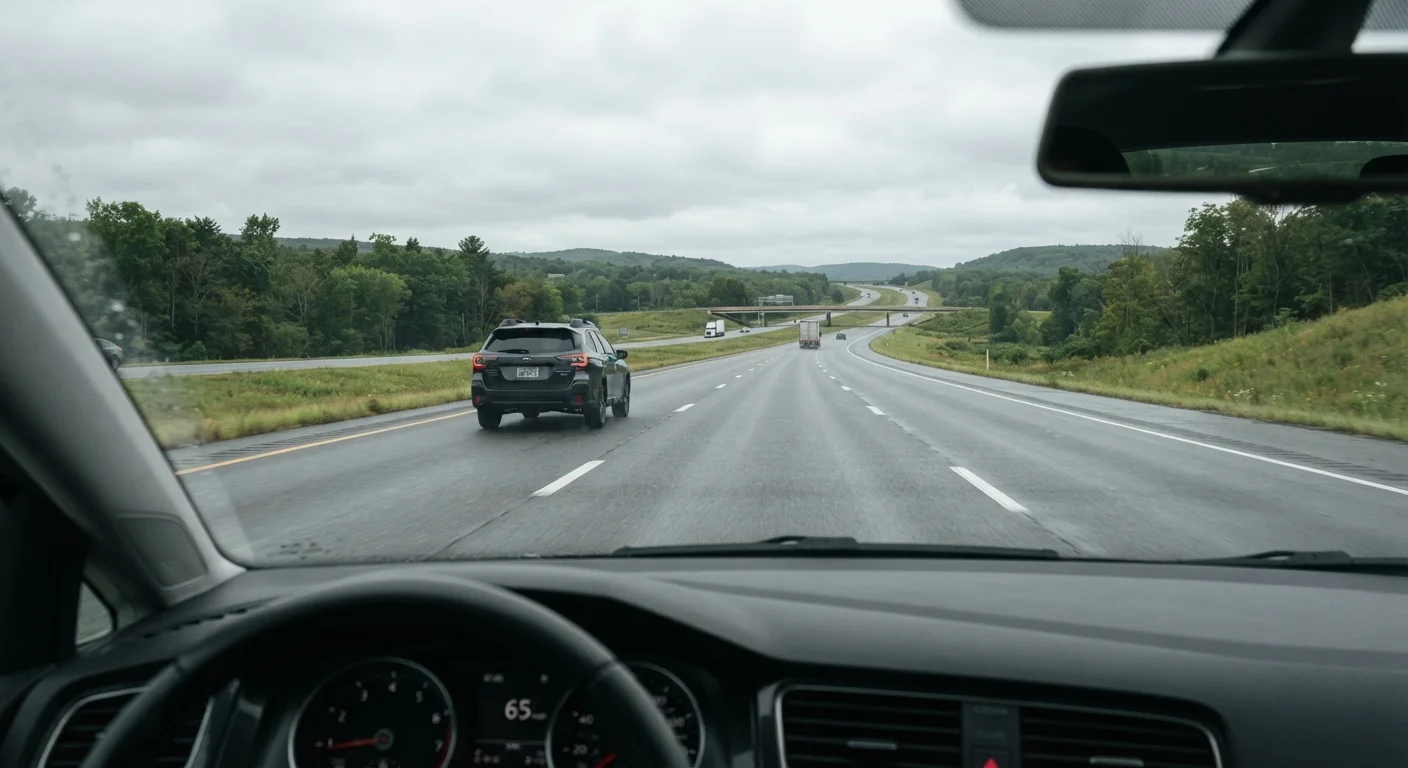
Ask most drivers how much space they should leave between themselves and the car ahead, and they'll cite the three-second rule. That's not wrong — but it's dangerously incomplete. The three-second rule, taught in driver's education courses across the US, gives you a quick mental benchmark: pick a fixed point on the road, and make sure at least three seconds pass between the moment the vehicle ahead crosses it and the moment you do.
The problem is that drivers routinely misapply this rule, treat it as sufficient under all conditions, or abandon it entirely in traffic. Understanding when and why the rule falls short is what separates confident drivers from truly safe ones.
Following distance intersects with other critical safety habits. For a broader look at the rules that govern US roads, see lane rules and right-of-way basics that apply in most states.
Myth
The three-second rule is enough to keep me safe in any driving situation.
Fact
Three seconds is a dry-road, alert-driver minimum — many conditions require four to six seconds or more.
The three-second rule assumes dry pavement, a fully alert driver, and a properly maintained vehicle with good tires and brakes. Remove any of those factors and the math changes significantly. Rain, worn brake pads, a distracted moment, or a heavy vehicle load all increase the distance required to stop safely. Treating three seconds as a ceiling rather than a floor is one of the most common — and most consequential — mistakes drivers make.
Myth
Tailgating only matters at high speeds. In slow traffic, it's not dangerous.
Fact
Low-speed rear-end collisions cause a significant share of traffic injuries, including whiplash and pedestrian crush incidents.
Stop-and-go traffic creates its own collision pattern. Distraction is at its peak when driving feels routine, and reaction time is still the limiting factor regardless of speed. A driver checking a phone at 20 mph who doesn't notice a sudden stop ahead has almost no margin. Additionally, in dense urban settings, a chain-reaction rear-end collision can push a vehicle into a crosswalk or intersection.
Myth
SUVs and trucks stop faster because they're heavier and more powerful.
Fact
Heavier vehicles generally require longer stopping distances, not shorter ones, due to increased momentum.
Physics works against larger vehicles here. A heavier vehicle carries more kinetic energy at any given speed, and while modern trucks and SUVs have capable braking systems, they still require more distance to dissipate that energy compared to a smaller passenger car under equivalent conditions. Drivers who upgrade from sedans to trucks often underestimate this shift and carry over the same following habits — a dangerous assumption.
Myth
If I'm a skilled, experienced driver, I can safely follow more closely.
Fact
Skill improves hazard recognition, but it cannot overcome the physical limits of braking distance.
Experience helps drivers anticipate and react earlier — but it doesn't shorten the distance a vehicle physically needs to stop once the brakes are applied. Overconfidence in one's own reflexes is well-documented as a risk factor across driving research. Even the fastest human reaction times add substantial distance at highway speeds before braking even begins.
Myth
Leaving a large gap ahead of me just invites other cars to cut in.
Fact
A gap that's occasionally filled by another vehicle still protects you — because you reset the distance and brake far more gradually.
When another driver merges into the space ahead of you, the appropriate response is to ease off the throttle slightly and re-establish your following distance — not to close the gap aggressively. Drivers who resist this end up in a cycle of reactive braking that increases risk for everyone in the lane. A calm reset is both safer and less fatiguing over long drives.
Conditions That Demand More Space
Even drivers who correctly apply the three-second rule in ideal conditions often forget to adjust when circumstances change. Wet pavement alone can increase stopping distance by 50% or more depending on speed and tire condition. Ice can extend it by four to ten times compared to dry asphalt. At highway speeds, that gap between perception and a complete stop becomes enormous.
~29%
Of all US crashes are rear-end collisions
Rear-end collisions consistently represent roughly a quarter to nearly a third of all reported crashes annually, according to National Highway Traffic Safety Administration data.
1.5 sec
Average driver reaction time before braking
Research on human reaction time suggests drivers typically take 1.5 seconds or more to perceive a hazard and begin braking — distance that adds up quickly at freeway speeds.
4–10×
Stopping distance increase on ice vs. dry road
Stopping distances on ice can be four to ten times longer than on dry pavement at the same speed, depending on tire type and road surface temperature.
Fatigue compounds the problem in a way many drivers underestimate. A drowsy driver's reaction time can approach or exceed that of someone over the legal alcohol limit. If you're on a long drive, consider the guidance in managing driver fatigue on long trips before assuming alertness alone will save you.
Visibility is the other underappreciated variable. At night or in fog, you may not see a hazard until you're already within your stopping distance. Night driving and headlight range explains why even correctly adjusted headlights leave less margin than most drivers assume.
Adverse Conditions Require Immediate Adjustment
As soon as rain begins, visibility drops, or road surfaces become questionable, increase your following distance before you feel like you need to — not after. Waiting for a close call to prompt the adjustment is the pattern that leads to collisions. Build the habit of recalibrating distance the moment conditions shift.
Putting It Into Practice
The simplest upgrade to your following distance habit: increase from three seconds to four or five in any condition that isn't dry, daylight, and uncongested. On freeways at speeds above 65 mph, five or six seconds is a more defensible baseline. With a commercial truck, RV, or towed trailer ahead of you — where sudden stops are less predictable and load shifts matter — extend further still.
In heavy urban traffic where maintaining large gaps invites lane-changers, focus on reading the road further ahead. Anticipating slowdowns earlier means you can brake more gently over a longer distance rather than reacting late to brake lights directly in front of you. Distraction is the enemy of that skill — even hands-free phone use degrades situational awareness. The research on hands-free phone use is worth reviewing if you make calls while driving.
Following distance isn't a rigid formula. It's a dynamic judgment call that requires recalibration every few minutes based on speed, conditions, vehicle load, and your own alertness. The drivers who get it right aren't the ones who memorized a number — they're the ones who treat every trip as an exercise in situational awareness.