

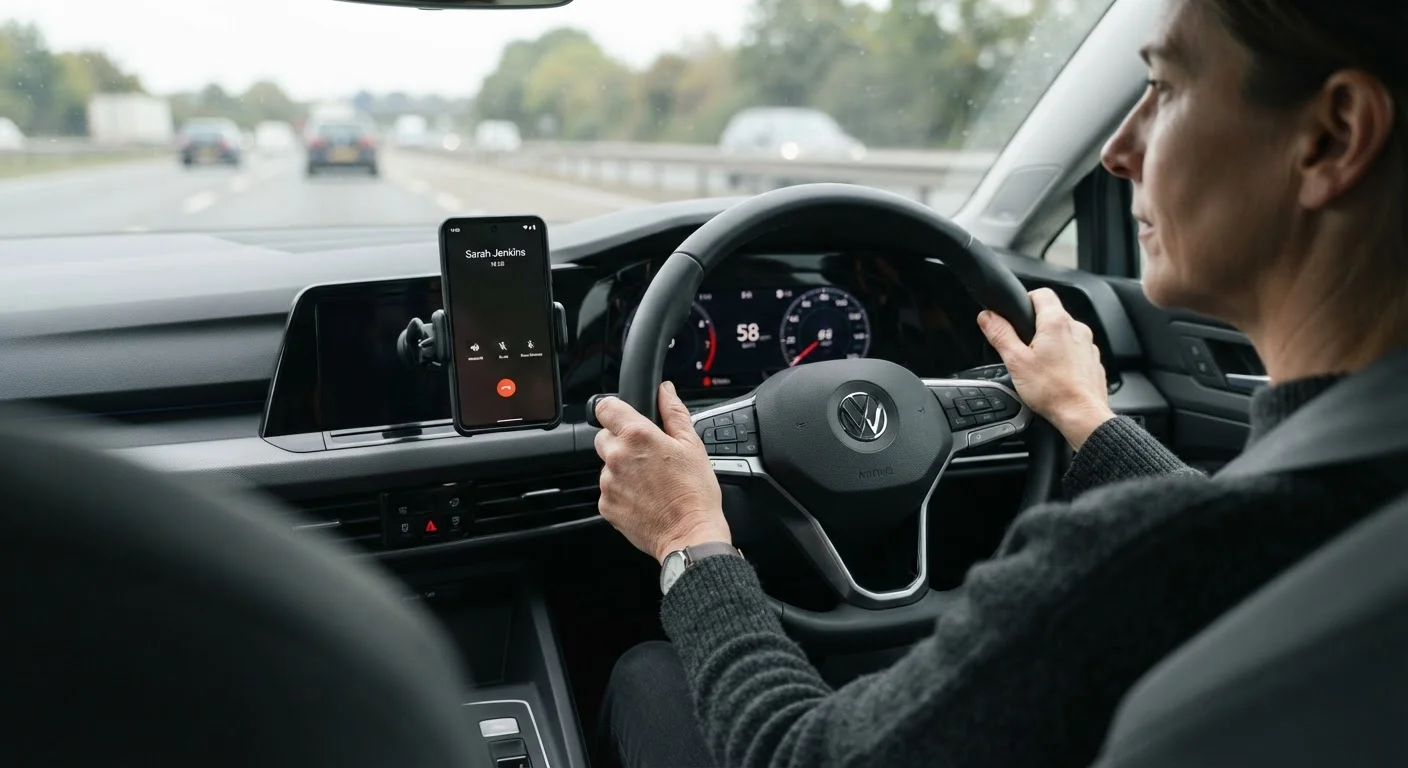
Key Takeaways
- Handheld phone use while driving is illegal in most US states and measurably impairs reaction time.
- Hands-free calling still causes significant cognitive distraction — it is not risk-free.
- Research shows drivers on phone calls miss up to 50% of relevant visual information, regardless of device type.
- Voice-to-text features can also create cognitive load, especially when composing or correcting messages.
- The safest approach is to silence notifications and delay all calls until the vehicle is parked.
Option A
Hands-Free Phone Use
The widely assumed safer alternative.
Best for: Drivers who must stay reachable and want to keep both hands on the wheel.
Option B
Handheld Phone Use
The clearly riskier and increasingly illegal option.
Best for: No driving scenario — handheld use while driving is broadly discouraged and widely prohibited.
If you need to make a call while driving
Hands-Free Phone Use
Keeping both hands on the wheel reduces physical distraction, and hands-free calling is legal in far more jurisdictions — but cognitive distraction remains, so keep calls brief.
If safety is your top priority
Neither — pull over or wait
All phone use while driving divides attention. Parking before calling eliminates both physical and cognitive distraction entirely.
If you frequently drive in heavy traffic or complex road conditions
Neither — silence your phone
High-demand driving environments compound distraction risk significantly. Even brief glances or cognitive load from conversations can be dangerous in congested conditions.
What the Research Actually Shows
Many drivers treat hands-free calling as a safe substitute for handheld use. The evidence, however, is more nuanced. Studies from the National Safety Council (NSC) and the AAA Foundation for Traffic Safety consistently find that cognitive distraction — not just physical distraction — is a major contributor to phone-related crashes.
Research cited by the NSC indicates that drivers engaged in phone conversations can miss seeing up to 50% of relevant visual information in their environment, a phenomenon sometimes called "inattention blindness." This occurs whether the phone is held in hand or connected through a car's Bluetooth system. The problem isn't where your hands are — it's where your mind is.
That said, handheld use adds a distinct physical layer of risk. Holding a device means one hand leaves the wheel, eyes often drop to the screen, and reaction times slow measurably. These combined effects make handheld use significantly more dangerous in practice, even if hands-free calling carries its own cognitive costs.
| Criterion | Hands-Free Phone Use | Handheld Phone Use |
|---|---|---|
| Physical distraction | Low — both hands remain free | High — one hand off the wheel |
| Cognitive distraction | Moderate to significant | High — visual + cognitive load |
| Legal status (most US states) | Generally permitted for adults | Banned in most states |
| Crash risk vs. no phone use | Elevated, per research | Significantly elevated |
| Eye contact with road | Eyes typically stay forward | Eyes frequently leave the road |
| Recommended for driving | Use sparingly if necessary | Not recommended |
The Legal Landscape Across US States
From a legal standpoint, the distinction between handheld and hands-free use is substantial. As of the time of writing, the majority of US states prohibit handheld phone use while driving, and many extend those restrictions to all drivers regardless of age. A smaller but growing number of states have enacted broader distracted driving laws that cover any non-essential device use.
Hands-free calling — using Bluetooth, a speakerphone mounted in a legal position, or a vehicle's integrated system — remains permitted in most states for adult drivers, though restrictions vary. Novice drivers and those holding learner's permits often face stricter rules, sometimes banning hands-free use entirely.
Because laws vary significantly by state and are updated regularly, drivers should verify current regulations with their state's department of motor vehicles or a reliable government source rather than relying on general summaries.
Laws Vary — Always Check Your State
Distracted driving laws in the US are set at the state level and change frequently. What is permitted in one state may carry a fine or license points in another. Drivers should consult their state's DMV website or official traffic safety resources for the most current rules applicable to their situation, especially when driving across state lines.
Voice-to-Text: A Closer Look
Modern smartphones and vehicles offer voice-to-text features that let drivers compose messages without looking at a screen. Many drivers assume this eliminates distraction. Research from the AAA Foundation for Traffic Safety suggests otherwise — voice-to-text interactions can actually produce higher cognitive load than a standard phone conversation, particularly when the system misinterprets words and the driver attempts to correct errors.
Listening to a navigation prompt is relatively low-demand. Composing a sentence, monitoring its transcription, and correcting mistakes is considerably more so. The more interactive and error-prone the task, the greater the mental resources it draws away from driving.
For context on how communication technology can be misunderstood more broadly, see our common technology misconceptions article, which examines similar gaps between public perception and technical reality.
Practical Guidance for Safer Driving
The most effective way to eliminate phone-related distraction is straightforward: park before calling, or use Do Not Disturb driving modes that silence incoming notifications automatically. Most modern smartphones include this feature, and many vehicle systems can activate it when motion is detected.
If a call is unavoidable while driving, hands-free is the legally and physically preferable option — but drivers should keep conversations short, avoid emotionally charged discussions, and prioritize road conditions over the call. Pulling off safely is always an option.
Distraction is only one dimension of driving safety. The same attentional demands that phone calls create also compound other risks. Our guides on safe following distance and driver fatigue on long trips explore related factors that reduce reaction time and situational awareness behind the wheel.
50%
Visual information missed during phone calls
The National Safety Council cites research showing drivers can miss up to half of relevant visual cues while engaged in a phone conversation, even hands-free.
4x
Increased crash risk from handheld use
The National Highway Traffic Safety Administration (NHTSA) has cited research suggesting handheld phone use can quadruple crash risk compared to undistracted driving.
27 seconds
Mental recovery time after voice commands
AAA Foundation for Traffic Safety research found drivers can remain cognitively distracted for up to 27 seconds after completing a voice-based interaction.