

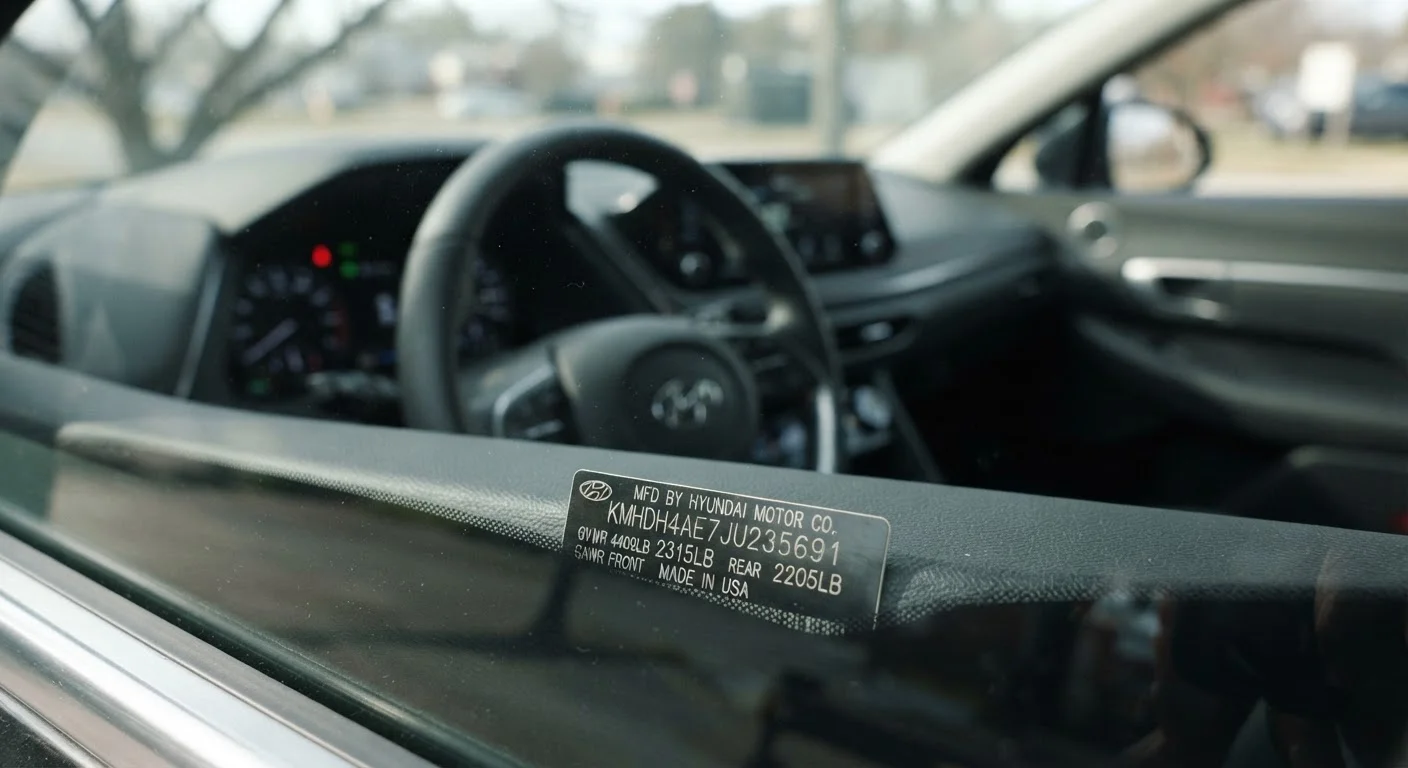
Key Takeaways
- Every car, truck, or motorcycle sold in the US since 1981 carries a unique 17-character VIN.
- A VIN encodes the vehicle's manufacturer, country of origin, model, engine type, and production sequence.
- You can find a vehicle's VIN on the dashboard, door jamb, title, or insurance card.
- Running a VIN check can reveal accident history, recalls, and odometer records before you buy a used car.
- The tenth character in a VIN always identifies the vehicle's model year.
Vehicle Identification Number (VIN)
A Vehicle Identification Number, or VIN, is a unique 17-character code assigned to every motor vehicle at the time of manufacture. Like a fingerprint, no two vehicles share the same VIN. The code encodes key details about the car — including where it was built, what it is, and its individual serial number — and stays with the vehicle for its entire life.
VINs follow an international standard (ISO 3779) that has been required on all vehicles sold in the US since 1981. Each character position has a specific meaning defined by this standard.
What a VIN Actually Is
Every vehicle on US roads carries a unique identity code stamped into its body at the factory. This code — the Vehicle Identification Number, or VIN — is a 17-character string of letters and numbers that acts as a permanent record of exactly what a vehicle is and where it came from.
The VIN system was standardized in the United States in 1981, when the National Highway Traffic Safety Administration (NHTSA) required all manufacturers to use a consistent 17-character format. Before that, manufacturers used their own formats, making vehicle records difficult to cross-reference.
Three letters are deliberately excluded from VINs: I, O, and Q. These are omitted because they can be confused with the numbers 1 and 0, which could lead to errors in official records.
VINs Apply Beyond Passenger Cars
Motorcycles, trailers, recreational vehicles, and many off-road vehicles also carry VINs. The same decoding principles apply, though some vehicle categories have slight variations in how certain character positions are used. When in doubt, consult the manufacturer's documentation or a qualified mechanic.
How to Read a VIN, Section by Section
A VIN is not random — every character carries meaning. It breaks down into three logical sections:
World Manufacturer Identifier (Characters 1–3)
The first three characters identify who made the vehicle and where. The first character indicates the country of manufacture (for example, 1, 4, or 5 indicates the United States; J indicates Japan; W indicates Germany). The second and third characters narrow down the specific manufacturer and vehicle type.
Vehicle Descriptor Section (Characters 4–9)
Characters four through nine describe the vehicle itself — body style, engine type, restraint systems, and model line. Character nine is a check digit, a mathematically calculated value used to verify the VIN is legitimate and not altered or fabricated.
Vehicle Identifier Section (Characters 10–17)
This final section distinguishes one individual vehicle from another built on the same line. Character 10 always represents the model year — a letter or number corresponding to a specific year according to a fixed chart (for example, A = 1980, K = 2019, P = 2023). See our guide to automotive model years for more on how manufacturers assign model years. Character 11 identifies the assembly plant, and characters 12–17 form the vehicle's unique sequential production number.
17
Characters in every standardized VIN
The 17-character VIN format has been required by NHTSA for all US-market vehicles since 1981.
~250M+
Registered vehicles on US roads
Each carries a unique VIN, making the system one of the largest vehicle-tracking infrastructures in the world.
Position 10
Character that always encodes model year
Per the ISO 3779 standard, the tenth VIN character is a fixed indicator of the vehicle's model year using an alphanumeric chart.
Where to Find Your VIN
A VIN appears in multiple places on a vehicle and in its paperwork:
- Dashboard plate: Visible through the windshield on the driver's side, at the base where the dashboard meets the glass. This is the easiest location to check without opening anything.
- Driver's side door jamb: A sticker inside the door frame lists the VIN along with tire pressure recommendations and manufacturing details.
- Vehicle title and registration: Your state-issued title document and registration card both carry the VIN.
- Insurance card: Many insurers print the VIN on proof-of-insurance documents.
- Engine bay: Some manufacturers also stamp the VIN on the firewall or engine block, useful for verifying a VIN hasn't been tampered with.
When evaluating a used car, always compare the VIN across at least two physical locations to confirm they match. Mismatched VINs can indicate fraud or a replaced body panel.
Always Cross-Check VINs When Buying Used
Before completing a used vehicle purchase, compare the VIN on the dashboard plate with the one on the door jamb sticker and the title document. All three should match exactly. Any discrepancy is worth investigating with a licensed professional or law enforcement vehicle inspector before proceeding.
Why Knowing Your VIN Is Practically Useful
A VIN unlocks several useful resources that can inform both buying decisions and ongoing vehicle ownership:
Safety Recall Checks
NHTSA maintains a free online database where any VIN can be searched to reveal open safety recalls. A recall means the manufacturer must repair a known defect at no cost to the owner — but only if the owner brings the vehicle in. Many recalls go unclaimed simply because owners don't know about them.
Vehicle History Reports
Third-party and government-backed services can generate a report tied to a specific VIN showing title history, reported accidents, odometer readings at past inspections, and whether the vehicle has ever been declared a total loss. This is especially valuable when buying a used vehicle privately.
Parts and Service Accuracy
When ordering replacement parts or scheduling service, providing the VIN — rather than just the make, model, and year — ensures the correct components are identified. Two vehicles with identical year, make, and model badges can have different engines or configurations depending on production run. See our guide to reading a service schedule for more on navigating vehicle maintenance records, and our guide to mechanic service reports when interpreting repair invoices.