

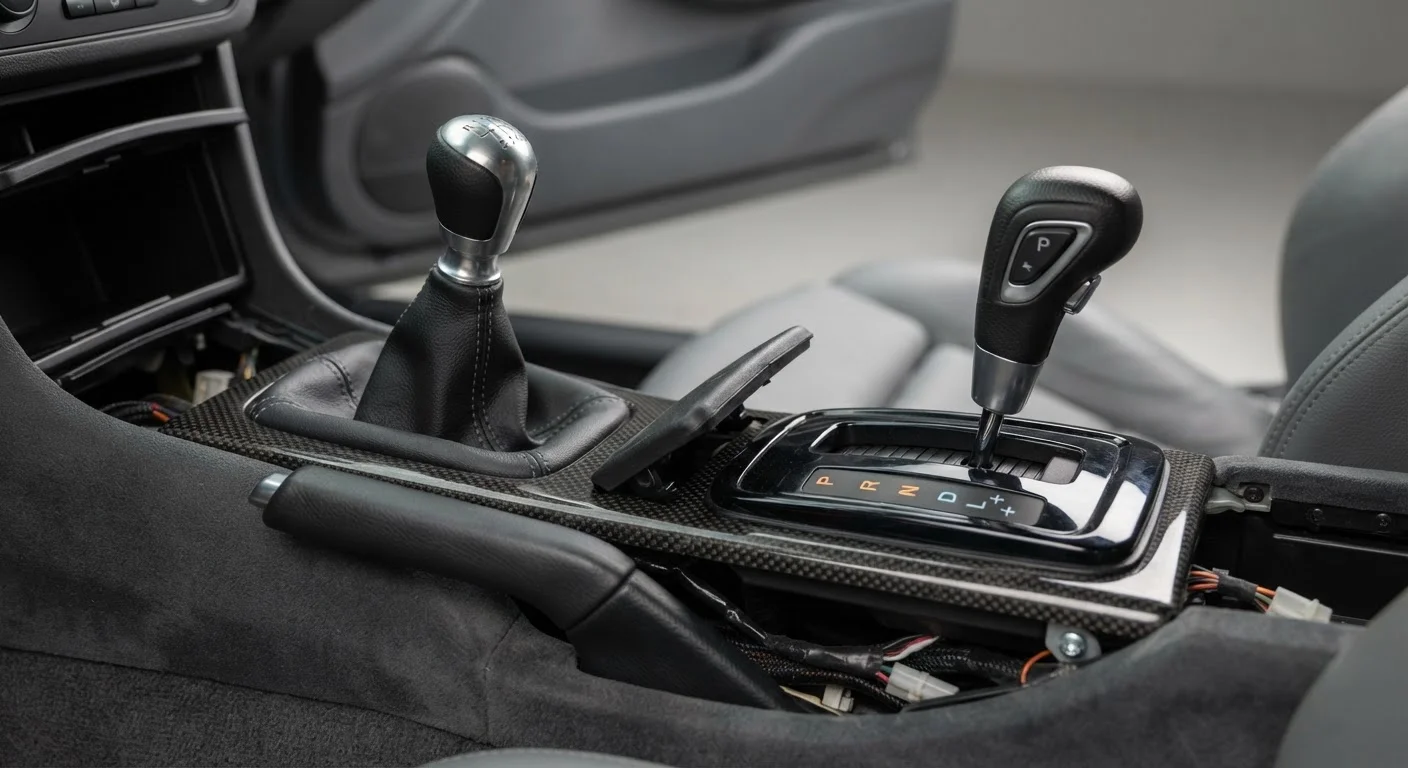
Key Takeaways
- Manual transmissions use a driver-operated clutch to engage and disengage gears mechanically.
- Automatic transmissions use a torque converter and hydraulic system to shift gears without driver input.
- Both systems accomplish the same goal: matching engine output to road speed efficiently.
- Each transmission type has distinct maintenance needs that owners should understand.
- Modern automatics have largely closed the fuel economy gap that once favored manuals.
Option A
Manual Transmission
The driver-controlled, mechanical power transfer system.
Best for: Drivers who want direct control over gear selection and are comfortable operating a clutch pedal.
Option B
Automatic Transmission
The self-managing gearbox that handles shifts independently.
Best for: Drivers who prefer a simpler driving experience, particularly in heavy traffic or on varied terrain.
If you frequently drive in stop-and-go city traffic
Automatic Transmission
Automatics eliminate the constant clutch work that heavy traffic demands, reducing driver fatigue significantly.
If you want maximum direct control over how your vehicle accelerates
Manual Transmission
Manual gearboxes let the driver choose exactly when to shift, providing precise control over engine power delivery.
If you're new to driving or prioritise ease of learning
Automatic Transmission
Without a clutch pedal to manage, automatics have a lower learning curve and are less likely to stall.
If you enjoy a mechanical connection to the driving experience
Manual Transmission
Many drivers find the tactile feedback of a clutch and gear lever more engaging and satisfying on open roads.
The Core Job of Any Transmission
An engine produces power efficiently only within a limited range of speeds, measured in RPM (revolutions per minute). A transmission's job is to act as a mechanical go-between, translating that narrow power band into the wide range of speeds a vehicle needs — from crawling in a parking lot to cruising on a highway. Both manual and automatic gearboxes accomplish this through a set of gears, but the mechanisms they use to select those gears are fundamentally different. Understanding those mechanisms helps drivers make sense of maintenance requirements, unusual sounds, and repair estimates.
For a broader look at how vehicle systems interact, the Car Maintenance hub covers the full range of components worth understanding as an owner.
How a Manual Transmission Works
A manual gearbox relies on three key components working together: the flywheel, the clutch, and the gear set. The flywheel is a heavy disc bolted to the engine's crankshaft that spins continuously while the engine runs. The clutch sits between the flywheel and the transmission input shaft.
When the driver presses the clutch pedal, a release bearing pushes against a diaphragm spring in the clutch assembly, pulling the clutch disc away from the flywheel. This disengages the engine from the transmission — power stops flowing. The driver can then move the gear lever to select a new ratio. Releasing the pedal gradually re-engages the clutch disc against the spinning flywheel, transferring power smoothly to the transmission and, ultimately, the driven wheels.
Inside the gearbox, pairs of gears of different sizes are always meshed together on parallel shafts. Moving the gear lever causes a component called a synchroniser to lock a specific gear pair to the output shaft. Each ratio multiplies or reduces engine torque (rotational force) differently — low gears multiply torque for acceleration, while high gears reduce it for efficient cruising.
| Criterion | Manual Transmission | Automatic Transmission |
|---|---|---|
| Gear selection | Driver-controlled via gear lever | Computer-controlled automatically |
| Engine-gearbox coupling | Mechanical clutch disc | Hydraulic torque converter |
| Gear arrangement | Parallel-shaft gear pairs | Planetary gear sets |
| Primary fluid | Gear oil (infrequent changes) | Transmission fluid (regular changes needed) |
| Main wear item | Clutch disc and pressure plate | Clutch packs, solenoids, fluid |
| Driver skill required | Clutch control and gear timing | Minimal — brake and accelerator only |
| Stall risk at low speed | Yes, if clutch released too quickly | No — torque converter prevents stalling |
How an Automatic Transmission Works
An automatic transmission replaces the manual clutch with a torque converter — a fluid-filled coupling that sits between the engine and the gearbox. Inside the torque converter, two sets of fan-like blades (called the pump and the turbine) face each other in a sealed housing filled with transmission fluid. The pump spins with the engine and pushes fluid against the turbine, which in turn drives the transmission. Because the connection is hydraulic rather than mechanical, the vehicle can idle in gear without stalling.
Inside the automatic gearbox itself, a planetary gear set replaces the simple parallel-shaft arrangement of a manual. A planetary set consists of a central sun gear, several planet gears orbiting around it, and an outer ring gear. By locking different elements of this set using hydraulically controlled clutch packs and brake bands, the transmission produces different gear ratios — all without the driver touching a lever.
A dedicated computer called the transmission control unit (TCU) monitors vehicle speed, throttle position, and load, then signals solenoids (electrically controlled valves) to direct hydraulic pressure and trigger the appropriate shift. This is why automatic transmissions require clean, properly filled transmission fluid — the hydraulic system depends on it entirely.
Transmission Fluid Is Not 'Lifetime'
Some vehicles are marketed with 'lifetime' automatic transmission fluid, meaning the manufacturer does not specify a change interval. However, many independent mechanics and engineers caution that fluid does degrade over time and high mileage, particularly in demanding driving conditions. Check your owner's manual and consider consulting a qualified mechanic about the appropriate service schedule for your specific vehicle and driving habits.
Key Differences and Maintenance Implications
The mechanical differences between the two systems translate directly into different maintenance needs. Manual transmissions generally use a simpler gear oil that requires infrequent changes, but the clutch disc is a wear item that will eventually need replacement — typically after many years of use, though driving habits have a significant effect. Riding the clutch (keeping partial pressure on the pedal while moving) accelerates wear considerably.
Automatic transmissions require regular transmission fluid and filter changes because the hydraulic system is sensitive to fluid degradation. Neglecting this is among the most common causes of automatic transmission problems. Always consult your vehicle's owner's manual for the manufacturer's specified service intervals — for guidance on reading that document, see what the owner's manual is actually trying to tell you.
If a mechanic's service report mentions terms like clutch pack wear, solenoid fault, or synchroniser noise, understanding the basics above makes those descriptions far less opaque. The guide on reading a mechanic's service report can help decode that language further.
It's also worth noting that modern vehicles increasingly use transmissions that blend elements of both systems — continuously variable transmissions (CVTs) and dual-clutch transmissions (DCTs) are two examples. These sit outside the traditional manual/automatic divide, and are part of a broader powertrain evolution covered in the article on EV, hybrid, and plug-in hybrid drivetrains.