

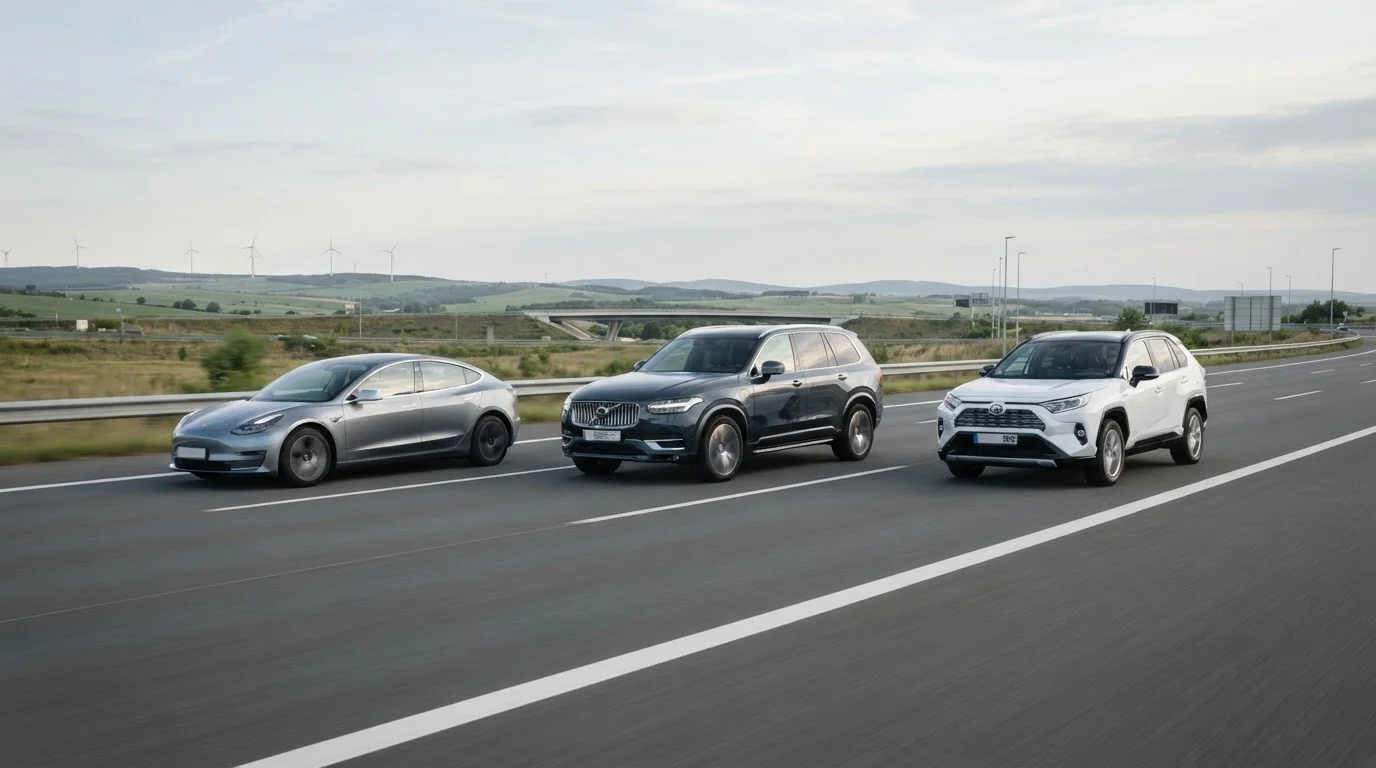
Key Takeaways
- Battery electric vehicles run solely on electricity and produce no tailpipe emissions during operation.
- Standard hybrids self-charge through regenerative braking and cannot be plugged in.
- Plug-in hybrids offer a limited all-electric range alongside a conventional gasoline engine.
- Each powertrain suits different driving habits, charging access, and range requirements.
- Understanding these differences helps drivers evaluate new car options more confidently.
Option A
Battery Electric Vehicle (BEV)
The fully electric, zero-tailpipe-emission choice.
Best for: Drivers with predictable daily routes, home charging access, and willingness to plan longer trips around charging stops.
Option B
Plug-In Hybrid (PHEV)
The bridge between combustion and full electrification.
Best for: Drivers who want electric capability for daily commutes but value the flexibility of a gasoline backup for longer or unpredictable trips.
If you charge at home and drive a predictable daily route
Battery Electric Vehicle (BEV)
A BEV eliminates fuel costs for daily driving and requires no gasoline. Home charging makes it highly convenient for commuters with consistent mileage.
If you take frequent long road trips or lack reliable charging access
Plug-In Hybrid (PHEV)
The gasoline backup removes range anxiety on long drives while the electric mode handles shorter daily trips efficiently.
If you want improved fuel economy with no charging infrastructure required
Standard Hybrid (HEV)
A conventional hybrid requires no plugs or behavior changes — it self-charges and delivers meaningful fuel savings over pure gasoline vehicles.
Three Electrified Powertrains, Three Different Philosophies
Walk into any dealership today and you'll encounter cars described as electric, hybrid, or plug-in hybrid — sometimes within the same model family. These labels reflect genuinely different engineering approaches, not just marketing tiers. Understanding what separates them is increasingly important as automakers expand electrified lineups across nearly every segment. For context on how those lineups are structured, see our guide on new car segments.
The three main categories are: Battery Electric Vehicles (BEVs), which run entirely on electricity stored in a large onboard battery; Hybrid Electric Vehicles (HEVs), which pair a gasoline engine with a small battery that self-charges through the drivetrain and braking; and Plug-In Hybrid Electric Vehicles (PHEVs), which combine a larger rechargeable battery — plugged in externally — with a conventional gasoline engine.
Each reflects a different trade-off between electrification, convenience, and range.
| Criterion | Battery Electric (BEV) | Plug-In Hybrid (PHEV) |
|---|---|---|
| Power source | Electric motor only | Electric motor + gasoline engine |
| Charging required | Yes — essential | Yes — to maximize EV range |
| Typical electric range | 150–350+ miles | 20–50 miles |
| Tailpipe emissions | None during operation | None in EV mode; present on gas |
| Refueling options | Charging only | Charging + gasoline stations |
| Best for long road trips | With charging planning | Yes — gasoline backup available |
| Self-charging capability | Regenerative braking only | Regenerative braking + plug-in |
How Each System Works Under the Hood
BEVs store energy in high-voltage battery packs — typically 50 to 100+ kWh — and power one or more electric motors that drive the wheels directly. There is no combustion engine, no exhaust pipe, and no oil changes in the traditional sense. The driving range depends entirely on battery capacity and varies significantly based on speed, temperature, and load.
Standard hybrids use a relatively small battery (often under 2 kWh) that captures kinetic energy during braking — a process called regenerative braking — and uses it to assist the gasoline engine under acceleration. The driver never plugs the car in; the system manages energy automatically. This makes HEVs one of the most seamless transitions from a conventional car.
PHEVs occupy the middle ground. Their batteries are substantially larger than a standard hybrid's — commonly 8 to 25 kWh — enabling meaningful all-electric driving ranges, generally between 20 and 50 miles depending on the model. Once that electric range is depleted, the vehicle operates like a conventional hybrid. PHEVs do require access to a charging outlet to maximize their electric capability; without regular charging, they effectively function as less efficient hybrids due to the added weight of a larger battery.
For a look at how different transmissions interact with these systems, our explainer on manual vs. automatic transmissions offers useful mechanical context.
~40 mi
Average PHEV all-electric range
The U.S. Department of Energy estimates most PHEVs offer between 20 and 50 miles of electric-only range before switching to gasoline.
3x
Growth in U.S. EV model availability
The number of electric vehicle models available in the U.S. market has grown substantially over recent years as automakers expand electrified lineups.
No plug
Standard hybrid charging requirement
Conventional HEVs require no external charging — their batteries recharge entirely through the drivetrain and regenerative braking while driving.
Real-World Implications for Drivers
The right powertrain depends heavily on where and how you drive. BEV ownership is most practical for drivers who can charge at home overnight and whose daily mileage falls comfortably within the vehicle's rated range. Range anxiety — the concern about running out of charge before reaching a charging station — remains a genuine consideration, particularly in rural areas or on long highway trips. Our related article explores why range anxiety persists and how manufacturers are responding.
PHEVs offer a practical compromise: electric driving for the daily commute, gasoline for everything beyond that. However, this benefit requires consistent charging. Drivers who rarely plug in may find the weight of the larger battery actually reduces fuel economy compared to a standard hybrid.
HEVs require no infrastructure changes whatsoever. They deliver better fuel efficiency than conventional gasoline vehicles without changing how a driver interacts with refueling. For buyers who travel frequently, live in areas with limited charging infrastructure, or simply want simplicity, the standard hybrid remains a well-established and reliable path.
Automakers are increasingly designing these powertrains on shared vehicle architectures — a topic worth understanding if you're evaluating multiple models. See our feature on platform sharing in the auto industry for more detail.
What About 'Mild Hybrids'?
Some vehicles are marketed as mild hybrids (sometimes abbreviated MHEV). These use a small battery and electric motor to assist the gasoline engine — reducing load and improving efficiency — but cannot power the vehicle on electricity alone. Mild hybrids typically offer more modest fuel economy gains than full hybrids and are generally not plug-in capable. If fuel savings are a priority, it's worth understanding where a specific model sits on the hybrid spectrum before making assumptions based on the label.