

Key Takeaways
- Start with a written list categorized by need, not habit, to avoid reflexive overpacking.
- The "one-week rule" — plan outfits, not individual items — dramatically reduces clothing volume.
- Toiletries and electronics are the two categories where travelers most consistently overpack.
- Checking luggage policies and your destination's climate before packing prevents last-minute repacking.
- A final audit pass, removing one item per category, is one of the most effective packing habits.
What you will need
Why Most Packing Advice Misses the Point
Most overpacking doesn't happen because travelers are careless — it happens because they're anxious. The instinct to prepare for every scenario leads to bags full of redundant items, speculative outfits, and products available at any convenience store. Understanding this pattern is the first step toward changing it. For a deeper look at the reasoning behind habitual overpacking, see our piece on why travelers overpack and the thinking patterns behind it.
Packing light isn't about deprivation — it's about precision. The goal is to carry exactly what the trip demands, nothing more. That means building a system based on your itinerary rather than your anxiety, and trusting that most things you forget can be managed.
Medications and Documents Come First
Before applying any packing-light strategy, set aside all prescription medications, travel documents, and any items that cannot be replaced or purchased at your destination. These are non-negotiable and should never be cut in a weight-reduction pass. Keep them in a designated, easily accessible compartment throughout your trip.
The steps below give you a repeatable framework you can apply to any trip, from a weekend city break to a two-week international itinerary.
What you will need
What You'll Need Before You Start
Having the right tools and information in place before you begin packing makes the process faster and more accurate. A few items are genuinely helpful for staying within limits and keeping your bag organized:
Packing cubes
Compress and organize clothing by category, making it easier to locate items and audit what you've packed.
Luggage scale
Verify your bag's weight before reaching the airport to avoid unexpected overweight fees.
Reusable toiletry bottles (3.4 oz / 100 ml)
Decant full-size products into travel-compliant sizes for carry-on travel, reducing both weight and volume.
Universal travel adapter
Consolidates your power needs into one compact device rather than carrying multiple country-specific adapters.
You don't need all of these to pack well, but each one solves a specific friction point that commonly derails even experienced travelers.
The Step-by-Step Packing Framework
Follow these steps in order. Each builds on the previous one, moving from strategic planning through to a final physical check. Skipping steps — particularly the audit at the end — is where most travelers revert to old habits.
Define your trip's functional demands
Before writing a single item down, spend a few minutes mapping what you will actually be doing on the trip. A beach week, a business conference, and a hiking trip have very different functional requirements. List the activities — dining out, outdoor excursions, meetings, beach days — and note any dress codes or environmental conditions. This context is your filter for every decision that follows.
Draft a categorized list before touching your bag
Write your packing list in categories: clothing, toiletries, electronics, documents, medications, and miscellaneous. Keeping items grouped prevents the common mistake of packing by memory or habit — which is one of the leading drivers of overpacking. For each category, write down everything you think you might need, then move to the next step to trim it.
Apply the outfit-planning method to clothing
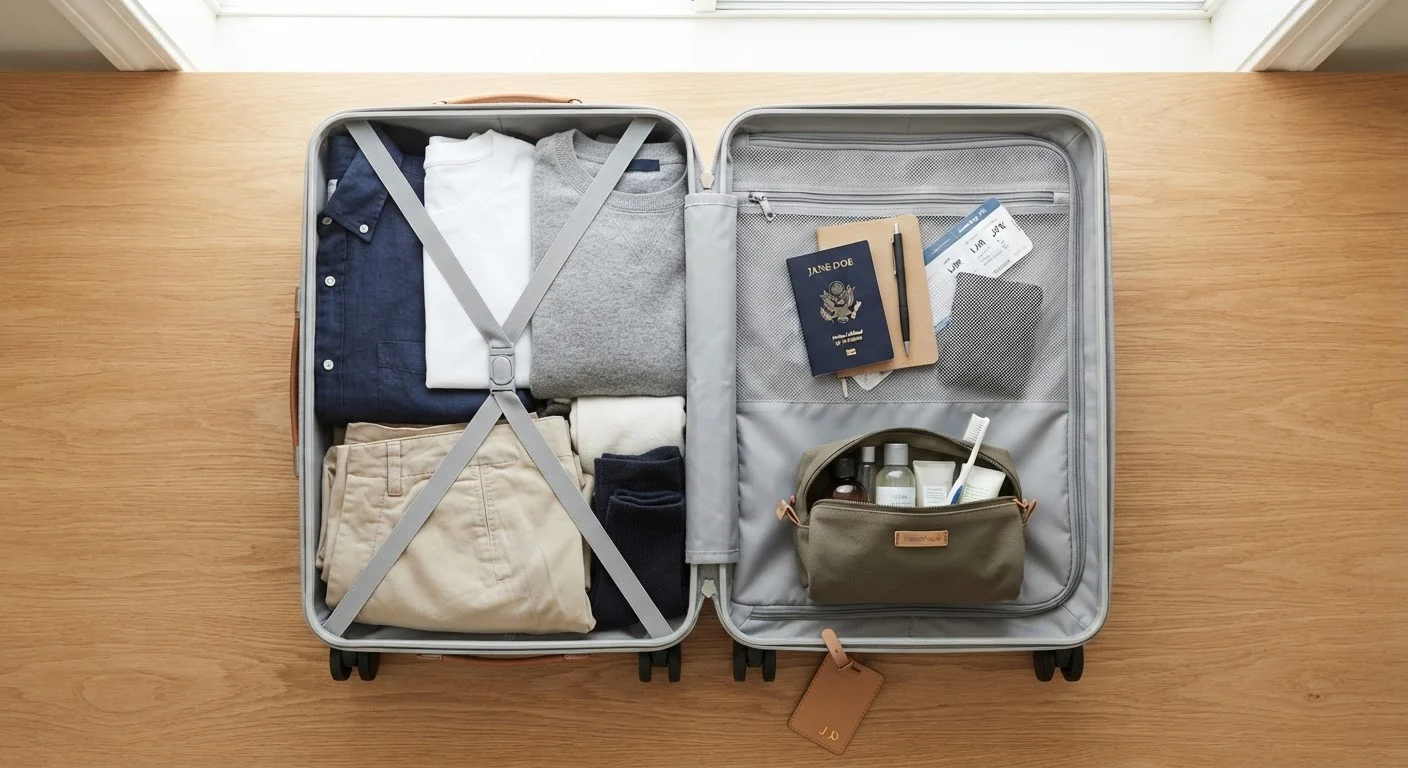
Instead of counting garments, plan complete outfits for each type of activity on your trip. Lay them out mentally or physically, then look for overlap — a pair of neutral trousers that works for both a restaurant dinner and a city walk, for example. Aim for a maximum of one outfit per day of travel, with two to three items serving double duty across different contexts. Most travelers find they need significantly fewer pieces than they initially assumed once they work from outfits rather than items.
Audit your toiletries and electronics ruthlessly
Toiletries and electronics are consistently the two heaviest categories for most travelers. For toiletries, identify what your accommodation will provide (most hotels supply shampoo, conditioner, and body wash) and eliminate duplicates. Decant only the quantity you'll realistically use — not the full bottle. For electronics, ask whether each device has a task that another item can't cover: a tablet and a laptop often serve the same purpose on leisure trips. Bring charging cables only for devices you're actually bringing.
Perform a final one-item-per-category cut
Once your bag is packed, open it and remove at least one item from each category. This deliberate constraint forces honest evaluation: if you hesitate to remove something, ask whether you would genuinely miss it or simply feel uncertain without it. Uncertainty is not the same as need. After the cut, weigh the bag if you have a luggage scale, and compare it against your carrier's limits.
Decide on carry-on versus checked based on your final load
Once your pack is finalized, confirm whether it fits within carry-on dimensions for your carrier. Traveling with only a carry-on eliminates checked baggage fees, wait times at carousels, and the risk of lost luggage — but it also requires stricter adherence to liquid rules and size limits. See our guide to choosing between carry-on and checked luggage for a full breakdown of trade-offs by trip type.
Roll, Don't Fold, for Bulky Items
Rolling clothes rather than folding them generally saves space and reduces creasing for casual items like t-shirts, jeans, and knitwear. Reserve flat folding for structured garments like blazers or dress shirts. Combining both techniques can help you fit more into the same bag without force-compressing anything.
Once your steps are complete, run through our pre-departure checklist to confirm documents, health prep, and home security are also in order before you leave.
Common Mistakes to Watch For
Even with a solid system, a few predictable errors tend to creep back in:
- Packing for the worst case, not the likely case. Pack for what you'll probably need, not the least likely scenario. Most trips don't involve dramatic weather shifts or formal events that weren't planned in advance.
- Ignoring what the destination provides. Hotels, vacation rentals, and hosts often supply towels, hair dryers, and basic toiletries. Confirm before packing these items.
- Saving the heaviest decisions for last. Shoes and outerwear should be decided early — they take up disproportionate space and weight relative to their number.
- Assuming you'll do laundry but not planning for it. If laundry access is realistic on your trip, factor it into your clothing count explicitly. If it's not, don't count on it.
Don't Rely on Buying Essentials Abroad
While it's tempting to assume you can pick up forgotten items at your destination, availability, cost, and time can all work against you — especially in smaller towns or international destinations. Items like specific medications, contact lens solutions, or specialty adapters may be hard to source. Always confirm what is genuinely available before leaving something critical behind.
For trips where you're driving rather than flying, the calculus shifts somewhat — see our road trip packing guide for where drivers most commonly miscalculate.