

Key Takeaways
- Premium cabin seats dramatically reduce physical fatigue on flights over eight hours.
- Economy class fares can cost a fraction of business class on the same route.
- Smart economy strategies — seat selection, sleep aids, light packing — close some of the comfort gap.
- The value of an upgrade depends heavily on trip purpose, duration, and personal health factors.
- Frequent flyer miles and upgrade programmes can shift the calculation significantly.
Flat-bed or near-flat seating enables genuine sleep
On routes over ten hours, the ability to lie fully horizontal significantly improves sleep quality and reduces physical fatigue upon arrival.
Substantially more personal space and privacy
Business and first class seats typically offer 50–80+ inches of pitch, wider seats, and often privacy dividers — reducing the physical and psychological stress of the flight.
Higher-quality meal service and dedicated amenities
Premium cabins generally offer multi-course meals, better beverage selection, and amenity kits with skincare and comfort items designed for long journeys.
Priority services reduce pre- and post-flight stress
Priority boarding, lounge access, and expedited baggage handling can meaningfully reduce total travel fatigue, especially on trips with connections.
Arriving more functional for work or important events
Travellers who must perform at a high level immediately after landing — for meetings, presentations, or major occasions — gain a practical advantage from better rest.
Cost difference is substantial and often prohibitive
On many transatlantic routes, business class fares can be five to ten times the price of an economy seat on the same flight, placing them out of reach for most leisure budgets.
Economy strategies close much of the comfort gap
Seat selection, compression socks, sleep masks, and noise-cancelling earbuds address the most common discomforts and make a well-prepared economy seat considerably more bearable.
Premium cabins vary widely in actual quality
Not all business class products are equal — older aircraft on some routes offer seats that are barely superior to premium economy, making research essential before assuming an upgrade is worth its price.
Cost could fund an additional trip entirely
The price difference between economy and business class on a long-haul route is often enough to cover airfare, accommodation, and activities for a separate short trip.
Shorter long-haul routes narrow the benefit
On flights of six to eight hours, the recuperative advantage of a flat bed is less pronounced than on twelve-plus-hour journeys, making the premium harder to justify financially.
Our Verdict
For most leisure travellers on a budget, a well-prepared economy seat is a reasonable choice — especially on routes under ten hours. For travellers with physical health considerations, those flying for high-stakes work, or anyone who can use miles or points to offset the cost, a premium cabin delivers genuine, tangible benefits that go beyond luxury.
Comfort class upgrades make the strongest case for frequent flyers using points, business travellers needing to arrive functional, and anyone with medical or mobility needs on very long routes.
What 'Long-Haul' Really Means for Your Body
A long-haul flight is generally defined as any journey exceeding six hours, with ultra-long-haul routes stretching beyond twelve. At these durations, sitting in a fixed position stops being merely uncomfortable and begins to carry measurable physical consequences. Reduced circulation, joint stiffness, and disrupted sleep are common across all cabin classes — but the degree to which a passenger experiences them varies considerably depending on seat design, space, and onboard amenities.
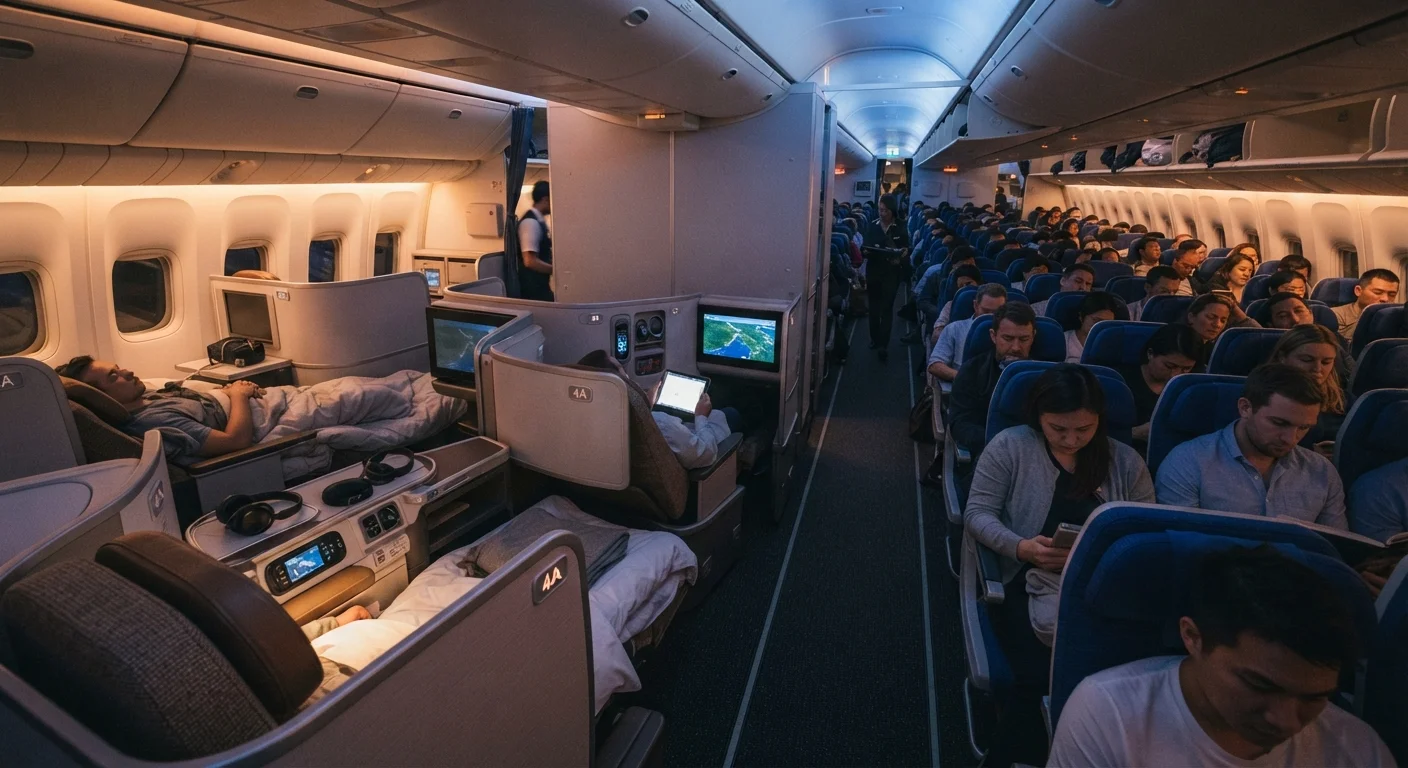
Economy seats on most wide-body aircraft offer between 30 and 32 inches of seat pitch (the distance from one point on a seat to the same point on the seat in front). Business and premium economy seats routinely offer 38 to 80-plus inches, with many full flat-bed business seats converting to a fully horizontal sleeping surface. That difference is not cosmetic — it directly affects whether you can extend your legs, shift your posture, or sleep horizontally rather than upright.
Understanding how your body responds to long travel — including the role sleep quality plays in jet lag recovery — is a useful starting point before deciding which cabin to prioritise.
The Case for Comfort: What Premium Cabins Actually Provide
Flat-bed or near-flat seating enables genuine sleep
On routes over ten hours, the ability to lie fully horizontal significantly improves sleep quality and reduces physical fatigue upon arrival.
Substantially more personal space and privacy
Business and first class seats typically offer 50–80+ inches of pitch, wider seats, and often privacy dividers — reducing the physical and psychological stress of the flight.
Higher-quality meal service and dedicated amenities
Premium cabins generally offer multi-course meals, better beverage selection, and amenity kits with skincare and comfort items designed for long journeys.
Priority services reduce pre- and post-flight stress
Priority boarding, lounge access, and expedited baggage handling can meaningfully reduce total travel fatigue, especially on trips with connections.
Arriving more functional for work or important events
Travellers who must perform at a high level immediately after landing — for meetings, presentations, or major occasions — gain a practical advantage from better rest.
Beyond the seat itself, premium cabins typically include priority boarding, enhanced meal service, dedicated lavatories, and more attentive crew-to-passenger ratios. On many airlines, business class passengers also receive lounge access before departure — a meaningful benefit on long connection layovers.
The physical recovery argument is strongest on routes exceeding ten hours. Arriving in Tokyo or Johannesburg having slept flat for seven hours is a materially different experience from arriving stiff, under-rested, and foggy after the same journey in a middle economy seat. For travellers attending important meetings, events, or family occasions immediately after landing, that difference has real-world consequences.
If you are exploring how to reduce overall trip costs while still affording a premium seat, consider reading about when to book for the best fare outcomes.
The Case for Economy: Cost, Strategy, and Making It Work
Cost difference is substantial and often prohibitive
On many transatlantic routes, business class fares can be five to ten times the price of an economy seat on the same flight, placing them out of reach for most leisure budgets.
Economy strategies close much of the comfort gap
Seat selection, compression socks, sleep masks, and noise-cancelling earbuds address the most common discomforts and make a well-prepared economy seat considerably more bearable.
Premium cabins vary widely in actual quality
Not all business class products are equal — older aircraft on some routes offer seats that are barely superior to premium economy, making research essential before assuming an upgrade is worth its price.
Cost could fund an additional trip entirely
The price difference between economy and business class on a long-haul route is often enough to cover airfare, accommodation, and activities for a separate short trip.
Shorter long-haul routes narrow the benefit
On flights of six to eight hours, the recuperative advantage of a flat bed is less pronounced than on twelve-plus-hour journeys, making the premium harder to justify financially.
Economy class on a long-haul flight need not be an ordeal if approached with preparation. Seat selection matters more than most travellers realise: bulkhead rows and exit rows offer meaningfully more legroom on many aircraft, and window seats allow you to lean against the cabin wall and sleep without being disturbed by neighbours.
Packing a lightweight travel pillow, noise-cancelling earbuds, an eye mask, and compression socks addresses the most common economy discomforts. Packing light also means carry-on only, which eliminates baggage fees that can narrow the price gap between economy and premium economy.
30–32 in
Typical economy seat pitch on wide-body jets
Most major carriers configure economy with 30–32 inches of seat pitch on long-haul wide-body aircraft, compared to 38–80+ inches in premium cabins.
5–10×
Business class fare premium over economy
On many major transatlantic and transpacific routes, business class cash fares can be five to ten times the cost of the cheapest available economy seat.
The savings from flying economy on a transatlantic or transpacific route are not trivial. On many major routes, the price difference between economy and business class can fund an entire additional trip. For travellers whose primary goal is the destination rather than the journey, redirecting that budget is a sound decision.
When the Calculation Changes
Several factors genuinely shift which choice makes more sense for an individual traveller. Frequent flyer programmes and airline credit card points can convert a prohibitively expensive business seat into a reachable redemption — sometimes at a fraction of the cash price. If you accumulate miles regularly, it is worth evaluating whether your loyalty programme delivers real value before assuming upgrades are out of reach.
Health Considerations on Long Flights
Prolonged sitting on any long-haul flight — regardless of cabin class — carries some risk of reduced circulation. General strategies such as standing periodically, staying hydrated, and wearing compression socks are widely recommended. Travellers with pre-existing circulatory conditions, recent surgery, or other relevant health factors should speak with a qualified healthcare professional before flying long-haul. This article provides general travel information, not medical advice.
Travellers with specific health conditions — including deep vein thrombosis (DVT) risk, chronic back problems, or mobility limitations — should consult a healthcare professional before any long-haul flight regardless of cabin class. Compression garments, regular movement, and hydration are general strategies; personalised guidance requires a qualified medical opinion.
Trip purpose also matters. A once-in-a-decade anniversary journey to a distant destination may justify the splurge in a way that a routine work trip does not. Conversely, a budget trip shaped around exploring an unfamiliar destination may be better served by keeping flight costs low and allocating resources on the ground.