

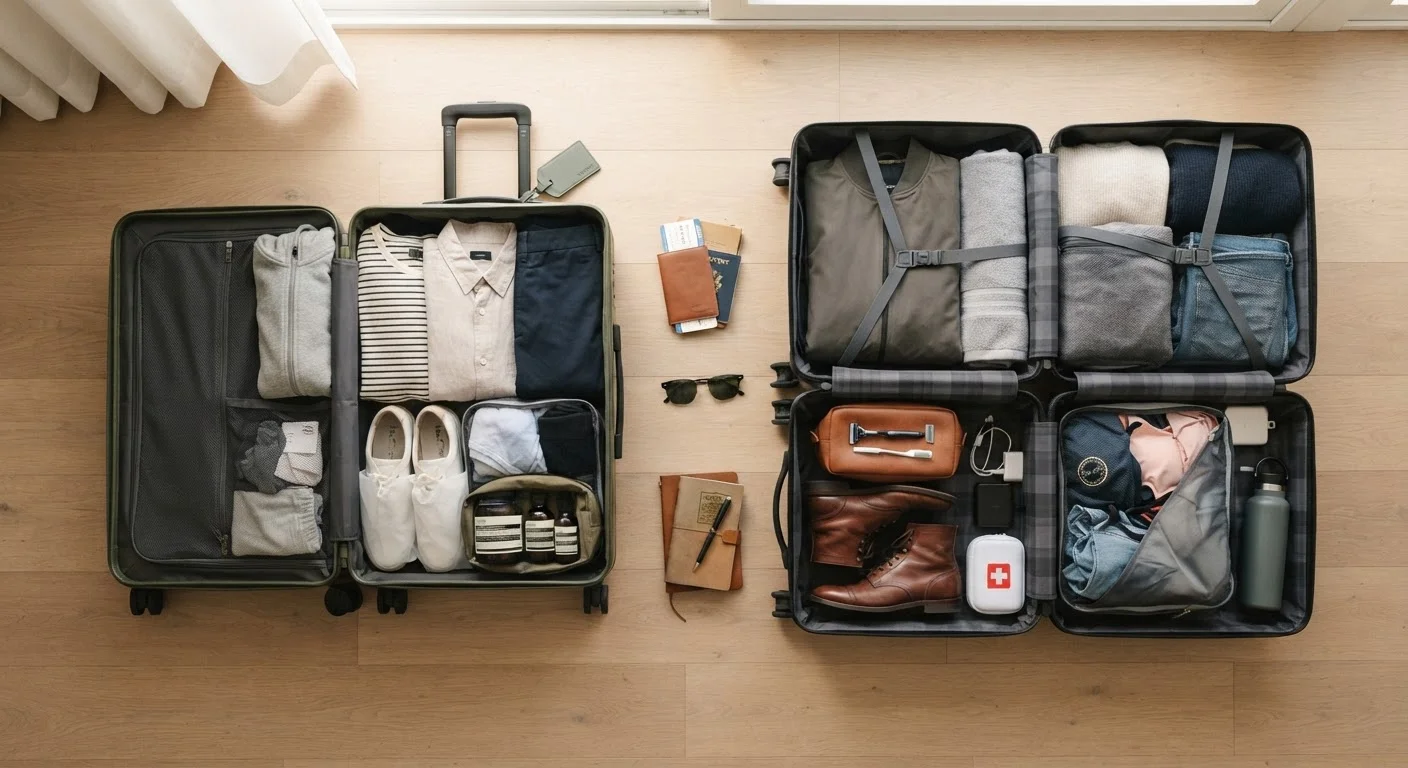
Key Takeaways
- Carry-on bags save time at the airport but restrict what you can pack, especially liquids and sharp objects.
- Checked bags offer more space and fewer restrictions, but add cost and risk of delay or loss.
- Trip length, destination type, and airline policies are the three most important factors in your decision.
- Some trips — multi-week travel, family journeys, or gear-heavy activities — genuinely require a checked bag.
- Hybrid strategies, such as a carry-on plus a personal item, can work well for medium-length trips.
Option A
Carry-On Bag
The streamlined, flexible choice for light travellers.
Best for: Short trips, frequent flyers, and anyone who wants to move quickly through airports without waiting at baggage claim.
Option B
Checked Bag
The spacious, worry-free option for longer or more complex trips.
Best for: Extended stays, family travel, or itineraries requiring formal attire, sporting gear, or restricted liquids.
If you're taking a short domestic trip of one to four nights
Carry-On Bag
A well-packed carry-on is almost always sufficient for a short trip and eliminates baggage fees and wait times entirely.
If you're travelling for more than two weeks or across multiple climates
Checked Bag
Longer trips typically require more clothing and gear than a carry-on can hold, especially if you need formal attire or weather-specific layers.
If you're travelling with young children or the whole family
Checked Bag
Children's items — strollers, formula, bulky clothing — quickly exceed carry-on limits, and checked bags reduce the burden of managing multiple small bags through a busy terminal.
If you're a frequent business traveller on predictable routes
Carry-On Bag
Speed and reliability matter most for regular travellers; carry-on bags give you full control over your luggage and keep your schedule on track.
If your trip involves adventure sports, diving, or specialized equipment
Checked Bag
Sports gear and equipment almost always exceed size or safety restrictions for carry-on luggage and must be checked — often in dedicated hard-sided cases.
What Each Option Actually Means for Your Journey
Choosing between a carry-on and a checked bag shapes your entire airport experience — from the moment you arrive to when you finally reach your destination. A carry-on bag travels in the overhead bin or under the seat in front of you. It stays with you throughout the flight and exits the plane the moment you do. A checked bag is surrendered at the airline counter or a bag-drop kiosk, loaded into the aircraft hold, and retrieved from a baggage carousel after landing.
Neither option is universally superior. Each involves genuine trade-offs in cost, convenience, and flexibility that depend heavily on the specifics of your trip. Understanding those trade-offs — rather than defaulting to habit — is what separates a smooth journey from an avoidable headache.
If you want to sharpen your overall packing strategy first, our guide on packing light without leaving essentials behind offers a practical framework for deciding exactly what to bring, regardless of which bag type you choose.
| Criterion | Carry-On Bag | Checked Bag |
|---|---|---|
| Typical cost | Usually included in fare | Fee per bag on most US carriers |
| Size limit | Airline-specific, roughly 22×14×9 in | Typically up to 62 linear inches |
| Liquid restrictions | TSA 3-1-1 rule applies | No liquid volume restriction |
| Risk of loss or delay | Very low — stays with you | Small but real risk of misrouting |
| Time at airport | Faster — no check-in queue or carousel wait | Adds check-in and retrieval time |
| Packing capacity | Limited — suits 1–4 nights typically | Spacious — suits longer or complex trips |
| Mobility between destinations | High — easy to carry and manoeuvre | Lower — bulkier through transit |
The Real Costs and Time Factors
Baggage fees are among the most visible costs in air travel today. Most major US carriers charge for checked bags on domestic routes, with fees varying by airline, fare class, and loyalty status. Carry-on bags, by contrast, are typically included in standard fares — though some budget carriers now charge for overhead-bin carry-ons as well. Always confirm your airline's specific policy when booking.
0.6%
Rate of mishandled bags globally
According to the SITA 2023 Baggage IT Insights report, the global mishandling rate for checked bags was approximately 6 per 1,000 passengers — a significant improvement from prior years but still a meaningful consideration for time-sensitive travel.
20–40 min
Typical baggage carousel wait time
Industry estimates suggest passengers commonly wait 20 to 40 minutes for checked bags at busy domestic airports, though this varies considerably by airport, airline, and time of day.
Time is the less obvious but equally real cost. Checking a bag adds steps: arriving earlier to allow for check-in, waiting at the carousel after landing (often 20–40 minutes on busy routes), and the small but non-zero risk of delayed or misdirected luggage. For a one-night trip, that overhead is hard to justify. For a two-week holiday, it barely registers.
Liquid restrictions are another practical constraint. The TSA's 3-1-1 rule limits carry-on liquids to containers of 3.4 ounces (100 ml) or less, all fitting in one quart-sized clear bag. Checked bags face no such restriction, making them the practical choice if your toiletry routine involves full-sized products or specialty items.
When to Choose a Carry-On
A carry-on strategy works best when your trip is short (generally four nights or fewer), your itinerary is point-to-point rather than multi-city, and you're travelling light enough to pack efficiently. Business travellers in particular often favour carry-ons for their speed and predictability — there's no waiting, no risk of a delayed bag derailing a tight schedule.
Carry-ons also shine on trips where you'll be moving between cities or accommodations frequently. Hauling a large checked bag through cobblestone streets or onto regional trains adds significant friction. Travelling lighter gives you more mobility and less fatigue. For ideas on reducing what you bring without sacrificing what you need, see our piece on why travellers overpack and the thinking patterns behind it.
One important caveat: on regional or small commuter aircraft, overhead bin space is often limited or unavailable. Airlines may require you to gate-check your carry-on at no charge — meaning it travels in the hold anyway. If your itinerary includes a regional connector, factor this in.
Gate-Checking on Small Aircraft
On regional or turboprop aircraft, overhead bins are often too small for standard carry-on bags. Airlines will ask you to gate-check the bag, meaning it goes into the hold and is returned to you at the jet bridge after landing — not at baggage claim. This is typically free and a normal part of regional travel, but it's worth knowing in advance so you remove any valuables or medications you'll need during the flight.
When a Checked Bag Makes More Sense
Longer trips, family travel, and gear-heavy itineraries frequently tip the scales toward checking a bag. Two weeks of clothing — especially across varying climates or dress codes — rarely fits in a carry-on without significant compromise. The same is true for any trip requiring formal wear, winter gear, or bulky footwear.
Traveling with children almost always justifies a checked bag. Between clothing changes, entertainment items, and the safety products many parents pack, the additional space is usually necessary rather than optional. Families heading on road trips have even more flexibility, since luggage goes directly in the vehicle — but air travel with kids changes the calculus entirely.
If your destination is abroad and your trip spans multiple weeks, a checked bag also simplifies the logistics of purchasing and carrying larger souvenir or gift items home. For destination-specific packing considerations, our travel destinations hub can help you think through what different regions typically require.