

Key Takeaways
- Coastal New England peaks in summer; the Gulf Coast is popular from fall through spring to avoid peak heat and hurricane season.
- New England's shore is defined by rocky headlands, tidal pools, and working fishing harbors; the Gulf is defined by wide, sandy barrier islands.
- Both coastlines offer standout seafood cultures, but the ingredients and preparations differ significantly by region.
- Water temperature varies dramatically — Gulf waters are consistently warmer and calmer for swimming than New England's cold Atlantic surf.
- Each coastline pairs well with inland experiences: New England's forests and historic towns; the Gulf's bayous, cities, and Delta culture.
Option A
Coastal New England
The rugged, historic shoreline with four-season character.
Best for: Travellers who want dramatic scenery, maritime history, seafood culture, and cooler summer temperatures.
Option B
Gulf Coast
The warm, expansive shoreline of sand, culture, and year-round sun.
Best for: Travellers seeking long stretches of beach, warm waters, and rich Southern and Creole food traditions.
If you want warm water and beach-focused relaxation
Gulf Coast
Gulf water temperatures routinely reach the mid-80s °F in summer, and the gentle surf makes swimming comfortable for all ages.
If you prefer dramatic coastal scenery and cooler weather
Coastal New England
Rocky headlands, working lighthouses, and forested bluffs give New England a rugged visual character unlike anywhere else on the East Coast.
If food and cultural immersion matter most
Gulf Coast
The Gulf region blends Creole, Cajun, and Southern traditions into a food culture — centred on cities like New Orleans — that is genuinely distinctive.
If you want a shoulder-season trip with manageable crowds
Coastal New England
September in New England offers quieter harbors, early fall foliage, and continued mild weather — a strong value for timing-conscious travellers.
If you plan to combine beach time with a road trip
Gulf Coast
The Gulf Coast Highway corridor spans multiple states and connects diverse destinations from the Florida Panhandle through Louisiana with relatively flat, easy driving.
The Landscape: What You're Actually Looking At
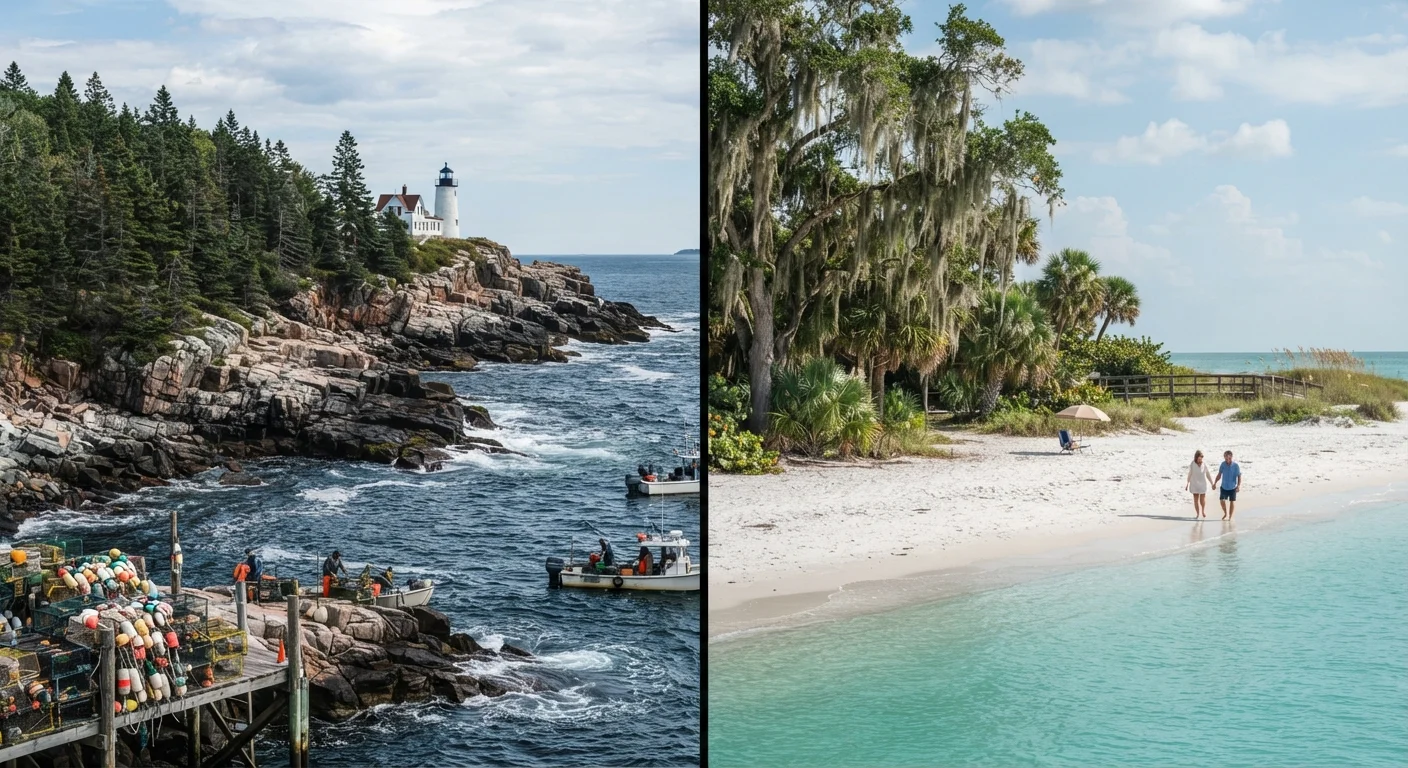
Strip away the brochure language, and these two coastlines look almost nothing alike. Coastal New England — spanning roughly from the Connecticut shore north through Maine — is characterized by glacially carved terrain. Expect granite headlands, tidal inlets, barrier beaches interrupted by rocky outcrops, dense evergreen forest meeting the waterline, and working lobster harbors where the smell of salt and rope is part of the atmosphere. The water is a deep blue-grey, and the shoreline demands exploration on foot more than from a beach chair.
The Gulf Coast tells a completely different story. From the Florida Panhandle westward through Alabama, Mississippi, Louisiana, and into Texas, the defining feature is wide, flat barrier islands with fine-grained sand — in some places almost white — and shallow, warm water that shades from aqua to green depending on the light. The terrain here is low and expansive; marshes, sea grass beds, and bayous extend inland, creating a complex coastal ecosystem that feels nothing like the granite-edged northeast.
For travellers who appreciate geology informing a sense of place, this distinction matters. New England's coast was literally shaped by glaciers; the Gulf's by river sediment, wind, and warm-water deposition. Different destinations demand different mindsets, and that's especially true here.
Climate and Timing: When to Go
Timing a coastal trip well can determine whether you leave refreshed or frustrated. On the Gulf Coast, summer months bring intense heat, high humidity, and the heightened possibility of tropical weather — hurricane season runs from June through November. Many experienced Gulf travellers prefer the October-through-April window, when temperatures are mild, crowds thin, and the water remains warm enough for swimming. Winter is genuinely pleasant along most of the Gulf corridor, which few other American beach regions can claim.
New England operates on an almost opposite calendar. The coast comes alive from late June through early September; water temperatures peak at around 60–68 °F in midsummer off Maine, warmer on Cape Cod and the Rhode Island shore. Outside that window, coastal New England can be raw and grey — appealing in its own right for certain travellers, but not the warm-beach experience many visitors expect. September earns particular praise for fewer crowds and the earliest hints of foliage visible from coastal trails.
| Criterion | Coastal New England | Gulf Coast |
|---|---|---|
| Peak travel season | Late June – September | October – April |
| Average summer water temp | 60–68 °F (Maine to Cape Cod) | 82–86 °F |
| Beach type | Rocky headlands, mixed sand and stone | Wide, flat, fine-grained sand |
| Surf conditions | Moderate Atlantic swell | Generally calm, low surf |
| Signature seafood | Lobster, clam chowder, fried clams | Crawfish, shrimp étouffée, chargrilled oysters |
| Hurricane risk | Low to moderate | Moderate to high (June–November) |
| Cultural anchors | Maritime history, colonial towns | Creole/Cajun culture, jazz, bayou ecology |
Seafood Culture: Similar Menus, Completely Different Flavours
Both coastlines take seafood seriously, but the resemblance stops there. New England's seafood identity is built around a handful of iconic preparations: whole steamed lobster, clam chowder (the cream-based style that New Englanders are emphatic about), fried clams, steamed mussels, and oysters from cold, clean estuaries. The cooking is often simple by design — quality shellfish from cold water is the point, and the best preparations get out of its way. A lobster shack on the Maine coast with picnic tables and newspaper-lined trays is a genuine cultural institution, not a tourist gimmick.
Gulf Coast seafood is bolder and more complex in seasoning. Cajun and Creole traditions — rooted in French, West African, Spanish, and Indigenous cooking — produce dishes like crawfish étouffée, shrimp and grits, Gulf oysters chargrilled with butter and garlic, and gumbo layered with file powder and andouille sausage. New Orleans anchors this tradition, but the culinary culture spreads across the region. The American South as a travel destination offers important context for understanding how deep this food culture runs.
A Note on Sustainable Seafood Choices
Both regions have faced fishing pressure over the decades. When dining, look for menus that note locally sourced or sustainably harvested seafood. In New England, farmed oysters and mussels are generally considered low-impact choices. On the Gulf, wild-caught Gulf shrimp from domestic boats has a different environmental profile than imported farmed shrimp. Asking questions at local restaurants is both acceptable and appreciated in most coastal communities.
Beyond the Shore: What Each Region Offers Inland
Neither coastline is best understood in isolation from its hinterland. In New England, coastal towns sit within easy reach of forested state parks, Revolutionary-era historic districts, college towns, and mountain terrain in Vermont and New Hampshire. A week-long trip might combine lighthouse trails on the Maine coast with a ferry to a car-free island, a day in a former whaling port, and a night in a harbor inn. The region rewards slower, more deliberate travel — stopping longer in fewer places tends to reveal more than rushed itineraries.
The Gulf region opens onto bayou country, river delta landscapes, jazz history, civil rights history, and one of America's most layered cities in New Orleans. A Gulf Coast road trip connecting Pensacola's white-sand beaches through Biloxi, New Orleans, and on toward Galveston gives travellers a genuine range of ecosystems and cultural registers within a single drive. Those interested in natural spaces will find the Gulf's national seashores and wildlife refuges worth building into any itinerary — much as national parks reward visitors who look beyond the obvious.
~3,500 mi
Gulf of Mexico U.S. coastline length
According to NOAA, the U.S. Gulf Coast spans approximately 3,500 miles of shoreline across five states.
~5,600 mi
New England tidal shoreline (Maine alone)
Maine's tidal shoreline — including its thousands of islands and inlets — is estimated by NOAA at roughly 5,600 miles, illustrating the coast's complex, irregular character.
~$1.5B
Annual U.S. lobster industry value
The American lobster fishery, centered in New England, has been valued at over one billion dollars annually in recent years, according to NOAA Fisheries landing reports.