

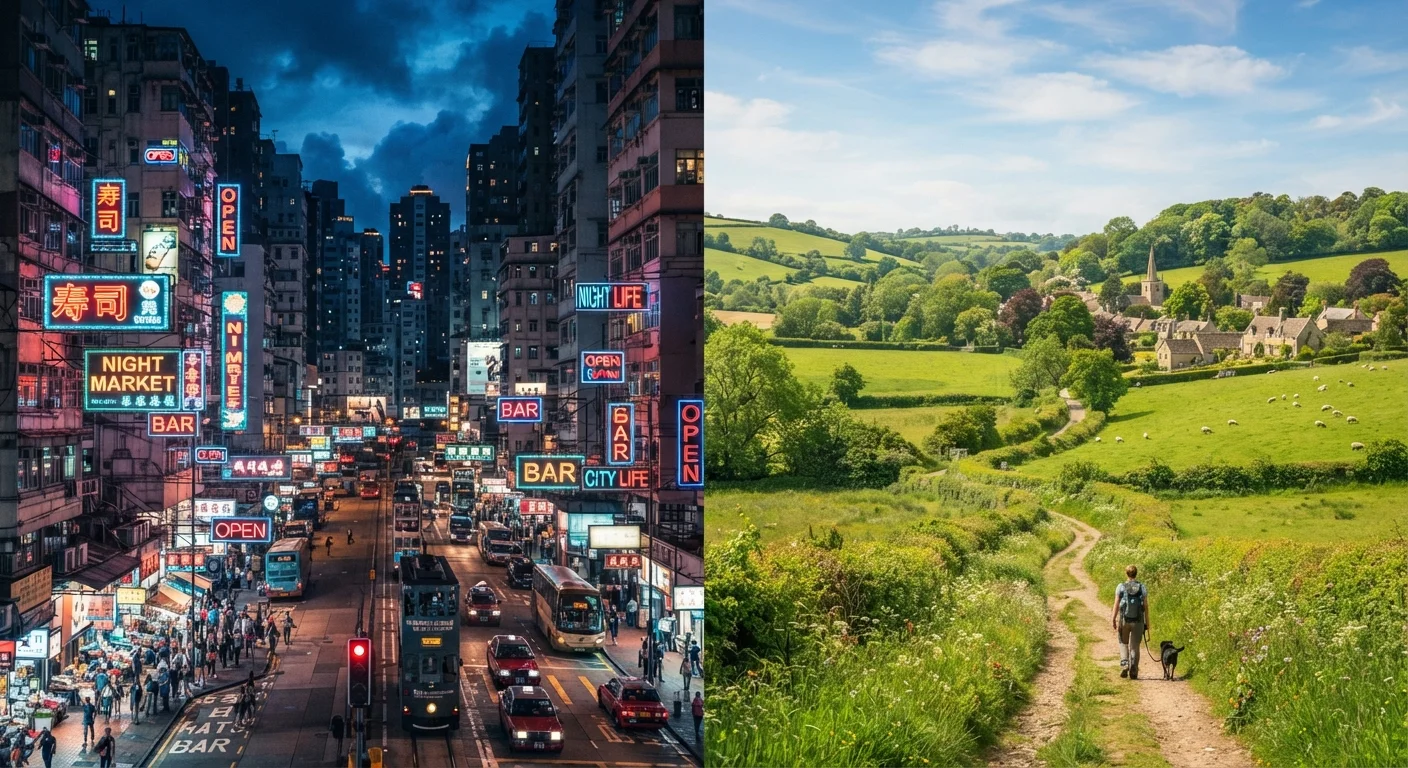
Key Takeaways
- Urban trips reward advance planning: bookings, transit research, and itinerary timing matter far more in cities.
- Rural destinations often require self-sufficiency — fuel, connectivity, and supplies can be scarce.
- Pacing and expectations differ fundamentally between city breaks and countryside travel.
- Neither style is inherently better; the right choice depends on what you genuinely need from the trip.
- Safety and research considerations shift significantly depending on which environment you choose.
Our Verdict
Urban and rural trips are not simply different backdrops — they impose genuinely different demands on your planning, budget, flexibility, and mindset. Cities offer infrastructure and density of experience at the cost of crowds, noise, and logistical complexity. Rural destinations offer space and authenticity at the cost of convenience and connectivity. Understanding what each asks of you before you commit is the most useful planning step you can take.
| Best for | Recommended |
|---|---|
| Travelers who want cultural density and structured itineraries | Urban destinations |
| Those seeking solitude, nature, and a slower pace | Rural destinations |
| First-time travelers or those without a vehicle | Urban destinations |
| Road trippers comfortable with self-sufficient travel | Rural destinations |
The Core Difference in What Each Trip Asks
Choosing between a city and a countryside destination isn't just an aesthetic preference — it's a practical decision that reshapes almost every aspect of your trip. Urban travel rewards those who plan ahead, move efficiently, and can navigate crowded, fast-moving environments. Rural travel rewards patience, flexibility, and a willingness to be genuinely out of reach.
For a deeper look at how travel philosophy shapes these choices, see our comparison of city breaks and slow travel. This article focuses on something more concrete: the practical demands each setting places on you before and during the trip.
| Urban Destinations | Rural Destinations | |
|---|---|---|
| Advance booking necessity | High — accommodation and attractions fill quickly | Moderate — but operating seasons matter more |
| Transportation requirements | Public transit or rideshare usually viable | Personal vehicle typically essential |
| Connectivity | Reliable Wi-Fi and cell service expected | Spotty or absent; offline prep required |
| Self-sufficiency needed | Low — services are dense and available | High — supplies and fuel must be planned |
| Budget predictability | Lower — tourist pricing and fees vary widely | Moderate — fewer options but fewer surprises |
| Pace and stimulation | Fast-paced; high sensory input | Slow; requires comfort with quiet |
What Urban Destinations Demand
Cities are information-rich environments that require a relatively high level of pre-trip organization. Accommodation in desirable neighborhoods often books out weeks or months in advance, especially in major metropolitan areas. Transit systems — subways, buses, rideshares — can be efficient but disorienting until you learn the local logic. Peak hours, crowded attractions, and variable neighborhood safety all benefit from research before you arrive.
Budgeting in cities also tends to be less predictable. Food, transport, and entry fees can add up quickly, and tourist-heavy zones often carry premium pricing. Understanding which neighborhoods are walkable, which attractions require timed entry passes, and what local transit options exist will make a material difference to your experience. Our guide to researching destinations responsibly covers how to evaluate sources and verify conditions before you travel.
Research Neighborhoods, Not Just Cities
Major cities contain multitudes — a single metropolitan area can have neighborhoods that feel completely different in terms of pace, pricing, and safety. Before booking accommodation, look at district-level reviews and transit access rather than treating the city as a uniform destination. This is especially important if you are visiting a city for the first time.
What Rural Destinations Demand
Rural travel is a different kind of discipline. The planning burden shifts from logistics to self-sufficiency. Cell service may be unreliable or absent entirely, so downloading offline maps before departure is essential. Gas stations, pharmacies, and grocery stores may be few and far between — knowing where your next fuel stop is can be a genuine safety issue, not just an inconvenience.
Accommodation in rural areas varies widely, from established campgrounds and lodges to smaller inns with limited online presence. Verifying cancellation policies, confirming operating seasons, and calling ahead is often more necessary than in urban settings. For road trippers planning overnight stops, our guide to overnight stays on a road trip covers what to verify in advance. Weather and terrain can also shift rapidly in wilderness or remote areas — check official sources and local advisories before heading out.
Don't Rely Solely on Digital Maps in Remote Areas
GPS and mapping apps can lose signal or display outdated road information in remote rural areas. Download offline maps before departure and consider carrying a printed backup for truly isolated routes. Always inform someone of your planned route and expected return time when heading into wilderness or low-connectivity terrain.
Pacing, Expectations, and the Right Mindset
Urban travelers often fall into the trap of over-scheduling. A city with dozens of museums and neighborhoods can feel like an obligation rather than an experience when every hour is mapped out. Building in unstructured time — time to wander, eat somewhere unplanned, or simply sit in a public square — tends to produce more satisfying trips than a packed itinerary.
Rural travelers, conversely, sometimes underestimate how much open space and quiet can feel unfamiliar. Slow days, limited stimulation, and the absence of on-demand entertainment are features of countryside travel, not failures of planning. If that sounds appealing, it probably is your trip. If it sounds stressful, that's useful information too.
Spontaneity is more workable in some rural contexts than others — our balanced look at spontaneous road trips examines when flexibility is genuinely freeing and when it creates real risk. Urban spontaneity tends to be lower-stakes because the infrastructure exists to course-correct; rural spontaneity requires more fallback planning.
Whichever setting you choose, matching your expectations to what that environment actually delivers — rather than an idealized version of it — is the single most reliable predictor of a satisfying trip. For broader travel tips across both settings, our travel tips hub offers practical, up-to-date guidance.
57%
US adults who prefer nature-based vacations
According to an American Express Travel survey, more than half of US travelers express preference for outdoor or nature-focused trips when given a choice.
3x
Higher cost of urban tourist-zone dining
Travel budget researchers have generally found that meals in major tourist districts of US cities can cost two to three times the local average.