

Key Takeaways
- Free app tiers are often deliberately limited to nudge users toward paid upgrades.
- Paid plans are worth it when an app saves measurable time or replaces a more expensive tool.
- Ads, data collection, and storage caps are the most common trade-offs in free tiers.
- Stacking multiple paid subscriptions adds up faster than most users anticipate.
- Evaluating actual usage before upgrading is the most reliable way to justify the cost.
Zero financial risk to try the core product
Free tiers let users evaluate whether an app fits their workflow before spending anything, which reduces the risk of paying for something that doesn't meet their needs.
Functional enough for light or infrequent use
Many free tiers genuinely cover occasional users — a note-taking app with a modest storage limit, for example, may fully satisfy someone who doesn't rely on it daily.
Paid plans often replace more expensive alternatives
A paid subscription to a design platform may cost less monthly than hiring the equivalent task out or purchasing standalone software licenses.
Upgrades tend to remove the most disruptive free-tier limits
Paid plans typically eliminate ads, increase storage, and unlock export or sharing features — which are often the exact pain points that prompted the upgrade.
Annual billing usually reduces the per-month cost
Most platforms offer a discount for paying annually, which can make a paid plan more cost-effective for users who know they'll use the app consistently.
Free tiers are engineered to frustrate at key moments
Feature limits are deliberately placed at high-value actions — exporting, sharing, or scaling up — creating friction that nudges users toward upgrading rather than reflecting a neutral design decision.
Ad-supported free tiers collect behavioral data
Most advertising-funded apps generate revenue by sharing user activity data with ad networks, meaning the product is partially funded by the user's privacy rather than their wallet.
Support and reliability are typically second-tier for free users
Free users often receive slower, lower-quality customer support, and may be the first affected by performance throttling during peak demand.
Storage and usage caps reset or expire unexpectedly
Some apps impose rolling monthly quotas rather than fixed caps, which can cut off access mid-task when a usage limit resets on a calendar cycle the user isn't tracking.
Paid subscriptions are easier to start than to cancel
Cancellation flows are frequently buried or require contacting support directly, which is a deliberate design choice that increases passive subscriber retention.
Annual commitments reduce flexibility if the app stops being useful
Locking in annual billing for a discount can backfire if needs change mid-year, since most platforms do not offer prorated refunds after a short cancellation window.
Our Verdict
Free tiers are genuinely useful for light or infrequent use, but they are engineered with limits that surface quickly for anyone relying on an app daily. Paid plans deliver real value when the features unlocked align with a specific, recurring need — not when the upgrade is triggered by frustration alone. The smartest approach is to audit what you actually use before spending.
Readers who want to make deliberate, informed decisions about which apps genuinely justify a paid plan — and which free tiers are good enough.
How the Freemium Model Is Designed to Work
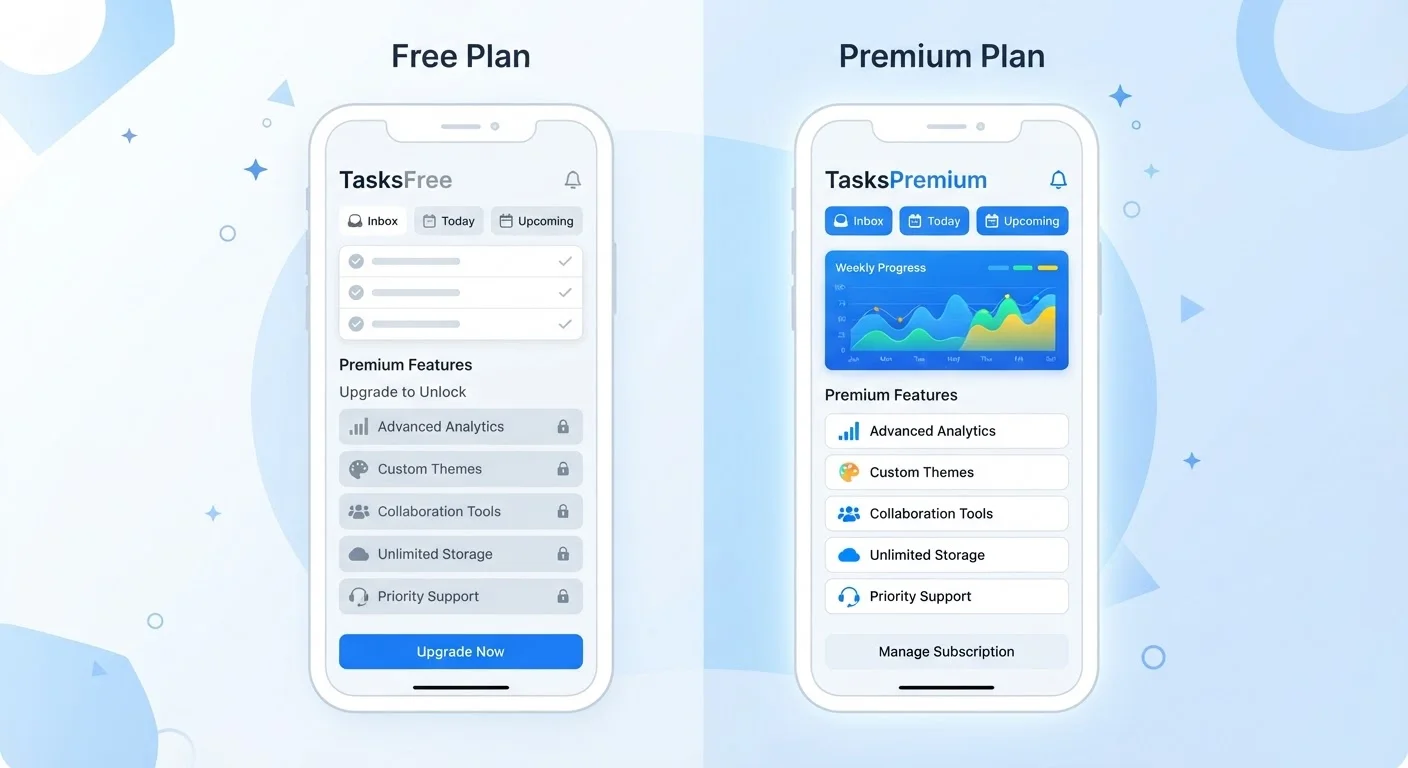
The freemium model — offering a free tier alongside paid upgrades — is now the dominant distribution strategy for consumer software. The basic logic is straightforward: lower the barrier to entry so users can experience the product, then limit enough features that a meaningful percentage convert to paying subscribers.
What matters for consumers is understanding that free tiers are not generous gifts — they are calibrated marketing tools. Developers study exactly which features to withhold to maximize conversion without driving users away. That calibration means free tiers can be genuinely useful, but they are rarely complete.
Annual vs. Monthly Billing: A Key Decision Point
Most platforms offer a meaningful discount — often 15–40% — for paying annually rather than monthly. This makes sense if you're confident you'll use the app consistently, but it removes flexibility. If you're still evaluating an app, starting on monthly billing and switching to annual once you're certain is a lower-risk approach. Always check the cancellation and refund policy before committing to an annual plan.
Common freemium limits fall into a few predictable categories: storage caps (cloud and productivity apps), usage quotas (AI tools, design platforms), feature gates (collaboration, export formats), and advertising (most consumer apps and games). Knowing which type of limit a specific app imposes helps you predict whether the free tier will meet your needs long-term.
What You're Actually Trading Away on a Free Plan
The most visible cost of a free tier is reduced functionality, but there are less obvious trade-offs worth understanding.
Free tiers are engineered to frustrate at key moments
Feature limits are deliberately placed at high-value actions — exporting, sharing, or scaling up — creating friction that nudges users toward upgrading rather than reflecting a neutral design decision.
Ad-supported free tiers collect behavioral data
Most advertising-funded apps generate revenue by sharing user activity data with ad networks, meaning the product is partially funded by the user's privacy rather than their wallet.
Support and reliability are typically second-tier for free users
Free users often receive slower, lower-quality customer support, and may be the first affected by performance throttling during peak demand.
Storage and usage caps reset or expire unexpectedly
Some apps impose rolling monthly quotas rather than fixed caps, which can cut off access mid-task when a usage limit resets on a calendar cycle the user isn't tracking.
Paid subscriptions are easier to start than to cancel
Cancellation flows are frequently buried or require contacting support directly, which is a deliberate design choice that increases passive subscriber retention.
Annual commitments reduce flexibility if the app stops being useful
Locking in annual billing for a discount can backfire if needs change mid-year, since most platforms do not offer prorated refunds after a short cancellation window.
Advertising is the most prevalent. Free apps in categories like news, music, and productivity routinely show ads, and those ads are often targeted using behavioral data collected within the app itself. If privacy is a concern, it's worth reading the app's data policy — free tiers frequently fund themselves through data sharing arrangements. See our guide to app permissions for a plain-language breakdown of what data apps can access.
Support access is another quiet casualty. Many platforms offer priority or live support only to paid users, leaving free-tier users dependent on community forums or automated help systems.
Where Paid Plans Deliver Real Value
Paid upgrades are most defensible when they unlock capability that directly replaces something else you'd pay for, or when they eliminate friction that costs you time. Collaboration features in productivity apps, unlimited cloud storage, and offline access are examples where the paid tier frequently changes how useful a tool actually is in practice.
Zero financial risk to try the core product
Free tiers let users evaluate whether an app fits their workflow before spending anything, which reduces the risk of paying for something that doesn't meet their needs.
Functional enough for light or infrequent use
Many free tiers genuinely cover occasional users — a note-taking app with a modest storage limit, for example, may fully satisfy someone who doesn't rely on it daily.
Paid plans often replace more expensive alternatives
A paid subscription to a design platform may cost less monthly than hiring the equivalent task out or purchasing standalone software licenses.
Upgrades tend to remove the most disruptive free-tier limits
Paid plans typically eliminate ads, increase storage, and unlock export or sharing features — which are often the exact pain points that prompted the upgrade.
Annual billing usually reduces the per-month cost
Most platforms offer a discount for paying annually, which can make a paid plan more cost-effective for users who know they'll use the app consistently.
The category matters significantly. For creative tools — video editing, graphic design, music production — free tiers often omit export quality or watermark outputs, making the free version impractical for any professional use. For personal finance apps, digital money management tools often gate budgeting insights or account sync behind a paywall, which is precisely the functionality that differentiates useful from decorative.
~5%
Typical freemium-to-paid conversion rate
Industry analyses of freemium software models consistently find that roughly 2–5% of free users convert to paid plans, meaning free tiers must serve a large audience to fund development.
2–3x
Underestimation of monthly subscription spend
Research into consumer spending perception suggests people routinely underestimate their total subscription costs by a factor of two to three when asked to recall them without checking bank statements.
The Subscription Stack Problem
One paid app subscription is rarely the issue. The problem emerges when three, five, or eight apps each charge a modest monthly fee. The cumulative effect is a recurring budget line that most users underestimate because each individual charge feels small at the time of signing up.
This is a well-documented behavioral pattern — small, recurring charges are cognitively processed differently from single large purchases, which is partly why subscription pricing became so prevalent. If you've noticed this in your own spending, understanding how subscriptions accumulate is a useful place to start thinking more deliberately about the total picture. Periodic audits — reviewing which paid apps you've actually opened in the last 30 days — tend to surface redundancies and forgotten renewals. Our subscription audit framework offers a structured way to run that review. And if you decide to cancel, check our pre-deletion checklist to avoid losing data or triggering unexpected charges.