
The First Year with a Rescue Dog: Understanding Fear, Regression, and Trust-Building

Key Takeaways
- Rescue dogs carry stress from past experiences that directly shapes their behaviour in a new home.
- Most dogs go through identifiable settling stages — understanding them prevents misreading normal adjustment as a personality problem.
- Regression is common and temporary; it signals stress, not stubbornness or failure.
- Consistent, low-pressure routines are the single most powerful trust-building tool available to owners.
- Some fear-based behaviours require guidance from a certified professional, not just patience.
Start here
Why Rescue Dogs Behave Differently
Next
The Three Stages of Settling In
Go deeper
Understanding Fear Responses and Regression
Apply it
How to Build Trust Effectively
When you're ready
When to Seek Professional Help
Why Rescue Dogs Behave Differently
When a dog arrives from a shelter, foster home, or rescue situation, they are not starting from a clean slate. Their nervous system has already been shaped — by early socialisation (or the lack of it), by previous living conditions, by loss, by confinement, and by repeated rehoming. Understanding this is the essential foundation for everything that follows.
From a neurological standpoint, chronic stress alters the way the brain processes threat. A dog that has lived with unpredictability learns to scan constantly for danger. This hypervigilance is an adaptive survival response — it was useful in an unstable past environment. In your calm home, it can look like skittishness, excessive barking, destructive behaviour, or withdrawal. None of these are personality flaws. They are the residue of a nervous system doing exactly what it learned to do.
For a broader foundation on bringing any new pet home, see our New Pet Owner's Complete Starting Point. And for dogs who missed critical early experiences, our article on socialisation windows in puppies explains the developmental science behind long-lasting behavioural patterns.
Hypervigilance
A state of heightened alertness where the brain constantly scans for threats. In rescue dogs, it's a learned survival response from an unpredictable past, not an inherent personality trait.
Regression
A temporary return to earlier fearful or problematic behaviours after a period of improvement. It's a normal stress response and doesn't erase previous progress.
Decompression period
The initial time — often weeks to months — a rescue dog needs to simply exist without pressure, allowing their nervous system to downregulate after the stress of shelter life or rehoming.
Positive reinforcement
A training approach where desired behaviours are rewarded, making them more likely to be repeated. For fearful dogs, it builds confidence without adding pressure or fear.
Fight-flight-freeze-fidget
The four primary ways dogs (and other animals) respond to perceived threats. Understanding which response your dog defaults to helps you interpret and de-escalate fearful situations.
Certified veterinary behaviourist
A veterinarian with advanced specialist training in animal behaviour, qualified to diagnose and treat complex behavioural conditions, including prescribing behavioural medication when appropriate.
The Three Stages of Settling In
Rescue communities often reference the 3-3-3 framework as a rough guide to how dogs typically adjust. While not a rigid timeline, it reflects real patterns that many owners and behaviourists observe:
- First 3 days: The dog is overwhelmed and likely shut down or hyperactive. They may not eat, explore, or interact normally. This is acute stress — not character.
- First 3 weeks: Routine starts to register. The dog begins testing boundaries, showing more of their actual personality — including any problem behaviours that were suppressed during initial shutdown.
- First 3 months: Genuine attachment and security begin to develop. Most dogs become substantially more relaxed, though specific fears may still surface.
One critical insight: the behaviours that emerge at the 3-week mark often alarm owners who expected steady improvement. In reality, a dog that begins acting out is a dog that now feels safe enough to show you who they are. That's progress, even when it doesn't feel like it.
Give 'Doing Nothing' Its Due
Many new rescue owners feel pressure to enrich, socialise, and stimulate their dog immediately. In the first weeks, the most valuable thing you can offer is simply a calm, safe space with no demands. Letting a dog rest, observe, and decompress without expectation is not wasted time — it's essential neurological recovery.
Understanding Fear Responses and Regression
Fear in dogs is expressed through four broad responses: fight, flight, freeze, and fidget (also called the fawn or appeasement response). A rescue dog may cycle through all of these depending on context. Recognising which response your dog defaults to helps you respond appropriately rather than accidentally escalating the situation.
Regression — when a dog who seemed to be improving suddenly reverts to earlier fearful behaviours — is one of the most discouraging experiences for new rescue owners. It's important to understand that regression is normal and expected, not a sign that the dog is broken or that your efforts have failed. The brain doesn't learn in a straight line; stress temporarily disrupts recently formed patterns, making old responses resurface.
Common regression triggers include a change in the owner's schedule, a visitor the dog doesn't know, a loud weather event, a vet visit, or even something as subtle as furniture being rearranged. When regression happens, the appropriate response is to simplify the environment, reduce demands, and return to the basics that initially built comfort.
Don't Mistake Shutdown for Calm
A rescue dog that seems eerily quiet and compliant in the first few days is often not relaxed — they are shut down, meaning their stress response has suppressed outward behaviour. This can be mistaken for a perfectly settled dog. Watch instead for genuine relaxation signals: loose body posture, soft eyes, voluntary approach, and a healthy appetite.
How to Build Trust Effectively
Trust is not built through affection alone — it's built through predictability. A rescue dog's nervous system is tuned to detect inconsistency. What signals safety most powerfully is a home where the same things happen at roughly the same times, where the owner's behaviour is calm and readable, and where nothing scary happens without warning or comfort.
Practical trust-building strategies include:
- Establish a routine — consistent feeding, walking, and rest times create a sense of order that directly reduces anxiety.
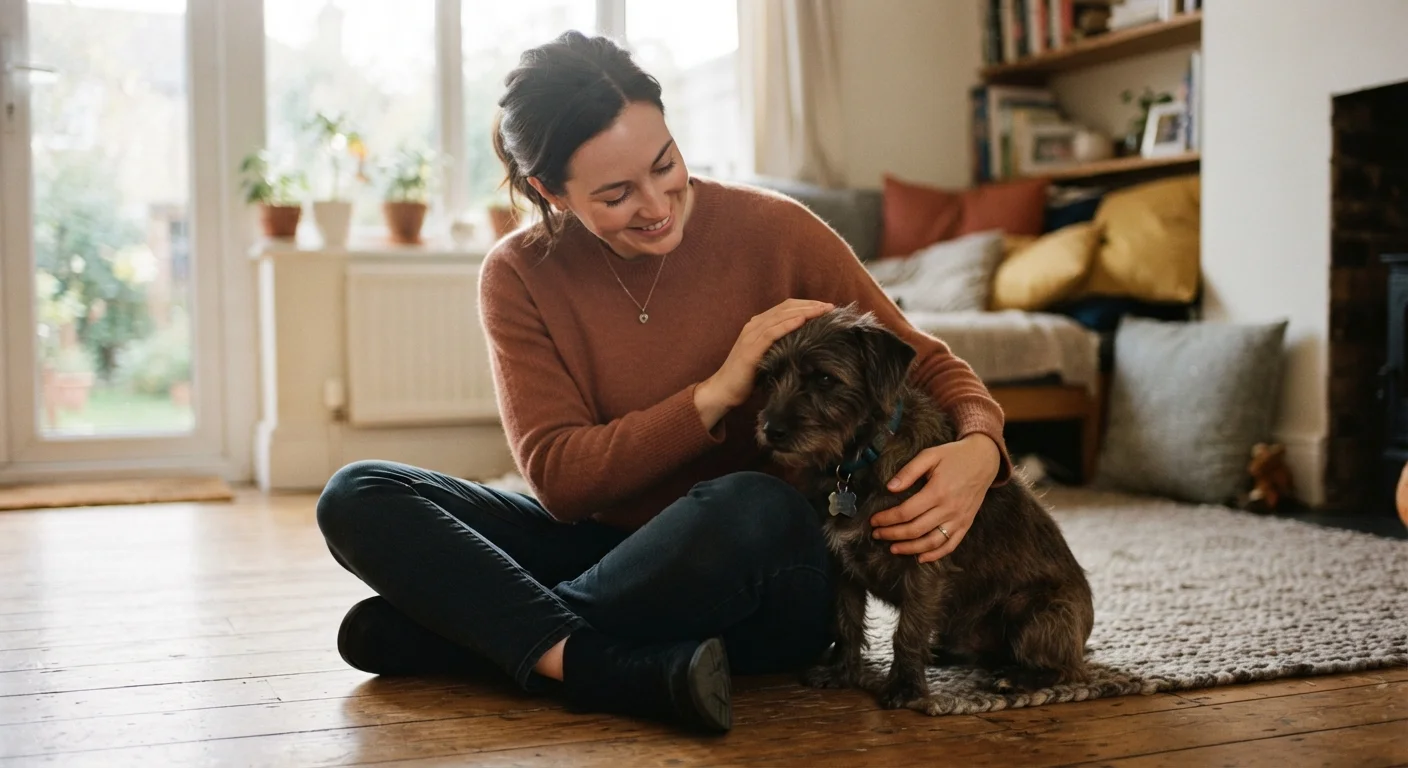
- Let the dog set the pace for contact — avoid forcing petting or picking up. Allow the dog to approach you and withdraw freely. This gives them control, which is calming for a previously uncontrolled life.
- Use positive reinforcement consistently — reward calm, curious, and sociable behaviours. Understanding your dog's motivational profile (whether food, play, or praise drives them most) makes this more effective. See our guide on motivational profiles in dogs for a practical framework.
- Limit overwhelming stimulation early on — busy parks, large gatherings, and unfamiliar dogs should be introduced gradually, not immediately.
For a wider set of daily habits that support long-term behavioural wellbeing, our article on building a calm, confident pet offers evidence-informed guidance any owner can implement.
When to Seek Professional Help
Patience and consistency resolve a great deal — but some rescue dogs carry trauma or anxiety that goes beyond what a loving home alone can address. Recognising when to bring in a professional is not a failure; it's responsible ownership.
Consider consulting a certified veterinary behaviourist or a certified professional dog trainer (CPDT-KA) if your dog:
- Shows aggression — growling, snapping, or biting — toward people or animals
- Experiences panic episodes that interfere with eating, sleeping, or basic functioning
- Has made no measurable progress after three to four months in a stable home
- Displays extreme separation distress that disrupts daily life
A veterinarian should also be involved, as some fearful or erratic behaviours have underlying medical causes, including pain or neurological conditions. Behavioural medication is sometimes part of a broader treatment plan and can make a meaningful difference in a dog's quality of life when appropriately prescribed. This is a clinical decision that belongs with a licensed veterinary professional.
The first year with a rescue dog is rarely linear. But for owners who commit to understanding their dog's signals and responding with patience and structure, genuine transformation is genuinely possible.
This article is for general informational purposes only and does not constitute veterinary or behavioural advice. If your dog is showing signs of significant distress or aggression, consult a licensed veterinary professional.