
Socialisation Windows in Puppies and Kittens: Why Timing Shapes Adult Behaviour

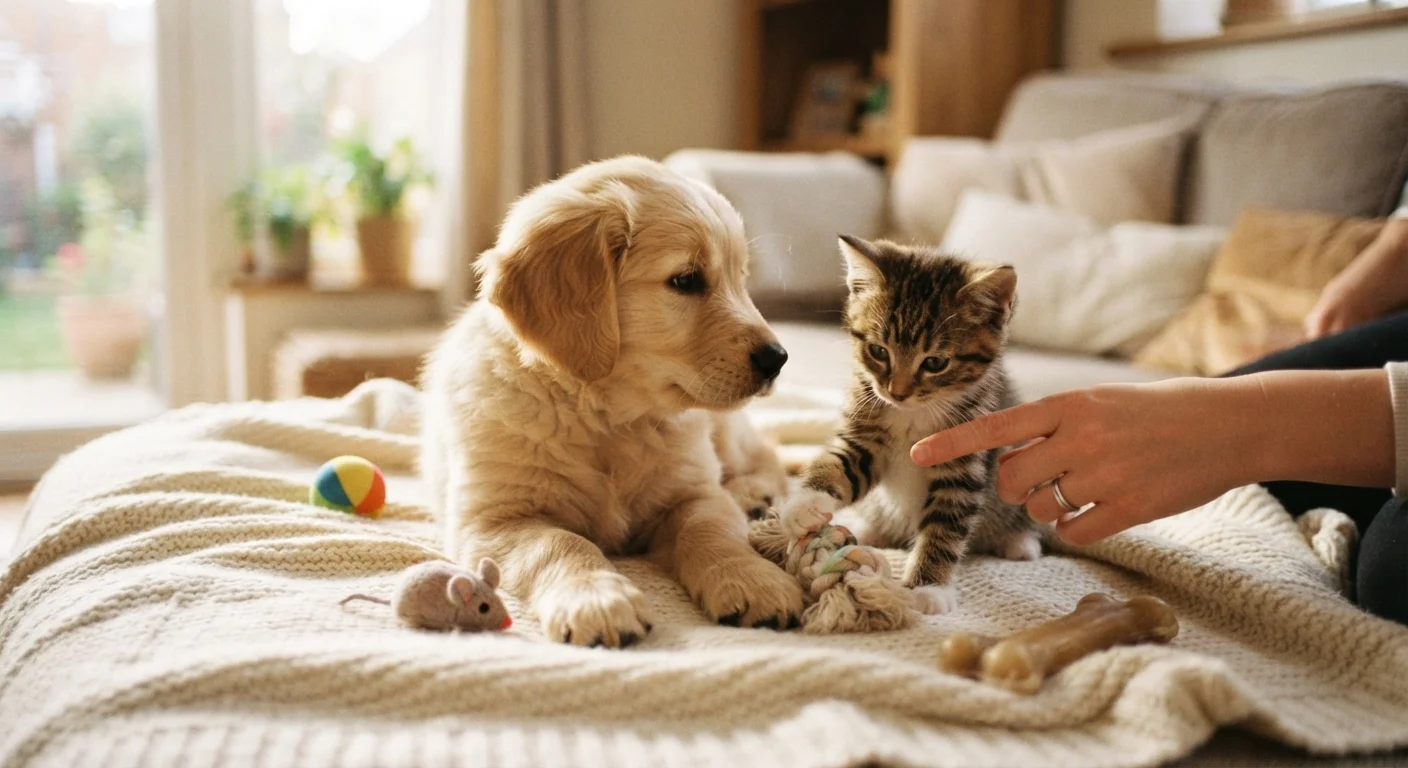
Key Takeaways
- Puppies have a primary socialisation window roughly between 3 and 12–14 weeks of age.
- Kittens have a shorter and earlier window, generally from 2 to 7 weeks.
- Positive exposure during these periods wires the brain for calm, confident adult behaviour.
- Fearful or absent experiences during the window can produce lasting behavioural challenges.
- Socialisation doesn't end at the window — ongoing enrichment matters throughout a pet's life.
- Late-adopted pets can still improve with patient, structured exposure, though progress is typically slower.
Socialisation Window
The socialisation window is a biologically defined developmental period — occurring in early puppyhood and kittenhood — during which a young animal's brain is especially receptive to new experiences. Exposures during this window shape how the animal perceives people, other animals, sounds, and environments for the rest of its life. Positive, varied experiences during this period build confidence and resilience; gaps or frightening encounters can produce lasting fear or reactivity.
Behavioural scientists refer to this as the 'sensitive period for socialisation.' It is distinct from learning that occurs at other life stages — not impossible later, but significantly less plastic neurologically.
A Window That Opens Once
When a puppy or kitten is born, its brain is not a blank slate — but it is, for a brief period, unusually open. During the socialisation window, the brain actively uses incoming sensory experience to build a template of 'what is normal.' Stimuli encountered during this period are logged as safe or threatening with a weight that later experiences rarely match.
For puppies, this window spans roughly 3 to 14 weeks of age. For kittens, it is shorter and earlier — approximately 2 to 7 weeks. In both species, the nervous system is still developing, and neural pathways that encode threat or safety are being established in real time. A puppy that regularly encounters children, traffic noise, and other dogs during this period learns to treat them as unremarkable features of the world. One that doesn't may spend its adult life treating the same stimuli as potential dangers.
This is why the experiences a young animal has — or doesn't have — before it even arrives at its permanent home can shape its temperament profoundly. Understanding the window isn't just useful knowledge; it helps owners make sense of why their pet responds to the world the way it does.
3–14 weeks
Primary socialisation window in puppies
Widely cited in veterinary behavioural literature as the period of greatest neurological receptivity to social stimuli.
2–7 weeks
Socialisation window in kittens
Shorter and earlier than in puppies, meaning much of the window closes before typical adoption age of 8–10 weeks.
~40%
Of relinquished dogs cited for behavioural issues
Behavioural problems — many rooted in early socialisation gaps — are among the most commonly cited reasons dogs are surrendered to shelters, according to shelter studies.
What Happens During the Window — And Why It's Different
The socialisation window is not simply a period of fast learning. It is a period of qualitatively different learning. During this phase, the brain's fear response systems are less developed, meaning young animals can approach and explore novelty with relatively low anxiety. Positive exposure during this window wires the brain for confidence; the same experience after the window closes requires overriding an already-established caution response — which is possible, but substantially harder.
Research in animal behaviour has consistently shown that the degree of early socialisation correlates strongly with adult temperament. Animals raised in stimulus-rich environments with regular, gentle human contact tend to be more adaptable, less reactive, and easier to work with throughout life. Those raised in isolation, or whose early encounters with stimuli were frightening rather than neutral or positive, are significantly more likely to develop anxiety, aggression rooted in fear, or chronic stress responses.
“The single most important thing you can do for a puppy is expose it to as many different people, places, and experiences as possible before it is 12 weeks old — in a way that is positive and not overwhelming.”
— Ian Dunbar, Veterinarian and animal behaviourist, founder of the Association of Pet Dog Trainers
It's also important to note that socialisation is not just about people. Exposure to varied surfaces, sounds at different volumes, other animal species, car travel, and handling of ears, paws, and mouths all contribute to an animal that can navigate adult life without persistent alarm. The breadth of the exposure matters as much as the frequency.
The Role of Breeders, Shelters, and Foster Carers
Because significant portions of both the puppy and kitten socialisation windows occur before adoption age, the responsibility for early exposure falls substantially on breeders, shelters, and foster carers. A kitten's entire sensitive period, for example, may be complete before it is old enough to be rehomed.
Reputable breeders and responsible shelters are increasingly aware of this and deliberately introduce young animals to varied stimuli — handling by multiple people, household sounds, gentle play with different objects, and controlled encounters with other animals. Understanding how care needs shift across a dog's life stages can help prospective owners ask the right questions when evaluating where an animal was raised.
When adopting, it is always reasonable to ask about an animal's early environment. A puppy raised in a quiet kennel with minimal human contact is not a lost cause, but an owner who understands the likely gaps is better positioned to address them intentionally rather than be surprised by the behavioural result.
Questions to Ask Before You Adopt
When considering a puppy or kitten, ask the breeder, shelter, or foster carer how many people have handled the animal, what sounds and environments it has been exposed to, and whether it has met children or other species. These questions signal that early socialisation matters to you — and the answers will tell you a great deal about what to expect and where to focus your energy after adoption.
After the Window: What Owners Can Still Do
The close of the socialisation window is not a hard cutoff for all learning — it is a shift in how readily that learning occurs. Adult pets can, and do, become more comfortable with new experiences through patient, positive exposure. The process is typically slower and requires more consistency, but meaningful change is possible.
For pets who missed adequate early socialisation, graduated desensitisation — introducing feared stimuli at very low intensity and pairing them with positive outcomes — is the approach most supported by behavioural science. For pets with significant anxiety or reactivity, working with a certified veterinary behaviourist or applied animal behaviourist is often the most effective path. This is a distinct professional role from a general trainer, and the distinction matters for complex cases.
Everyday enrichment also plays a role. Daily habits that support behavioural wellbeing — consistent routine, low-stress handling, and predictable environments — help any pet, regardless of early history, feel more settled. For multi-pet households, structured introductions that respect each animal's pace are especially important when one or both animals carries a history of limited socialisation.
As pets age, the behavioural effects of early socialisation can intersect with the changes that come with ageing itself. Behavioural shifts in senior pets sometimes echo lifelong patterns and sometimes signal something new — knowing the difference matters.
This article is for general informational purposes only and does not constitute veterinary or professional behavioural advice. Consult a qualified veterinarian or certified animal behaviourist for guidance specific to your pet's needs.