

Key Takeaways
- The brain processes a sale price as a social and emotional signal, not just a financial one.
- Anchoring bias makes a discounted price feel like a bargain even when the original price was inflated.
- Loss aversion can make the fear of missing a deal stronger than rational savings analysis.
- Urgency cues — countdown timers, limited stock alerts — amplify impulsive decision-making.
- Awareness of these tactics doesn't eliminate their effect, but it creates a useful pause before purchasing.
Discount Psychology
Discount psychology refers to the set of cognitive biases and emotional responses that make reduced prices feel more compelling than they may objectively be. When we see a sale, our brains process it less like a financial calculation and more like an opportunity not to be missed. Retailers deliberately design pricing displays to activate these mental shortcuts.
Key mechanisms include anchoring bias (judging value relative to a reference price), loss aversion (fearing the loss of a deal more than valuing the savings), and the scarcity heuristic (perceiving limited availability as proof of desirability).
How the Brain Responds to the Word 'Sale'
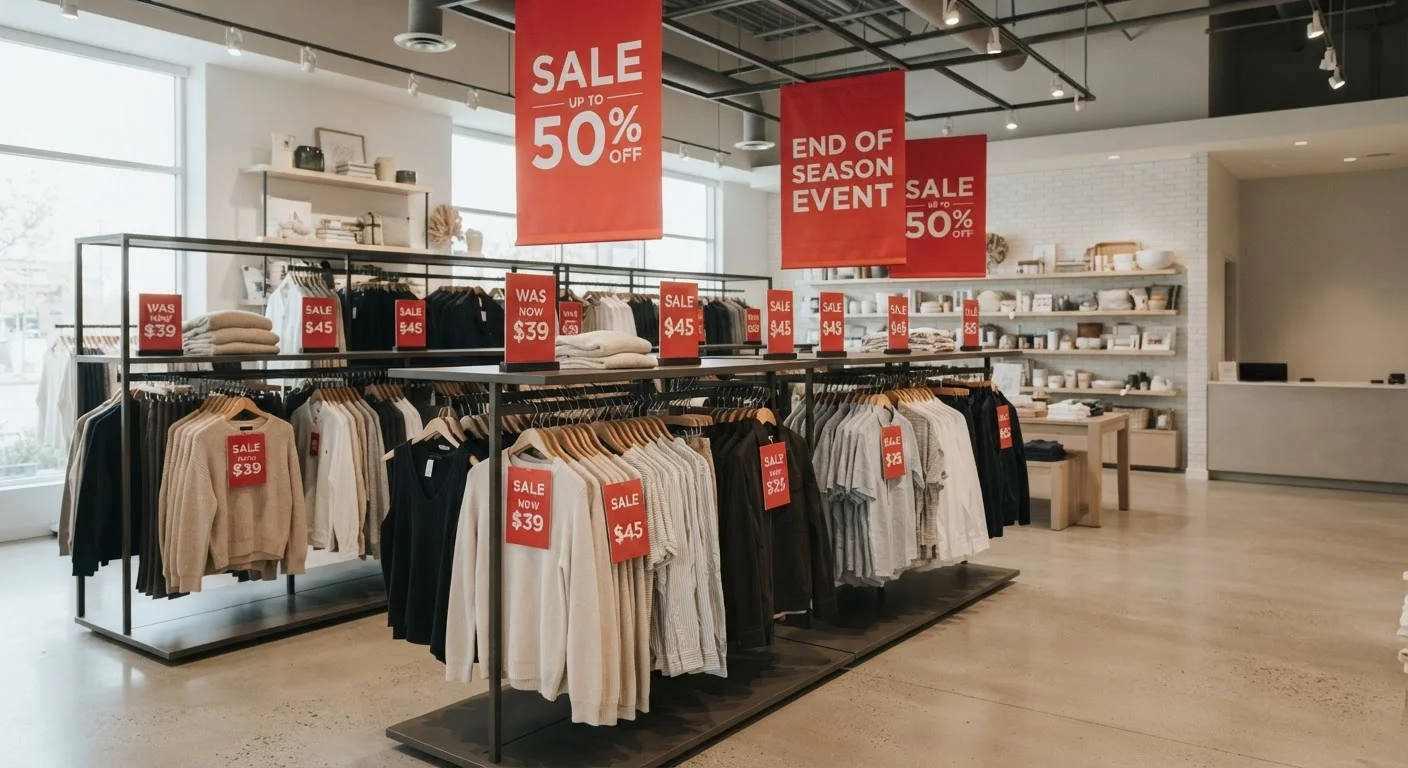
A single word — 'Sale' — is enough to change how the brain evaluates a product. Neuroimaging research has shown that price promotions activate reward-related regions of the brain, producing a mild rush similar to what happens when we anticipate any pleasurable outcome. This response happens quickly and largely beneath conscious awareness.
The effect isn't accidental. Retailers invest heavily in understanding how shoppers process pricing information, and the design of a sale display — the color red, large percentage-off figures, crossed-out original prices — is calibrated to maximize that initial emotional response. By the time rational deliberation kicks in, the emotional pull of the deal is already doing its work.
Understanding this dynamic is the first step toward more intentional shopping. For a broader look at the full range of retail persuasion strategies, the field guide to retail persuasion tactics covers how anchoring, scarcity, and social proof each work in practice.
~70%
Shoppers influenced by sale signs in-store
Research in consumer behavior consistently finds that a large majority of in-store purchase decisions are influenced by promotional price displays, even among shoppers who entered with a specific list.
2x
Loss aversion vs. equivalent gain
Behavioral economists Daniel Kahneman and Amos Tversky's foundational prospect theory work demonstrated that people generally feel losses roughly twice as intensely as equivalent gains — a finding that shapes how urgency and scarcity signals are designed in retail.
$5,400+
Estimated annual US household impulse spending
Various consumer finance surveys suggest that unplanned purchases — many triggered by promotions and sale displays — can account for substantial portions of household discretionary budgets.
Anchoring: Why the Original Price Is the Most Powerful Number
Anchoring is one of the most well-documented cognitive biases in behavioral economics. When evaluating a price, the brain doesn't calculate value in absolute terms — it compares the current price to whatever reference point appeared first. In a retail context, that reference point is almost always the 'original' or 'regular' price displayed alongside the sale price.
A product tagged at $35, marked down from $90, registers as a bargain almost automatically — even if comparable products typically sell for $35 without any markdown. The anchor ($90) has already framed the consumer's perception of fair value before any independent judgment can form.
This is particularly powerful online, where price histories are rarely visible. A product may have spent only a handful of days at its 'original' price before being placed on permanent sale. Some US states have regulations requiring that a 'former price' be genuine and recent, but enforcement varies and shoppers have limited visibility into how reference prices are established.
“The price tag is never just a number. It is a story the retailer tells about value, and anchoring is the opening line of that story.”
— Richard Thaler, Nobel Prize-winning economist and behavioral science researcher
Loss Aversion and Urgency: The Fear of Missing Out
Behavioral economists have long established that people feel the pain of a loss more acutely than the pleasure of an equivalent gain. In the context of shopping, this asymmetry means that the prospect of 'losing' a deal — watching it expire or sell out — can feel more pressing than the satisfaction of making a genuinely useful purchase.
Retailers amplify this tendency through urgency signals: countdown timers, 'only 3 left in stock' alerts, and 'offer ends tonight' messaging. These cues are not incidental — they are engineered to compress the decision window, reducing the time available for deliberate reflection.
The practical antidote is to introduce deliberate friction. Removing an item from your cart, waiting 24 hours, or asking whether you sought out the product before the sale appeared can interrupt the urgency loop. Shopping with a list is one evidence-backed habit that reduces the influence of in-the-moment urgency by pre-committing to intended purchases before entering a shopping environment.
Use a Simple Pre-Purchase Pause
Before buying a sale item, take thirty seconds to ask three questions: Did I plan to buy this before seeing the sale? Would I buy it at full price? Do I have a specific use for it? If the answer to all three is no, the discount — not genuine need — is likely driving the decision. This brief pause is often enough to override the urgency impulse.
Shopping More Deliberately in a World of Constant Promotions
Retail promotions are now near-constant, which creates an ironic problem: when everything is always on sale, the sale itself loses informational value. A discount no longer signals genuine scarcity or a time-limited opportunity — it is simply the default state of modern retail. Yet the emotional response to sale signage persists, because the design triggers are still present.
Practically, this means that evaluating a purchase requires looking past the promotion to the underlying value. Does this item serve a real purpose? Would you buy it at this price without the sale framing? Is this something you researched and decided you wanted, or something you encountered because a promotion surfaced it?
Doing that kind of pre-purchase thinking is exactly what separates confident, regret-free shopping from impulsive spending. The practical approach to pre-purchase research offers a structured framework for evaluating items before committing — a useful habit that works regardless of whether a sale sign is involved. For a wider foundation, the complete guide to smart shopping covers pricing, quality evaluation, and decision-making in one place.