

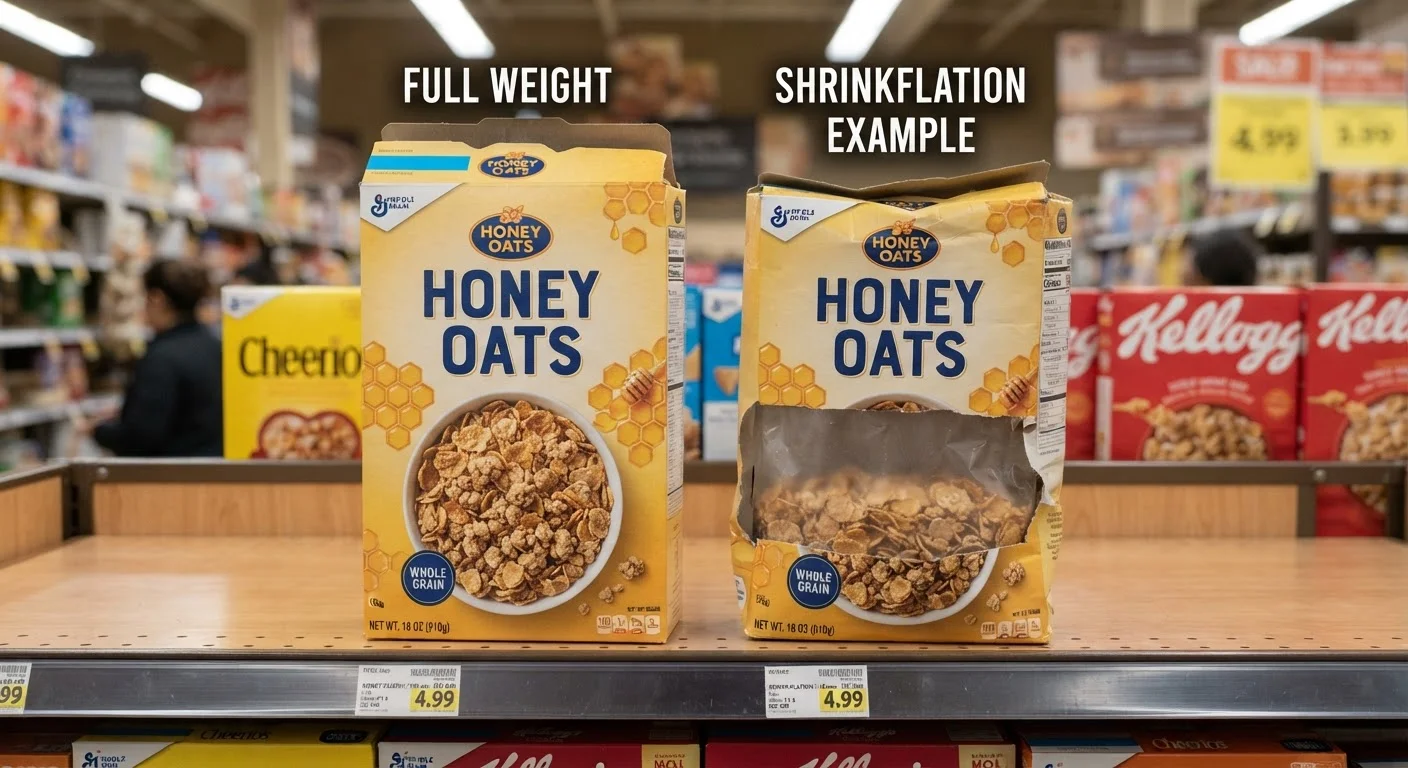
Key Takeaways
- Shrinkflation reduces the amount of product inside a package without a visible price increase.
- It is most common in packaged foods, household cleaners, and personal care products.
- Comparing unit prices (cost per ounce, gram, or count) is the most reliable way to detect it.
- Manufacturers often use redesigned packaging to mask smaller fill quantities.
- Shrinkflation tends to accelerate during periods of rising input costs, such as ingredients or energy.
- Shoppers who track net weight on labels over time are best positioned to spot these changes.
Shrinkflation
Shrinkflation is the practice of reducing the size, weight, or quantity of a product while keeping the retail price the same — or sometimes even raising it slightly. Because the packaging often looks identical, most shoppers don't notice the change. The result is that consumers pay more per unit of product without seeing an obvious price increase on the sticker.
Economists classify shrinkflation as a form of 'hidden inflation' — it affects real purchasing power without appearing in straightforward price-index comparisons unless unit pricing data is used.
What Shrinkflation Actually Looks Like
Picture a bag of potato chips you've bought for years. The price at the register hasn't moved, the bag looks the same, but somehow it feels lighter in your hand. That's shrinkflation in action. The manufacturer has reduced the net weight — perhaps from 10 oz to 8.5 oz — while maintaining the familiar look of the packaging.
It shows up in dozens of product categories: a box of breakfast cereal with a taller bag but less fill, a roll of paper towels with fewer sheets per roll, a container of yogurt that's been quietly narrowed at the base. The visual cues consumers rely on — package shape, shelf position, label design — remain largely unchanged, which is precisely the point.
Importantly, shrinkflation is not the same as a price cut masked by better value. The consumer ends up paying the same or more for less product. Over a household's weekly shop, these incremental reductions can add up meaningfully across multiple items.
Shrinkflation vs. Downsizing
The terms are sometimes used interchangeably, but 'downsizing' more broadly covers any reduction in product size or quantity, including deliberate reformulations. Shrinkflation specifically refers to the combination of a content reduction with a stable or rising price — the defining characteristic that affects consumer value. Both practices require the same defensive response: checking unit prices and net weights rather than relying on package appearance.
Why Manufacturers Reduce Contents Instead of Raising Prices
Consumer psychology research consistently finds that shoppers are more alert to price changes on a shelf label than to changes in net weight printed in smaller text on a package. A product that jumps from $3.49 to $3.99 signals a clear cost increase; the same product staying at $3.49 with 15% less inside is far easier to overlook.
This makes shrinkflation an attractive tool when companies face rising input costs — whether from commodity prices, energy, labor, or supply chain disruption. Rather than absorbing the margin hit or triggering a visible price increase that competitors might not match, manufacturers quietly adjust the fill quantity and preserve both their margin and their price-point positioning.
“Consumers are highly sensitive to price changes at the shelf but far less alert to weight or volume reductions. That asymmetry is exactly what makes shrinkflation such a persistent corporate strategy during inflationary periods.”
— Edgar Dworsky, Consumer advocate and founder of Consumer World, widely cited commentator on packaging and shrinkflation
It's worth noting that this is not necessarily a coordinated or malicious strategy. Individual product managers facing cost pressures often have limited options, and a content reduction that protects a product's market viability may be presented internally as a pragmatic response rather than a deceptive one. Understanding the business logic doesn't make it less important for shoppers to notice, however.
How to Spot Shrinkflation While You Shop
The single most effective tool against shrinkflation is the unit price label — the small figure on the shelf edge that expresses cost per ounce, per 100 grams, per count, or per fluid ounce depending on the product type. Because it normalizes price across different package sizes, it reveals true value in a way the sticker price alone cannot. Our guide on unit pricing and how to use it explains exactly how to read these labels and why they matter.
Beyond unit pricing, a few habits help:
- Check the net weight on the front or back of the package, not just the price. If a product you buy regularly now states a lower weight or count, the contents have changed.
- Notice packaging redesigns. A new look often accompanies a content reduction, sometimes framed as an improvement. See how common marketing language can obscure these changes in our article on decoding packaging claims.
- Be cautious with bulk purchases. If a bulk-format item has already been shrinkflated in its standard size, the larger format may not deliver the savings it appears to. Bulk buying doesn't always save money, and shrinkflation is one of the reasons why.
Make Unit Price Comparison a Habit
Before placing a familiar product in your cart, glance at the unit price on the shelf label rather than the total price. If the unit price has risen since your last purchase — even if the sticker price hasn't — the package likely contains less than it used to. This one habit can offset the effects of shrinkflation across your entire weekly shop.
Shrinkflation and the Bigger Picture
Shrinkflation is not a new phenomenon — economists and consumer advocates have documented it for decades — but it tends to become more prevalent during periods of sustained cost pressure. It is one of several mechanisms through which the real cost of living can rise faster than official price statistics suggest, since standard indices often track sticker prices rather than price-per-unit-of-content.
~3,500
US products affected in a single year
Consumer World's ongoing shrinkflation tracking has documented thousands of individual product size reductions across US grocery categories over multi-year periods.
9%
Average content reduction per affected item
Research published by the Bureau of Labor Statistics and independent consumer analysts has suggested typical shrinkflation reductions often fall in the range of 5–15% of net weight or count.
For everyday shoppers, the practical response is straightforward: pay attention to net weight, use unit pricing as a consistent reference, and treat packaging redesigns as a prompt to double-check what's actually inside. An informed shopper is harder to shortchange, regardless of what the front of the box says.