

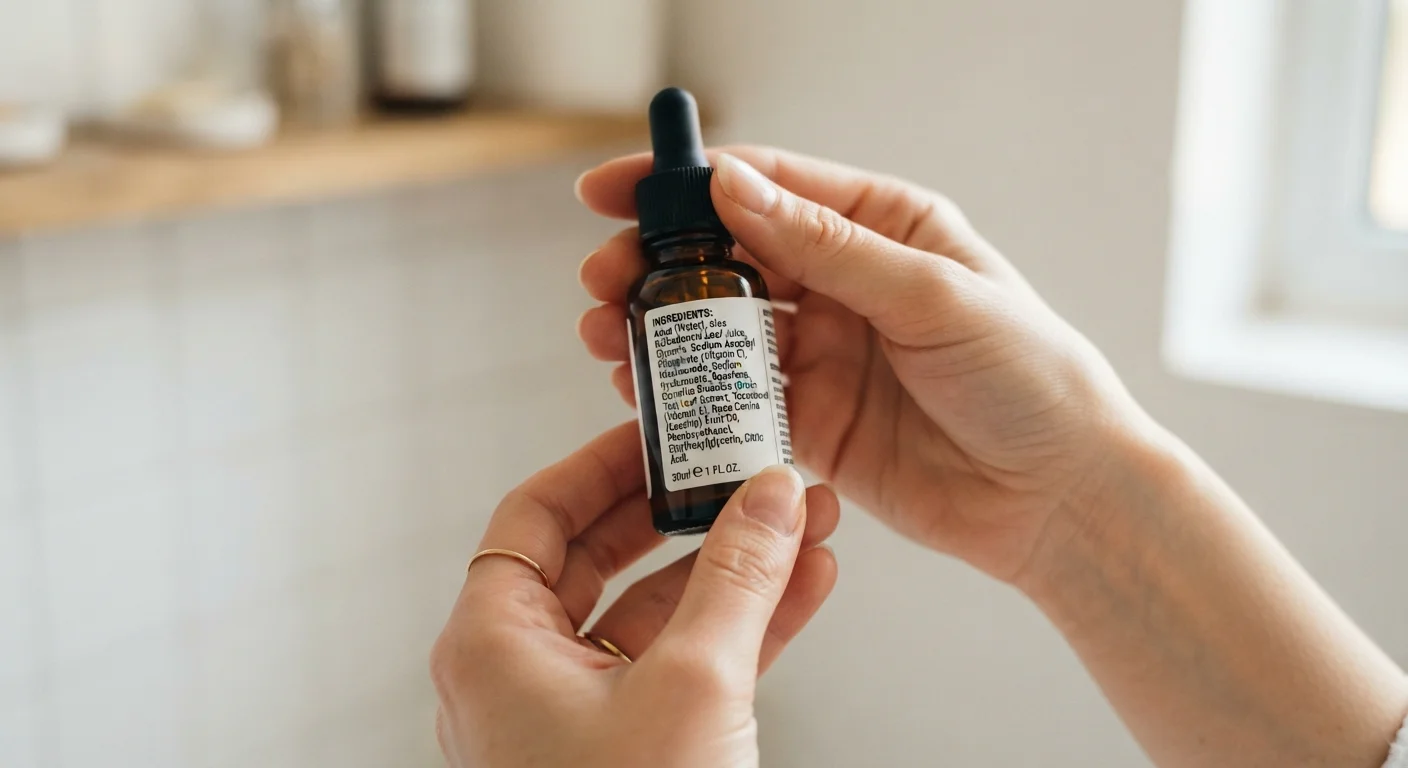
Key Takeaways
- Ingredients are listed by weight, from highest to lowest — the first few dominate the formula.
- The 1% threshold divides the list; ingredients below it can appear in any order.
- Front-of-pack claims like 'natural' or 'clean' are largely unregulated marketing language.
- A long ingredient list isn't automatically bad, and a short one isn't automatically better.
- Cross-referencing labels with reputable databases helps decode unfamiliar chemical names.
What you will need
Why the Order of Ingredients Actually Matters
Every ingredient list you encounter — whether on a cereal box, a moisturizer, or a household cleaner — follows a simple but powerful rule: ingredients appear in descending order by weight or concentration. The first ingredient makes up the largest share of the product. The last ingredient makes up the smallest.
This single fact changes how you read a label. If 'water' is the first ingredient in a face serum and a costly active like hyaluronic acid appears fifteenth, the product is mostly water with a trace of that active. That's not inherently dishonest, but it's useful context when comparing options.
For food labels specifically, the FDA requires this descending-weight ordering for all packaged foods sold in the U.S. The same principle applies to cosmetics, where the International Nomenclature of Cosmetic Ingredients (INCI) system standardizes the scientific names you see — which is why familiar ingredients like vitamin C appear as ascorbic acid or sodium ascorbyl phosphate. For a breakdown of those terms, see our reference guide to common skincare ingredient terms.
Longer Lists Aren't a Red Flag
A product with 25 ingredients isn't necessarily worse than one with 8. A long list can simply reflect a formula with multiple functional actives, stabilizers, and preservatives working together. Judge individual ingredients on their merits rather than using list length as a quality signal.
The 1% Rule and What Comes After It
Once you move past the primary ingredients, you hit a quiet inflection point in most formulas: the approximate 1% concentration threshold. Manufacturers in cosmetics and personal care are permitted to list any ingredients present at 1% or below in any order they choose. This matters because it means a compelling-sounding ingredient near the end of a list might be present in only a negligible amount.
On food labels, a similar dynamic plays out with sub-ingredients. When a food contains a compound ingredient — like 'granola' in a bar — its components are listed in parentheses immediately after, still in descending order within that sub-list.
Low Concentration Doesn't Mean Harmless for Everyone
Individuals with known allergies or sensitivities should pay particular attention to the lower portion of ingredient lists where fragrance compounds, preservatives, and colorants appear. Even trace-level exposure to certain ingredients can be relevant. Consult a healthcare professional if you have documented sensitivities before using a new product.
Preservatives, colorants, and fragrance compounds typically appear in the lower portion of any list. Their low concentration doesn't make them unimportant — some individuals have documented sensitivities to specific preservatives or fragrance chemicals even at trace levels. Consulting a healthcare professional is advisable if you have known sensitivities or allergies.
To understand how ingredient order interacts with how you apply a product, our article on layering skincare products in the right order is a practical next step.
Decoding Front-of-Pack Claims vs. the Actual List
Marketing language on the front of a package operates under a different — and generally looser — regulatory framework than the ingredient list itself. Terms like natural, clean, gentle, and free-from have no single legally binding definition in most U.S. product categories. The ingredient list on the back is your ground truth.
A few practical habits help cut through the noise:
- Match front claims to the list. If a label says 'made with oat,' find where oat or its derivative appears. If it's near the end, it's a minor component regardless of how prominently it's featured on the front.
- Look up unfamiliar names. The EWG's Skin Deep database and the FDA's food additive resource pages are publicly available, non-commercial references for common ingredient names and their functions.
- Understand 'fragrance' or 'parfum.' In cosmetics, this single term can represent a blend of dozens of undisclosed compounds under trade-secret protections — relevant information for sensitive skin.
The same critical approach applies to other consumer categories. If you're applying this thinking to food specifically, our article on reading a nutrition label without getting lost in the numbers covers the numbers side of the equation. Pet owners will also find this logic useful — see our primer on what's actually in the pet food aisle.
Marketing Terms Are Not Regulated Like Ingredient Lists
In most U.S. product categories, terms like 'natural,' 'clean,' or 'gentle' on product packaging carry no standardized legal definition. Only the ingredient list itself is subject to consistent regulatory requirements. Treating front-of-pack claims as editorial context rather than verified fact will serve you better as a consumer.