

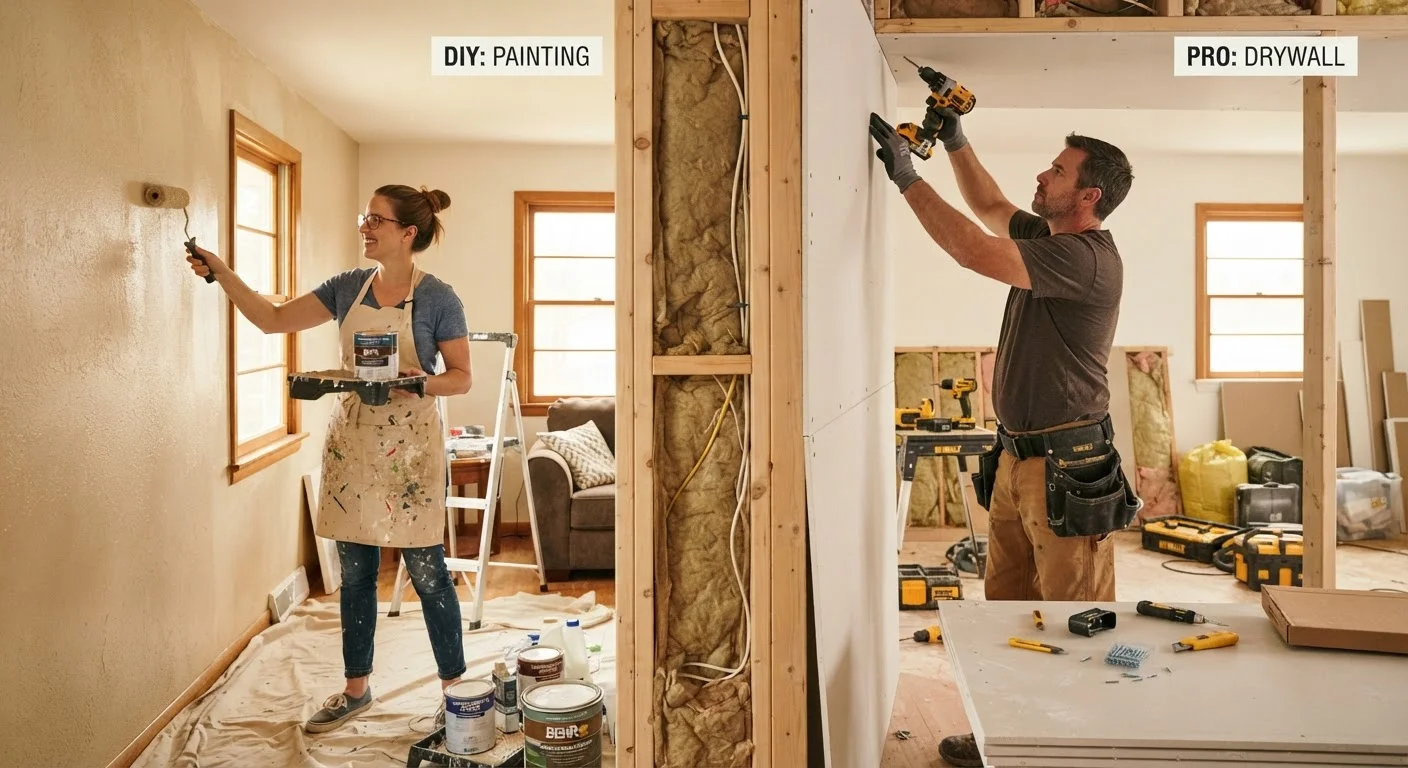
Key Takeaways
- Labour savings from DIY can be offset by tool costs, mistakes, and time investment.
- Electrical, gas, structural, and major plumbing work should typically be left to licensed professionals.
- Permits are often required even for DIY projects — skipping them can cause insurance and resale problems.
- The true cost of a contractor includes expertise, liability coverage, and warranty protection.
- A hybrid approach — DIY prep work plus professional finishing — can reduce costs without adding risk.
Significant labour cost savings on eligible tasks
Contractor labour often represents the largest share of a project budget. On straightforward jobs like painting or tile work, doing the work yourself can cut total project cost substantially.
Greater scheduling flexibility and control
DIY lets you work at your own pace and on your own timeline, avoiding contractor availability delays that can stretch simple projects out by weeks.
Builds practical skills for future maintenance
Successfully completing a home repair builds familiarity with your home's systems and confidence for handling similar tasks down the road.
Satisfaction and personal investment in results
Many homeowners find genuine satisfaction in hands-on work, and the knowledge of exactly what materials and methods were used can provide lasting reassurance.
Mistakes can cost more than professional work
An error in tiling, plumbing, or wiring can require professional remediation on top of the original failed attempt, making the total cost far exceed what a contractor would have charged upfront.
Hazardous work carries real safety risk
Electrical, gas, and structural work involve risks that can cause injury, fire, or structural failure. These categories are typically regulated for this reason and often require licensed tradespeople.
Permits may still be required — and often are skipped
DIY doesn't exempt a homeowner from permit requirements. Unpermitted work can complicate home sales, void insurance claims, and result in costly retrofits.
Tool and material costs reduce net savings
Specialised tools needed for a single project — tile saws, pipe threaders, drywall lifts — can eat significantly into anticipated savings when purchased or rented.
No warranty or liability coverage on DIY work
If DIY work fails or causes damage, there is no third-party warranty or insurance recourse. Licensed contractors carry liability insurance that protects homeowners if something goes wrong.
Our Verdict
Neither DIY nor hiring a contractor is universally the right call. Straightforward cosmetic projects — painting, tiling a backsplash, or landscaping — are often well within a prepared homeowner's reach. But anything involving structural integrity, permitted systems like electrical or gas, or tasks where errors carry serious safety or legal consequences is generally worth the contractor's fee. Honest self-assessment of your skills, time, and risk tolerance matters more than the prospect of saving money.
DIY suits motivated homeowners with relevant skills and time for low-risk cosmetic or maintenance tasks; professional contractors are the right choice for complex, hazardous, or code-regulated work.
What You're Actually Comparing
When homeowners weigh DIY against hiring a contractor, the instinct is to compare price tags. But the full picture is wider than that. Labour savings are real — contractor labour can account for 40–60% of a project's total cost — but they arrive bundled with time commitment, skill requirements, tool purchases, and the risk of costly mistakes.
A useful starting framework is to ask three questions before any project begins: Do I have the skill? Do I have the time? And critically: What happens if something goes wrong? For a paint job, an error means a weekend of touch-ups. For an improperly wired outlet, it can mean a house fire or failed home inspection. See our pre-work checklist for a structured way to evaluate any project before you pick up a tool.
The Case for DIY
Significant labour cost savings on eligible tasks
Contractor labour often represents the largest share of a project budget. On straightforward jobs like painting or tile work, doing the work yourself can cut total project cost substantially.
Greater scheduling flexibility and control
DIY lets you work at your own pace and on your own timeline, avoiding contractor availability delays that can stretch simple projects out by weeks.
Builds practical skills for future maintenance
Successfully completing a home repair builds familiarity with your home's systems and confidence for handling similar tasks down the road.
Satisfaction and personal investment in results
Many homeowners find genuine satisfaction in hands-on work, and the knowledge of exactly what materials and methods were used can provide lasting reassurance.
DIY makes the most sense when the task is cosmetic or low-risk, the skill ceiling is achievable with some research, and time is not a pressing constraint. Painting, installing peel-and-stick tile, replacing a faucet, or building simple garden structures are genuinely manageable for a careful, prepared homeowner. Resources like manufacturer installation guides and code-compliant how-to tutorials make many tasks more accessible than ever.
For those comfortable with basic plumbing fixes, projects like replacing a toilet fill valve or a faucet cartridge are reasonable weekend tasks. Our guide to weekend plumbing tasks you can safely handle yourself explains which repairs stay firmly in safe DIY territory.
The Case for Hiring a Contractor
Mistakes can cost more than professional work
An error in tiling, plumbing, or wiring can require professional remediation on top of the original failed attempt, making the total cost far exceed what a contractor would have charged upfront.
Hazardous work carries real safety risk
Electrical, gas, and structural work involve risks that can cause injury, fire, or structural failure. These categories are typically regulated for this reason and often require licensed tradespeople.
Permits may still be required — and often are skipped
DIY doesn't exempt a homeowner from permit requirements. Unpermitted work can complicate home sales, void insurance claims, and result in costly retrofits.
Tool and material costs reduce net savings
Specialised tools needed for a single project — tile saws, pipe threaders, drywall lifts — can eat significantly into anticipated savings when purchased or rented.
No warranty or liability coverage on DIY work
If DIY work fails or causes damage, there is no third-party warranty or insurance recourse. Licensed contractors carry liability insurance that protects homeowners if something goes wrong.
Licensed contractors bring more than labour — they carry liability insurance, are bonded, and their work is typically warrantied. If a professional's installation fails, the path to recourse is clear. If your own work fails, the cost of correction is entirely yours.
Certain project categories should almost always involve a licensed professional: electrical panel work, gas line modifications, structural changes, roofing on steep pitches, and any work that requires a permit and inspection. Unpermitted work can void homeowner's insurance, trigger fines, and complicate a future home sale. Our article on home renovation permits covers which projects commonly require them and how the process typically works.
When Permits Apply to DIY Work
A common misconception is that permits are only needed when hiring a contractor. In most US jurisdictions, the permit requirement is tied to the type of work — not who performs it. Electrical, plumbing, structural, and HVAC changes typically require permits whether the work is done professionally or by the homeowner. Always check with your local building department before starting regulated work.
Hidden Costs on Both Sides
DIY hidden costs are easy to underestimate. Tool rentals or purchases, materials wasted during a learning curve, and the value of hours spent all add up. A project budgeted at $200 in materials can quietly become $500 once you factor in a tile saw rental, a second batch of grout after a mixing error, and two full weekends of labour.
Contractor hidden costs run the other way: vague quotes, scope creep, and scheduling delays. Getting multiple written estimates, asking for itemised breakdowns, and checking references all help manage these risks. If budget pressure is driving you toward DIY for projects that may be outside your skill level, it's worth reading about the real trade-offs of strict budgeting — cutting costs in the wrong places can create larger expenses later.
40–60%
Typical share of project cost attributed to contractor labour
Industry estimates consistently place labour at roughly half of most residential renovation budgets, illustrating the theoretical savings ceiling for DIY.
~1 in 5
DIY home improvement projects that require a permit
Many homeowners underestimate permit requirements; skipping required inspections can create complications during home resale or insurance claims.
A Hybrid Approach Worth Considering
Many experienced homeowners land on a middle path: handle the prep work and cleanup themselves, and hire professionals for the skilled, regulated portions. On a bathroom renovation, for example, a homeowner might demo the old tile, handle painting, and install fixtures — while leaving the rough plumbing and electrical to licensed trades. This approach can meaningfully reduce total project cost without introducing safety or code risk.
The same logic applies to insulation upgrades: adding batt insulation in an accessible attic is a manageable DIY task, while spray foam in tight cavities is typically better left to specialists. Our guide to insulation types for the DIY homeowner breaks down which options suit different skill levels. Whatever approach you choose, unexpected homeownership costs have a way of appearing — building a realistic contingency into any project budget is always sound practice.