

Key Takeaways
- Fiberglass and mineral wool batts are the most accessible insulation types for DIY beginners.
- Blown-in insulation works well for attics but typically requires renting specialized equipment.
- Rigid foam boards offer high R-value per inch and are ideal for basement walls and exterior sheathing.
- Two-component spray foam is generally best left to licensed professionals due to chemical hazards.
- R-value requirements vary by climate zone — always check local building codes before starting.
Our Verdict
Batts suit most beginner DIYers tackling framed walls and floors, while blown-in cellulose is a strong choice for attic top-ups with rentable equipment. Rigid foam is the go-to for tight spaces and moisture-prone areas. Two-part spray foam delivers the highest performance but carries safety requirements that typically make it a professional job.
| Best for | Recommended |
|---|---|
| First-time DIYers insulating framed walls or floors | Fiberglass or Mineral Wool Batts |
| Homeowners adding insulation to an existing attic | Blown-In Cellulose |
| Basements, crawl spaces, and exterior applications | Rigid Foam Board |
| Air sealing irregular cavities requiring professional installation | Two-Component Spray Foam (Pro) |
Why Insulation Type Matters for DIYers
Insulation is one of the highest-impact home improvement projects for energy efficiency, but not every material suits every location — or every skill level. The wrong choice can leave gaps, trap moisture, or require a permit and licensed contractor you hadn't budgeted for. Understanding the four main insulation types helps you match the material to the job before you buy anything.
Before selecting a product, check your home's current R-value (a measure of thermal resistance) and compare it against the U.S. Department of Energy's recommendations for your climate zone. Higher R-values mean better insulating performance. For a broader look at when DIY makes sense versus calling in help, see our guide on DIY vs. contractor costs.
| Batts | Blown-In | Rigid Foam | Spray Foam (Pro) | |
|---|---|---|---|---|
| Typical R-value per inch | R-3 to R-4 | R-2.5 to R-3.7 | R-3.8 to R-6.5 | R-3.7 to R-6.5 |
| DIY-friendly | Yes | Yes (open attics) | Yes | Canned foam only |
| Special equipment needed | None | Blowing machine | None | Yes — full PPE |
| Air sealing ability | Low | Low | Moderate (taped) | High |
| Moisture resistance | Low–Moderate | Low | High | High |
| Relative material cost | Low–Moderate | Low | Moderate–High | High |
| Best application | Framed walls, floors | Attic floors | Basements, exterior | Rim joists, full cavities |
Batts: The Beginner's Starting Point
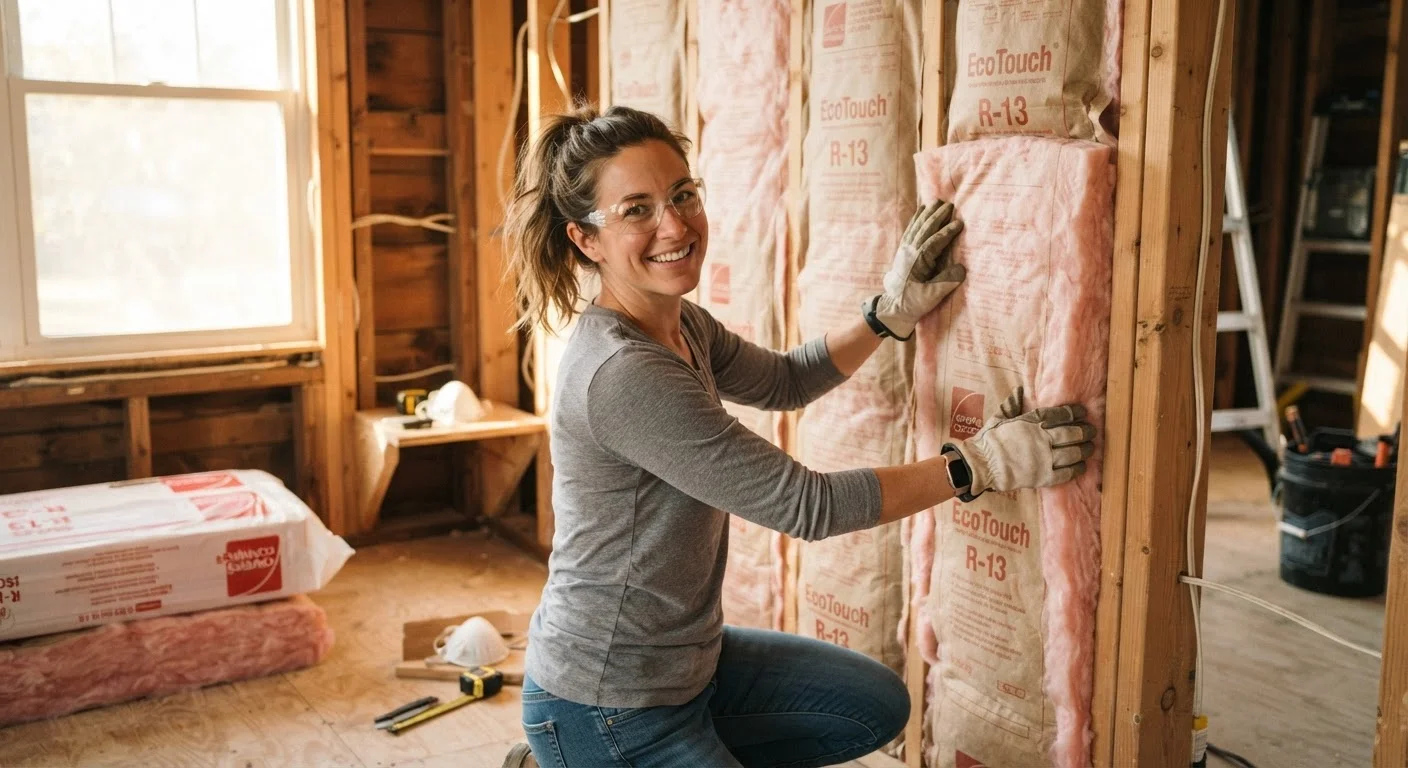
Fiberglass and mineral wool batts are pre-cut panels sized to fit standard stud and joist spacing (typically 16 or 24 inches on center). They're sold at most home improvement stores, require no special equipment, and can be cut with a utility knife and straightedge.
Best locations: Framed interior and exterior walls, floor joists, attic floors before finishing.
DIY considerations: Wear long sleeves, gloves, safety glasses, and an N95 respirator — fiberglass fibers are a skin and respiratory irritant. Fit batts snugly without compressing them; compression reduces R-value. Ensure kraft-faced batts are installed with the facing toward the warm side of the wall to function as a vapor retarder.
Check Stud Spacing Before Buying
Batts come in 15-inch and 23-inch widths to fit 16-inch and 24-inch on-center framing respectively. Measure your stud spacing before purchasing — a mismatch leads to gaps or unnecessary trimming. When in doubt, measure at least three bays since older homes sometimes have irregular spacing.
Mineral wool (rock wool) batts cost somewhat more than fiberglass but are naturally fire-resistant, more dimensionally stable, and easier to cut cleanly — worth considering for soundproofing applications or areas near heat sources.
Blown-In Insulation: Good for Attics, Requires Equipment
Blown-in insulation — most commonly loose-fill cellulose or fiberglass — is pumped into place using a blowing machine. Many retailers offer machine rental with minimum product purchases, making this a viable DIY option for open attic spaces.
Best locations: Open attic floors, hard-to-reach enclosed cavities.
DIY considerations: Depth guides (stakes placed in the attic) help you achieve even coverage. Seal all air bypasses — gaps around electrical boxes, plumbing penetrations, and top plates — before blowing insulation, as loose fill does not air-seal on its own. Cellulose is made from recycled paper and is treated for fire and pest resistance; it can settle slightly over time, so manufacturers often recommend installing above your target R-value to account for this.
Important: Blown-in insulation in enclosed wall cavities (dense-pack) requires specialized nozzles and techniques. If you're unsure, this sub-application is better handled by a professional.
Rigid Foam Board: High Performance in Tight Spaces
Rigid foam panels — available in expanded polystyrene (EPS), extruded polystyrene (XPS), and polyisocyanurate (polyiso) — deliver higher R-values per inch than batts, making them useful where space is limited. They're also moisture-resistant, which makes them well-suited for basement walls and exterior continuous insulation layers.
Best locations: Basement walls, crawl space walls, exterior wall sheathing, under slab.
DIY considerations: Panels score and snap cleanly with a utility knife and straightedge. Seal joints with foam-compatible tape or canned foam to eliminate thermal bridging. Note that most foam boards are not vapor barriers on their own — check manufacturer data and local code for vapor management requirements. XPS and polyiso typically have higher R-values per inch than EPS but also higher costs. For related air-sealing tips, see common myths about expanding foam sealant.
Foam Board and Fire Code Requirements
Rigid foam panels are combustible and most building codes require them to be covered by a thermal barrier — typically 1/2-inch drywall — when installed in living spaces. Leaving foam exposed in a finished basement or interior wall is a common code violation. Always check local requirements and consult your building department before leaving foam board uncovered.
Spray Foam: High Performance, High Caution
Two-component spray polyurethane foam (SPF) expands to fill cavities completely, providing both insulation and air sealing in one step — the highest combined performance of any insulation type. Small single-component cans are a practical DIY tool for sealing gaps and cracks. Full two-component kits, however, involve mixing isocyanate chemicals that require respirators rated for organic vapors, protective suits, and careful ventilation.
Best locations: Rim joists, small cavity air sealing (canned foam); full wall and roof applications typically require professionals.
DIY considerations: Canned foam for gap-filling is genuinely DIY-friendly. Two-component kits for larger coverage are manageable only with appropriate personal protective equipment and thorough safety preparation. Many jurisdictions require permits and licensed applicators for full-scale spray foam installations, particularly in occupied structures. Always verify local requirements before proceeding. Because of the complexity involved, most homeowners benefit from getting a professional quote alongside a DIY cost estimate — see when hiring a contractor makes financial sense for a balanced comparison.