

Key Takeaways
- Expanding foam sealant is an air and moisture barrier, not a structural adhesive or load-bearing material.
- Cured foam must be protected from UV exposure or it will degrade and crumble over time.
- Not all expanding foams are interchangeable — choose the right formulation for each specific application.
- Foam does expand significantly; overfilling gaps can cause damage to window and door frames.
- Properly applied foam can meaningfully reduce drafts and improve a home's energy efficiency.
Why Expanding Foam Gets a Bad Reputation
Walk into any hardware store and you'll find cans of expanding foam sealant lining the shelves. It's one of the most accessible and affordable air-sealing tools a homeowner can use — yet it's also one of the most frequently misapplied. Much of the trouble traces back to persistent myths that cause people to either misuse the product or avoid it entirely.
Understanding what expanding foam actually does — and what it doesn't — is the first step toward using it effectively. For a broader look at how foam fits alongside other insulation strategies, see our guide to insulation types for DIY homeowners.
Myth
Expanding foam can be used anywhere to seal any gap, regardless of size or location.
Fact
Different formulations of expanding foam are designed for specific uses — and some gaps require different products entirely.
Standard expanding foam works well for sealing gaps around pipes, wires, and small penetrations. However, gaps around window and door frames require a low-expansion or minimal-expanding foam to avoid warping the frames. For gaps near heat sources, fire-stop foam — a specially rated product — is required by most building codes. Using the wrong type can compromise both safety and performance.
Myth
Expanding foam provides significant structural support and can be used to reinforce or hold things in place.
Fact
Cured expanding foam is lightweight, compressible, and has no meaningful structural or load-bearing strength.
Once cured, expanding foam becomes a rigid but brittle cellular material. It is excellent at filling voids and blocking airflow, but it will crumble under pressure and cannot support weight. Using it to stabilize a wobbly post, fill a structural void, or anchor hardware is a common mistake that can lead to failure. Structural repairs require appropriate construction adhesives, mortar, or mechanical fasteners.
Myth
More foam means a better seal — filling a gap completely will always give the best results.
Fact
Overfilling a gap with expanding foam can cause warping, cracking, and a worse seal than a properly filled gap.
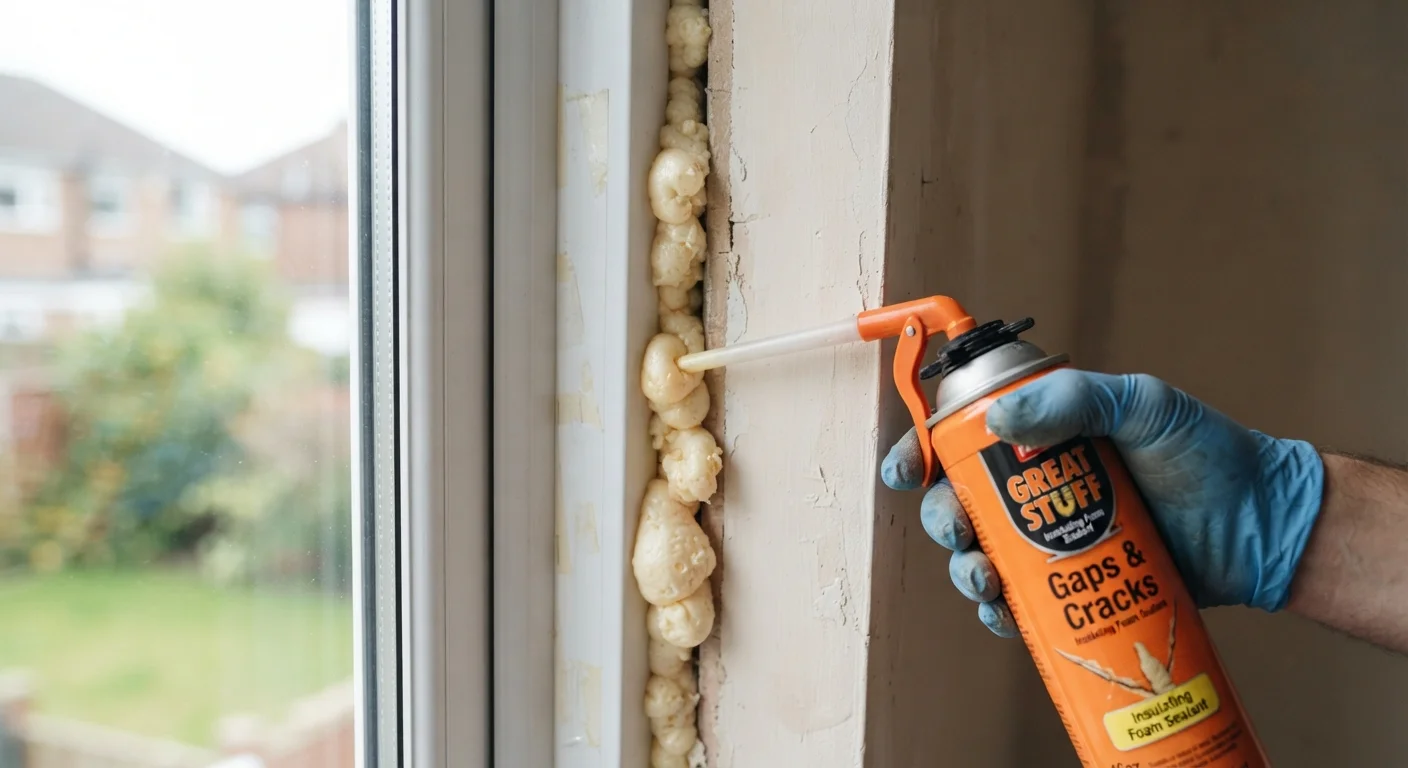
Expanding foam continues to expand after it leaves the can. Filling a gap entirely before the foam has expanded can exert significant outward pressure on surrounding framing — particularly around windows and doors — causing visible bowing or making them difficult to open and close. The correct approach is to fill gaps to roughly half their depth, let the foam expand, and apply a second pass only if needed once the first layer has cured.
Myth
Expanding foam is weatherproof and UV-resistant, so it doesn't need any finishing or protection.
Fact
Exposed expanding foam degrades quickly in sunlight and must be covered to remain effective.
Cured polyurethane foam — the base material in most expanding foam sealants — is highly vulnerable to ultraviolet radiation. Without protection, it will turn yellow, become brittle, and crumble within months of outdoor exposure. Any foam used in an exterior application or anywhere it will be exposed to light should be covered with exterior-grade paint, caulk, or flashing. This step is often skipped, which is why foam repairs sometimes appear to fail quickly.
Myth
Expanding foam is a good insulator, so it can replace traditional insulation in walls and floors.
Fact
While foam has some insulating value, canned expanding foam is an air sealant — not a substitute for proper insulation.
Canned expanding foam does have a measurable R-value per inch, but it's designed and sold primarily as an air and moisture sealant. The thin bead used to seal a gap around a pipe contributes essentially no insulating value in the broader wall assembly. Two-component spray foam insulation is a distinct, contractor-applied product with real insulating depth. If you're evaluating your home's insulation options, our overview of insulation types covers the full range of materials and their appropriate uses.
Getting the Most Out of Your Foam Application
Even homeowners who understand foam's limitations can run into trouble during application. A few practical habits go a long way toward a clean, effective result.
Never Use Standard Foam Near Fire-Rated Assemblies
Standard expanding foam is flammable and is not rated for use in fire-stop applications. Gaps around pipes, wires, or ducts passing through fire-rated walls or floors require specifically labelled fire-stop foam, which is a different product. Using the wrong foam in these locations may violate local building codes and could reduce the effectiveness of fire barriers in your home. When in doubt, consult a licensed contractor or your local building department.
- Wear gloves and eye protection. Uncured foam is extremely sticky and difficult to remove from skin. Dedicated foam cleaner or acetone can help, but prevention is easier.
- Dampen the surfaces first. Expanding foam is moisture-activated. Lightly misting the gap with water before applying promotes a more complete cure.
- Fill gaps to about half capacity. The foam will expand to fill the rest. Overfilling is one of the most common mistakes.
- Allow full cure time before trimming. Most formulations require at least one hour before trimming, and up to 24 hours before painting or finishing.
- Paint or seal exposed foam. Any foam left visible and open to sunlight should be covered with paint, caulk, or another UV-resistant finish to prevent breakdown.
30–40%
Home heating & cooling energy lost to air leaks
The U.S. Department of Energy estimates that air leakage accounts for 30–40% of a home's heating and cooling energy loss, making sealing a high-impact improvement.
2–6 inches
Maximum recommended gap size for canned foam
Most manufacturers specify that canned expanding foam performs optimally in gaps between roughly a quarter inch and six inches; larger voids require backing material or alternative products.
Taking the time to select the right product — gap-filling foam for windows and doors, fire-rated foam for penetrations near electrical or mechanical systems — makes a meaningful difference in both performance and safety.