

Key Takeaways
- Organic fertilisers feed soil microbes first; synthetic fertilisers deliver nutrients directly to plant roots.
- Synthetic options act faster but carry a higher risk of nutrient runoff and salt buildup over time.
- Organic materials gradually improve soil structure, water retention, and biological diversity.
- Neither type is universally superior — the best choice depends on your soil, plants, and goals.
- Combining both approaches strategically is a common and practical choice for many home gardens.
Option A
Organic Fertilisers
The slow-and-steady, soil-building approach.
Best for: Gardeners prioritising long-term soil health, microbial activity, and reduced synthetic inputs.
Option B
Synthetic Fertilisers
The precise, fast-acting nutrient delivery system.
Best for: Situations requiring rapid nutrient correction or highly controlled, measurable feeding.
If you want to improve depleted or compacted soil over a season or two
Organic Fertilisers
Organic matter rebuilds soil structure and feeds microbial life, creating lasting improvements that synthetic options alone cannot replicate.
If a soil test reveals a specific, acute nutrient deficiency
Synthetic Fertilisers
Synthetic formulas provide precise, fast-acting correction when a plant needs a particular nutrient quickly and at a measurable dose.
If you garden in containers or raised beds with soilless mix
Synthetic Fertilisers
Soilless media lacks the microbial ecosystem that activates organic nutrients, making synthetic feeding more reliable and predictable in these settings.
If you're building a kitchen garden or landscape bed for the long term
Organic Fertilisers
Regular organic additions progressively raise organic matter content, supporting healthier plants season after season with diminishing external input needs.
How Each Type Actually Works Underground
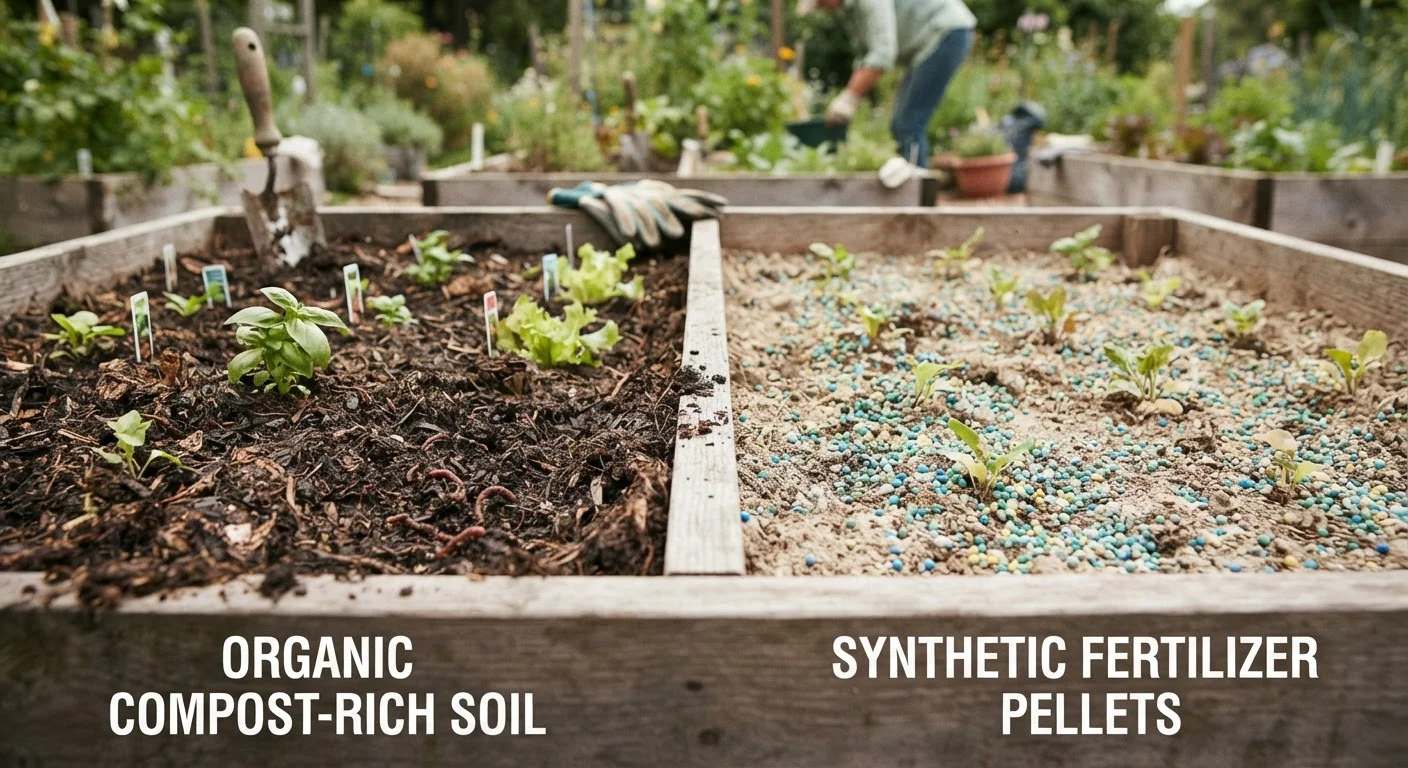
The core difference between organic and synthetic fertilisers isn't just what's in them — it's how nutrients reach your plants. Synthetic fertilisers are manufactured to contain nutrients in forms plants can absorb almost immediately, typically as water-soluble mineral salts. When you apply them, the chemistry is direct: ions dissolve in soil water and enter roots within days.
Organic fertilisers — derived from plant matter, animal byproducts, or minerals — work through an intermediate step. Soil bacteria and fungi break down the raw organic material, releasing nutrients gradually as a byproduct of that microbial activity. This means plants only access what the soil ecosystem has processed. For a deeper understanding of why this biological layer matters, see our article on soil health fundamentals.
This difference in mechanism has cascading effects on everything from root development to water movement through your garden beds.
| Criterion | Organic Fertilisers | Synthetic Fertilisers |
|---|---|---|
| Nutrient release speed | Slow (weeks to months) | Fast (days to one week) |
| Soil structure benefit | Improves over time | Minimal to none |
| Microbial activity | Feeds and supports microbes | Neutral to mildly suppressive at high rates |
| Leaching/runoff risk | Lower | Higher if over-applied |
| Nutrient precision | Variable by source | Precisely measurable |
| Cost per application | Often lower long-term | Variable; often lower upfront |
| Effective in cold soil | Limited (microbes slow down) | Yes, if soil not frozen |
What Happens to Soil Structure Over Time
Regular organic additions — compost, aged manure, worm castings, feather meal — contribute physical bulk to the soil in addition to nutrients. Over seasons, this organic matter binds soil particles into aggregates, improving the pore spaces that hold both air and water. Sandy soils become more moisture-retentive; clay soils drain more freely and become easier to work.
Synthetic fertilisers, applied repeatedly without organic matter, don't contribute to this structural improvement. Some high-salt synthetic formulas can, over many years, reduce beneficial microbial populations and slightly acidify or compact soil depending on the product chemistry and application rate. This isn't a reason to avoid them entirely — it's a reason to be aware of cumulative effects and to monitor with periodic soil testing.
5%
Target soil organic matter for healthy gardens
Most US garden soils contain 1–3% organic matter; many soil scientists consider 5% a practical goal for productive home gardens.
4–8 weeks
Typical organic nutrient release window
Release rate varies significantly with soil temperature and moisture — cooler soils slow microbial breakdown considerably.
1 billion+
Microbial organisms per teaspoon of healthy soil
USDA Natural Resources Conservation Service estimates healthy soil hosts enormous microbial communities that organic matter directly supports.
For guidance on decoding the numbers printed on fertiliser packaging, our explainer on NPK labels walks through what each ratio signals and when it matters.
Nutrient Availability, Timing, and Risk
Speed is where synthetic fertilisers have a clear practical edge. A plant showing yellowing leaves from nitrogen deficiency can show recovery within one to two weeks of a correctly dosed synthetic application. Organic sources may take four to eight weeks to release meaningful amounts of the same nutrient, depending on soil temperature and moisture — microbial activity slows considerably in cold or very dry conditions.
That speed comes with a tradeoff. Water-soluble synthetic nutrients not taken up quickly can leach below the root zone or run off into nearby waterways, particularly after heavy rain on slopes or compacted ground. Slow-release organic nutrients, by contrast, stay bound in organic compounds until microbes process them, reducing but not eliminating leaching risk.
Many experienced home gardeners use both: organic materials as a baseline soil amendment and synthetic products for targeted, occasional corrections — especially after a soil test flags a specific gap. You can read more about separating established gardening practice from popular misconceptions in our piece on common gardening advice.
Soil Testing Changes the Equation
Before adding any fertiliser — organic or synthetic — a basic soil test gives you a factual baseline for pH, existing nutrient levels, and organic matter content. Without it, you're guessing at quantities and may be adding nutrients your soil already has in adequate supply. Cooperative Extension services in most US states offer affordable testing, and results typically include specific amendment recommendations for your situation.