

| What NPK stands for | Nitrogen, Phosphorus, Potassium |
| How values are expressed | Percentage by weight of each nutrient |
| Order on the label | Always N first, then P, then K (Regulated labelling standard) |
| Best starting point for fertiliser choice | A professional soil test (Cooperative Extension Service recommendations) |
| Primary role of nitrogen | Leafy, green growth and chlorophyll production |
| Primary role of phosphorus | Root development, flowering, and fruiting |
| Primary role of potassium | Stress tolerance, water regulation, disease resistance |
The Three Numbers Explained
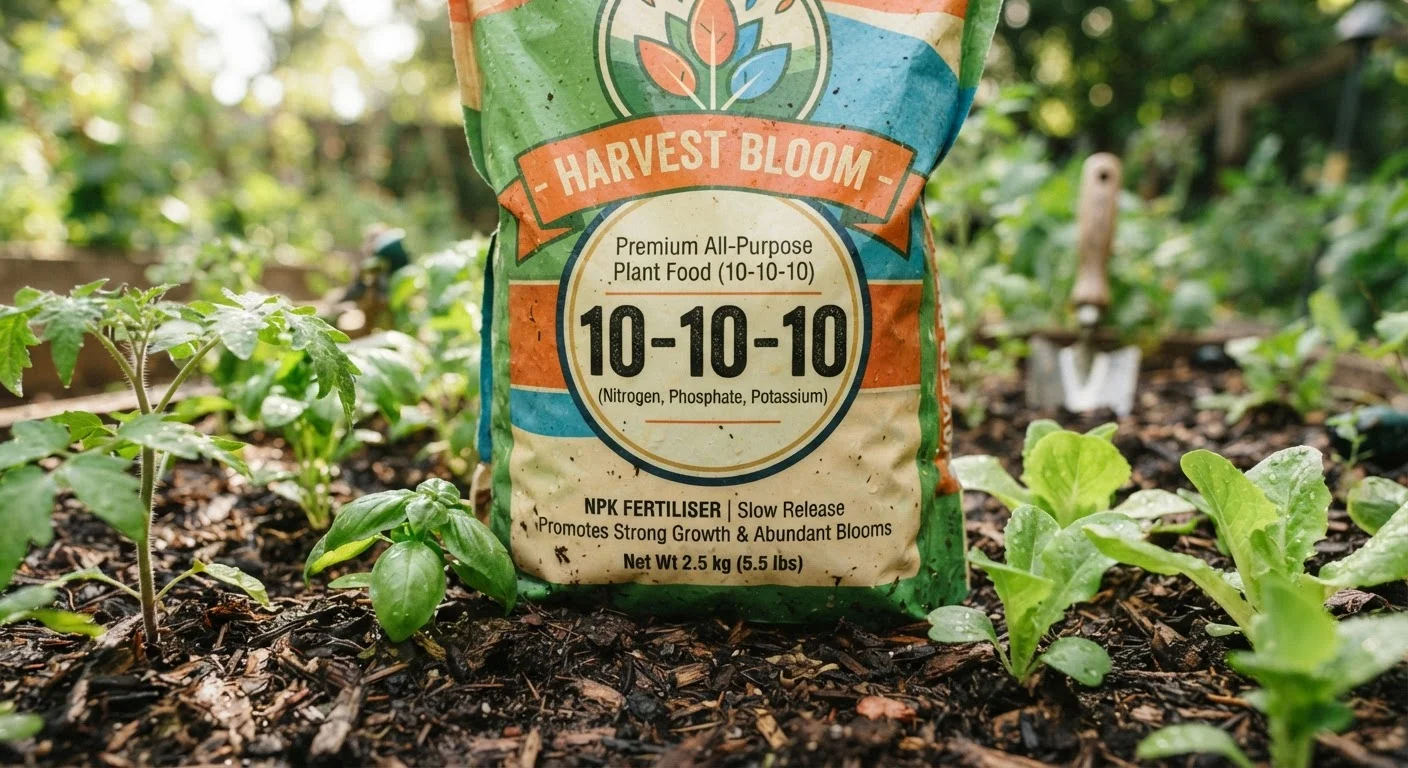
Pick up almost any fertiliser bag and you'll see a sequence like 10-10-10 or 5-10-5 printed prominently on the front. These are the NPK values — a standardised way of expressing the percentage by weight of three primary plant nutrients: nitrogen (N), phosphorus (P), and potassium (K).
A bag labelled 20-5-10 contains 20% nitrogen, 5% phosphorus, and 10% potassium. The remaining percentage is made up of filler material, secondary nutrients, or inert carriers that help distribute the product evenly. The numbers always appear in the same N-P-K order, making comparison straightforward once you know what you're looking for — much like reading a nutrition label on packaged food.
| What NPK stands for | Nitrogen, Phosphorus, Potassium |
| How values are expressed | Percentage by weight of each nutrient |
| Order on the label | Always N first, then P, then K (Regulated labelling standard) |
| Best starting point for fertiliser choice | A professional soil test (Cooperative Extension Service recommendations) |
| Primary role of nitrogen | Leafy, green growth and chlorophyll production |
| Primary role of phosphorus | Root development, flowering, and fruiting |
| Primary role of potassium | Stress tolerance, water regulation, disease resistance |
Understanding what each nutrient does helps you match the fertiliser to your garden's actual needs rather than guessing off the shelf.
What Each Nutrient Does
Each of the three macronutrients plays a distinct role in plant health:
NPK
The shorthand for the three primary plant macronutrients: nitrogen (N), phosphorus (P), and potassium (K). On fertiliser labels, NPK values are expressed as a percentage-by-weight ratio in that fixed order.
Guaranteed Analysis
The section of a fertiliser label legally required to state the minimum percentages of available nutrients. It is the standardised, comparable portion of the label across all products.
Slow-Release Fertiliser
A fertiliser formulated to release nutrients gradually over an extended period, often through polymer coatings or organic decomposition. It reduces the risk of plant burn and requires less frequent application.
Macronutrient
A nutrient required by plants in relatively large quantities for healthy growth. The primary macronutrients are nitrogen, phosphorus, and potassium; secondary macronutrients include calcium, magnesium, and sulfur.
Micronutrient
A nutrient needed by plants in very small amounts but still essential for normal function. Examples include iron, zinc, manganese, and boron. Deficiencies can cause visible symptoms despite good NPK levels.
Nutrient Burn
Damage to plant tissue caused by applying fertiliser at excessive concentrations. It typically appears as browning or scorching at leaf tips and edges and is most common with fast-release, water-soluble fertilisers.
Nitrogen (N) fuels leafy, green growth. It's a core component of chlorophyll and proteins, making it especially important for lawns, leafy vegetables like spinach and lettuce, and any plant you're growing primarily for its foliage. A yellowing of older leaves — starting at the tips — is a classic sign of nitrogen deficiency.
Phosphorus (P) supports root development, flowering, and fruit production. Seedlings and transplants benefit from a phosphorus boost to help them establish quickly. Mature fruiting plants — tomatoes, peppers, squash — also rely on adequate phosphorus at flowering time.
Potassium (K) strengthens overall plant resilience. It regulates water movement within cells, supports disease resistance, and helps plants tolerate temperature stress. Potassium deficiency often shows up as browning or scorching along leaf edges.
Matching NPK to Your Garden's Needs
The right NPK ratio depends on what you're growing and what your soil already contains. A soil test — available through many cooperative extension services and garden centres — is the most reliable starting point. Without one, you're applying nutrients somewhat blindly.
As a general guide:
- Lawns and leafy crops benefit from fertilisers with a higher first number (more nitrogen).
- Root vegetables and establishing transplants do better with a higher middle number (more phosphorus).
- Fruiting vegetables, flowering plants, and drought-stressed gardens favour a higher third number (more potassium).
- Balanced formulas like 10-10-10 are a reasonable all-purpose choice when you're uncertain, though they can over-supply nutrients your soil already has in abundance.
For a deeper understanding of how nutrients interact with your existing growing medium, see our guide to soil health — because no fertiliser can compensate for fundamentally poor soil structure.
Soil Testing Makes NPK Decisions Easier
Before purchasing any fertiliser, consider having your soil tested. Many university cooperative extension programs offer affordable testing kits that reveal existing nutrient levels and pH. With those results in hand, you can choose an NPK ratio that addresses real deficiencies rather than adding nutrients your soil already has in abundance. Over-supplying a nutrient — particularly nitrogen — can harm plants and the surrounding environment.
Reading Beyond the Big Three
NPK values are the headline figures, but a complete fertiliser label includes more information worth knowing. Look for:
- Secondary macronutrients — calcium, magnesium, and sulfur — often listed below the guaranteed analysis section.
- Micronutrients — iron, manganese, zinc, and others — sometimes included in specialty blends for acid-loving plants or specific crops.
- Release type — labels may indicate whether the product is fast-release (water-soluble) or slow-release (coated or organic-based). Slow-release formulas feed plants over weeks or months and typically pose lower risk of nutrient burn.
If you're weighing whether to use an organic or synthetic product, the NPK numbers alone won't tell the full story. Our comparison of organic vs. synthetic fertilisers covers how each type behaves differently in the soil over time.
Apply fertilisers according to label directions. Over-fertilising — especially with nitrogen — can burn plants, degrade soil biology, and contribute to nutrient runoff into local waterways. More is rarely better.
This article provides general gardening education. Specific application rates should be guided by a current soil test and the directions on your fertiliser product label.