

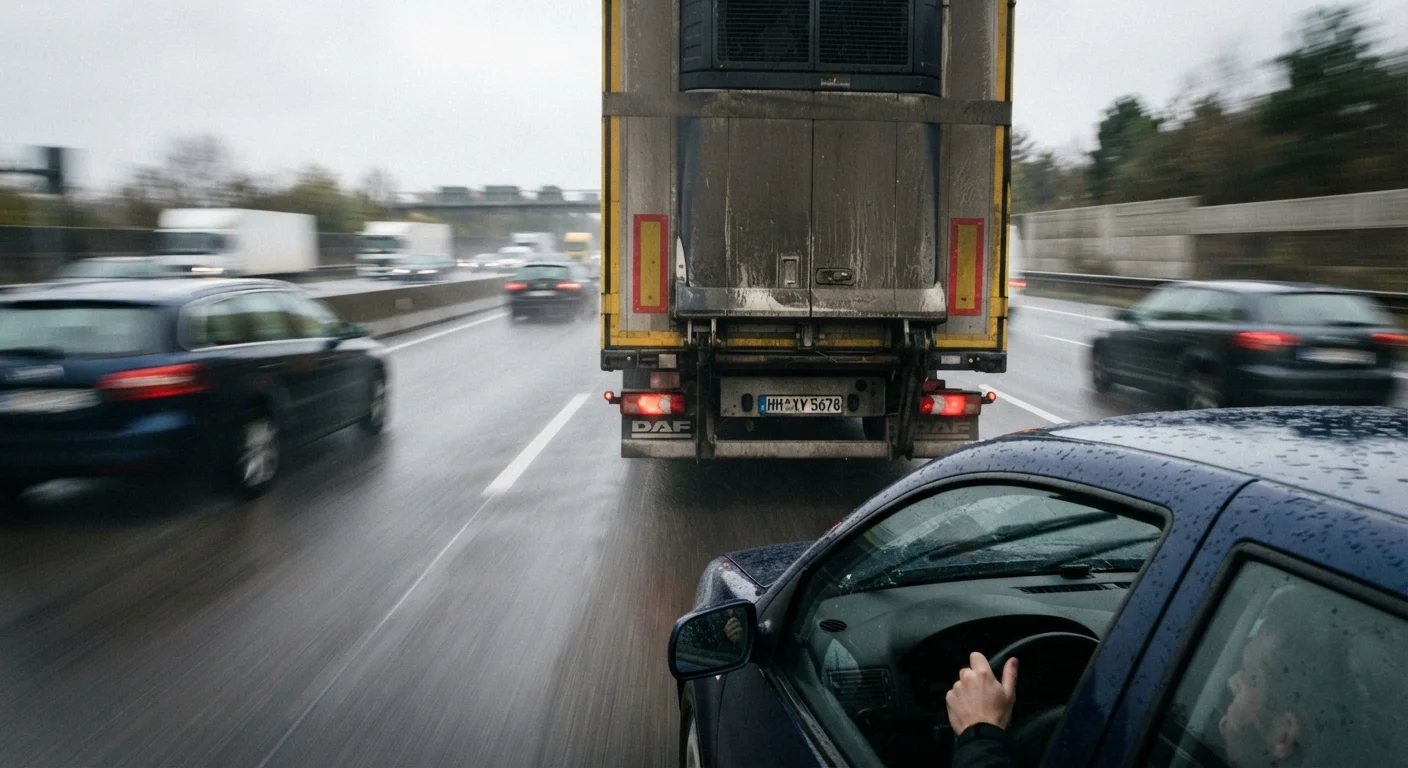
Key Takeaways
- At 60 mph, a car travels roughly 88 feet per second — leaving almost no margin at close following distances.
- Most rear-end crashes stem from following too closely combined with driver distraction.
- The three-second rule is a minimum; wet roads, heavy vehicles, and fatigue all require more space.
- Tailgating is a leading trigger for road rage escalation and secondary crashes.
- Adjusting following distance is one of the simplest, most effective crash-prevention habits available.
The Physics That Make Tailgating So Lethal
Most drivers underestimate how much distance a vehicle covers in the time between seeing a hazard and actually stopping. At 60 mph, a car moves approximately 88 feet every second. Add the average human perception-reaction time of about 1.5 seconds before the brake pedal is even pressed, and a vehicle has already traveled more than 130 feet before deceleration begins. If the driver ahead brakes hard, the gap closes in a fraction of a second.
Braking distance compounds the problem. At highway speeds, a typical passenger vehicle requires several hundred feet to come to a complete stop under ideal conditions. In rain, on worn tires, or when carrying a heavy load, that distance grows considerably. The rules around safe following distance exist precisely because physics doesn't negotiate.
~29%
Of all crashes involving rear-end collisions
According to the National Highway Traffic Safety Administration (NHTSA), rear-end crashes account for a substantial share of all police-reported traffic collisions in the US.
1.5 sec
Average driver perception-reaction time
Traffic safety research commonly cites 1.5 seconds as the typical perception-to-brake-application time, though distraction or fatigue can extend this significantly.
Common Tailgating Mistakes — and Why Drivers Make Them
Tailgating rarely feels reckless to the driver doing it. More often, it's a byproduct of habits, impatience, or overconfidence. Understanding why these errors occur is the first step to correcting them.
Assuming the car ahead will maintain a steady speed.
Why it happens: On open roads with light traffic, sudden stops feel unlikely, so drivers unconsciously close the gap and relax their vigilance.
Following at highway speeds with the same gap used in city driving.
Why it happens: Drivers calibrate following distance visually rather than by time, and a gap that feels adequate at 30 mph looks similar at 65 mph — even though stopping distances are dramatically longer.
Tailgating to pressure a slower driver to move over.
Why it happens: Impatience and frustration make close following feel like a rational signal, when in reality it removes all margin for error and can provoke unpredictable responses.
Not adjusting following distance in adverse weather or low visibility.
Why it happens: Drivers tend to maintain habitual spacing regardless of conditions because changing conditions develop gradually and the danger isn't immediately obvious.
Failing to account for the stopping distance of large or loaded vehicles.
Why it happens: Drivers of SUVs, trucks, or vehicles carrying cargo often apply the same instinctive following habits they used in lighter vehicles, not recognizing that extra weight significantly extends braking distance.
Aggressive following behavior can also spiral beyond a single vehicle. Research consistently links close following to road rage incidents, where one driver's pressure provokes a dangerous reaction from another. If you've ever witnessed an escalating highway confrontation, road rage triggers and how to manage them are worth understanding.
Tailgating Can Trigger Road Rage
Close following is frequently interpreted by the driver ahead as deliberate intimidation, even when the tailgating driver has no such intent. This misreading can provoke sudden braking, swerving, or a confrontation that puts multiple drivers at risk. Maintaining adequate space isn't just about physics — it also reduces the social friction that escalates into dangerous encounters.
Conditions That Make a Bad Habit Even Worse
Following too closely is dangerous in ideal conditions. In poor ones, it becomes significantly more so. Rain reduces tire grip and extends stopping distances — sometimes by 50% or more on wet pavement. Fog and nighttime driving reduce visibility sharply; headlight range is far shorter than most drivers assume, meaning a hazard can appear with almost no warning.
Heavy vehicles like SUVs and pickup trucks require more stopping distance than smaller cars, yet drivers of these vehicles often follow just as closely as those in compact sedans. Driving while fatigued slows reaction time considerably, narrowing the already-thin margin that a short following gap allows. The combination of any two of these factors — night driving plus rain, for instance — can make tailgating genuinely catastrophic.
For drivers navigating complex highway situations, lane changes and merging technique are also worth reviewing, as sudden speed changes during merges frequently catch close followers off guard.
Rear-End Crashes Are Rarely 'Unavoidable'
In most rear-end collisions, investigators find that the following driver had insufficient distance to stop given their speed and reaction time. While mechanical failures and sudden obstacles do occur, the vast majority of these crashes are preventable with adequate spacing. Treating following distance as a non-negotiable habit — not a situational preference — is one of the highest-impact safety decisions a driver can make.