

Key Takeaways
- Total stopping distance combines reaction distance and braking distance — both matter equally.
- Doubling highway speed can quadruple the braking distance needed due to kinetic energy physics.
- Reaction time alone accounts for roughly 1–1.5 seconds of travel before braking even begins.
- Wet or icy pavement significantly reduces tire-to-road friction, extending stopping distances.
- Heavier vehicles carry more kinetic energy and generally require longer distances to stop.
- Maintaining adequate following distance is the most practical way to account for stopping physics.
Stopping Distance
Stopping distance is the total distance a vehicle travels from the moment a driver perceives a hazard to the moment the vehicle comes to a complete stop. It includes two phases: the distance covered during the driver's reaction time, and the distance the vehicle continues to travel while the brakes are actively applied. Both phases are influenced by speed, road conditions, and the vehicle itself.
Braking distance increases with the square of speed — meaning doubling your speed roughly quadruples the distance needed to stop, a consequence of kinetic energy scaling as v².
Two Phases That Determine How Far You Travel Before Stopping
Most drivers think of stopping as a single action — pressing the brake pedal. In reality, it unfolds in two distinct phases, and both contribute meaningfully to how far your vehicle travels before it halts.
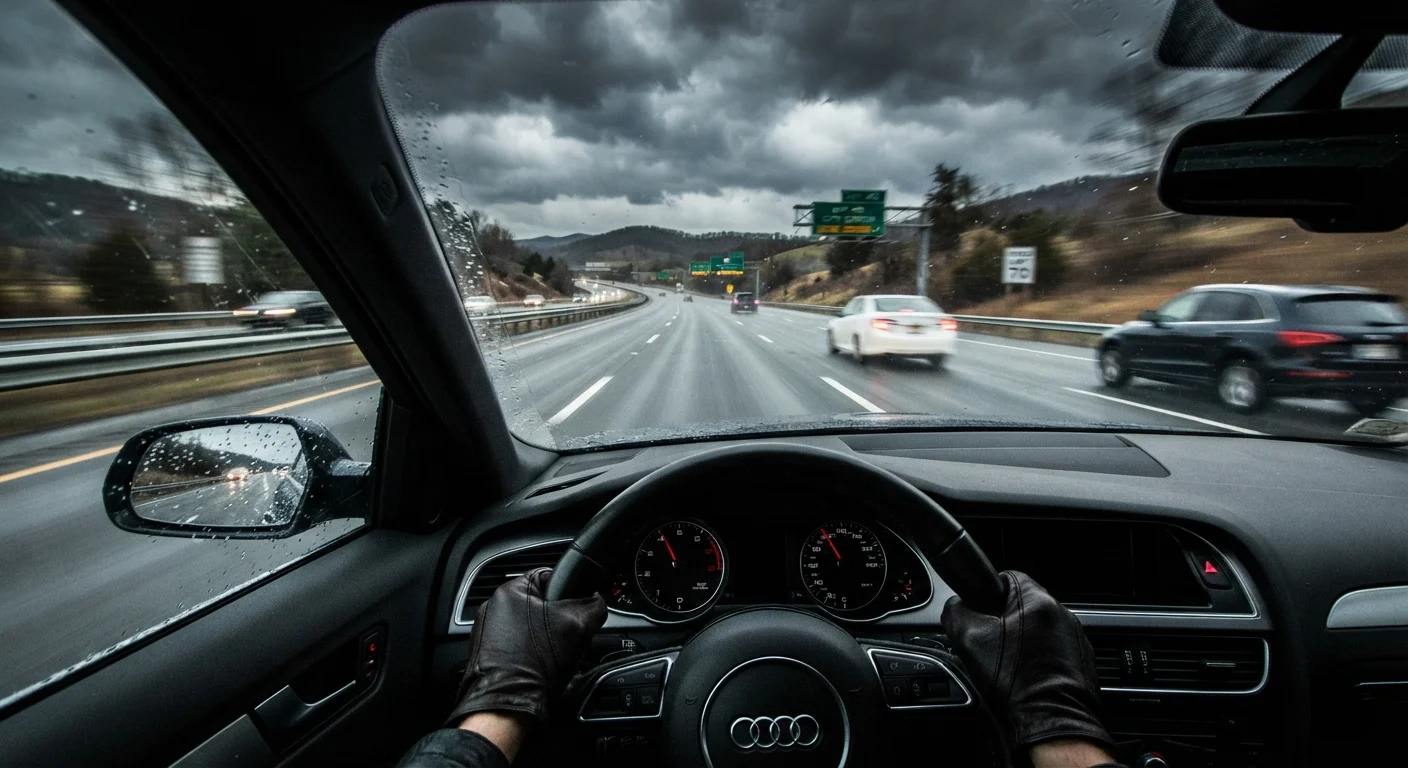
Reaction distance is how far your car moves while your brain processes a hazard and your foot reaches the pedal. Human reaction time averages roughly 1 to 1.5 seconds under alert conditions. At 60 mph — a common US highway speed — that translates to approximately 88–132 feet of travel before braking even begins.
Braking distance is the distance covered once the brakes are fully engaged. This phase is governed primarily by physics: the friction between your tires and the road surface, and the amount of kinetic energy your vehicle is carrying. The two phases combined give you total stopping distance.
Understanding this two-phase structure is foundational to safe following distance. See our guide to safe following distance for how to apply this in everyday driving.
Why Speed Has a Disproportionate Effect
The relationship between speed and stopping distance is not linear — it's exponential. This surprises many drivers who assume that going 20% faster means needing 20% more road to stop. The reality is considerably more demanding.
Kinetic energy — the energy a moving object carries — is calculated as one-half the mass multiplied by the velocity squared (½mv²). The squared term is what matters: doubling your speed quadruples your kinetic energy, and therefore quadruples the work your brakes must do. Going from 30 mph to 60 mph doesn't double your stopping distance; it roughly quadruples it.
~240–300 ft
Total stopping distance at 60 mph
Estimated for a typical passenger vehicle under good road conditions, including reaction distance.
4×
Braking distance increase when doubling speed
Due to kinetic energy scaling with the square of velocity — a fundamental principle of physics.
25–40%
Reduction in tire-road friction on wet pavement
Wet surfaces significantly degrade braking performance compared to dry asphalt conditions.
This physics-based relationship is why highway speed limits exist and why speed is consistently identified as a primary factor in crash severity. At 70 or 75 mph — common legal limits on US interstates — the margin for error shrinks dramatically compared to urban speeds.
Aggressive driving habits that build speed can also accelerate mechanical wear. Our editorial team has covered how hard braking and hard acceleration add hidden costs over time.
Road Surface, Tires, and the Friction Variable
Brakes don't stop a vehicle — friction does. Your brakes convert kinetic energy into heat, but it's the contact patch between each tire and the road that ultimately brings the vehicle to rest. When that friction is reduced, everything changes.
Dry asphalt provides the highest coefficient of friction under normal conditions. Wet pavement can reduce effective friction by 25–40%, meaning braking distances extend substantially even in moderate rain. Black ice — nearly invisible and often encountered in early morning conditions — can reduce friction so severely that normal stopping distances multiply several times over.
Tire condition is equally important. Worn tread evacuates water less efficiently, increasing the risk of hydroplaning — where a thin film of water lifts the tire off the road surface entirely. At that point, directional control, not just stopping power, is compromised.
Check Your Tires Before Highway Travel
Tire tread depth and inflation pressure directly affect how quickly your vehicle can stop. Use the penny test to check tread depth — if you can see the top of Lincoln's head, your tread is likely too worn for reliable wet-weather performance. Check inflation against the vehicle placard, not the maximum figure printed on the tire sidewall.
Understanding how your brake hardware functions is part of the picture. Our overview of disc vs. drum brake systems explains how each design manages heat and friction differently.
Vehicle Weight, Load, and What ABS Can — and Can't — Do
Two vehicles traveling at identical speeds on identical roads can have very different stopping distances based on their mass. A heavier vehicle carries more kinetic energy and demands more from its braking system. This is why heavily loaded pickup trucks, SUVs carrying full passenger capacity, and commercial vehicles all require greater following distances than unloaded passenger cars.
Anti-lock braking systems (ABS) are a meaningful safety advancement — but they're widely misunderstood. ABS prevents the wheels from locking up during hard braking, which preserves the driver's ability to steer around an obstacle rather than skidding straight into it. On dry pavement, ABS may not produce a meaningfully shorter stop than a skilled driver manually modulating brake pressure. Its primary value is control, particularly on wet or slippery surfaces.
Driver condition also functions as a variable in this equation. Fatigue lengthens reaction time — sometimes significantly. A driver who is drowsy may add a full second or more to the reaction phase, adding dozens of additional feet before the brakes engage. Our coverage of driver fatigue on long-distance trips explores this risk in depth.
Putting these factors together is what defensive driving is built around — anticipating conditions rather than reacting to them.