

Key Takeaways
- Disc brakes clamp a rotor from outside; drum brakes press shoes outward against an enclosed drum.
- Disc brakes dissipate heat more effectively, reducing brake fade under repeated hard stops.
- Drum brakes are still widely used on rear axles of economy vehicles due to lower production costs.
- Most modern passenger cars use disc brakes on all four wheels, especially performance-oriented models.
- Both systems require periodic inspection; worn pads, rotors, or shoes compromise stopping distances.
Option A
Disc Brakes
The modern, high-performance standard.
Best for: Best for vehicles requiring consistent, fade-resistant stopping power across a wide range of conditions.
Option B
Drum Brakes
The proven, cost-effective traditional system.
Best for: Best for lower-stress rear-wheel applications where simplicity and cost efficiency are priorities.
If you drive frequently in hilly terrain or stop-and-go traffic
Disc Brakes
Disc brakes shed heat more quickly, reducing the risk of brake fade during repeated braking cycles common in demanding conditions.
If you own an economy or older vehicle with rear drum brakes
Drum Brakes
Rear drum brakes on such vehicles are serviceable and cost-effective; they are well-suited to the lower braking demands placed on rear axles.
If you tow heavy loads or haul cargo regularly
Disc Brakes
The superior heat management and braking consistency of disc brakes is especially valuable when stopping heavier vehicle-and-load combinations.
If minimizing maintenance cost is your top priority
Drum Brakes
Drum brake components are generally less expensive and rear-axle drums tend to wear more slowly, extending service intervals on lighter-duty applications.
How Disc Brakes Work
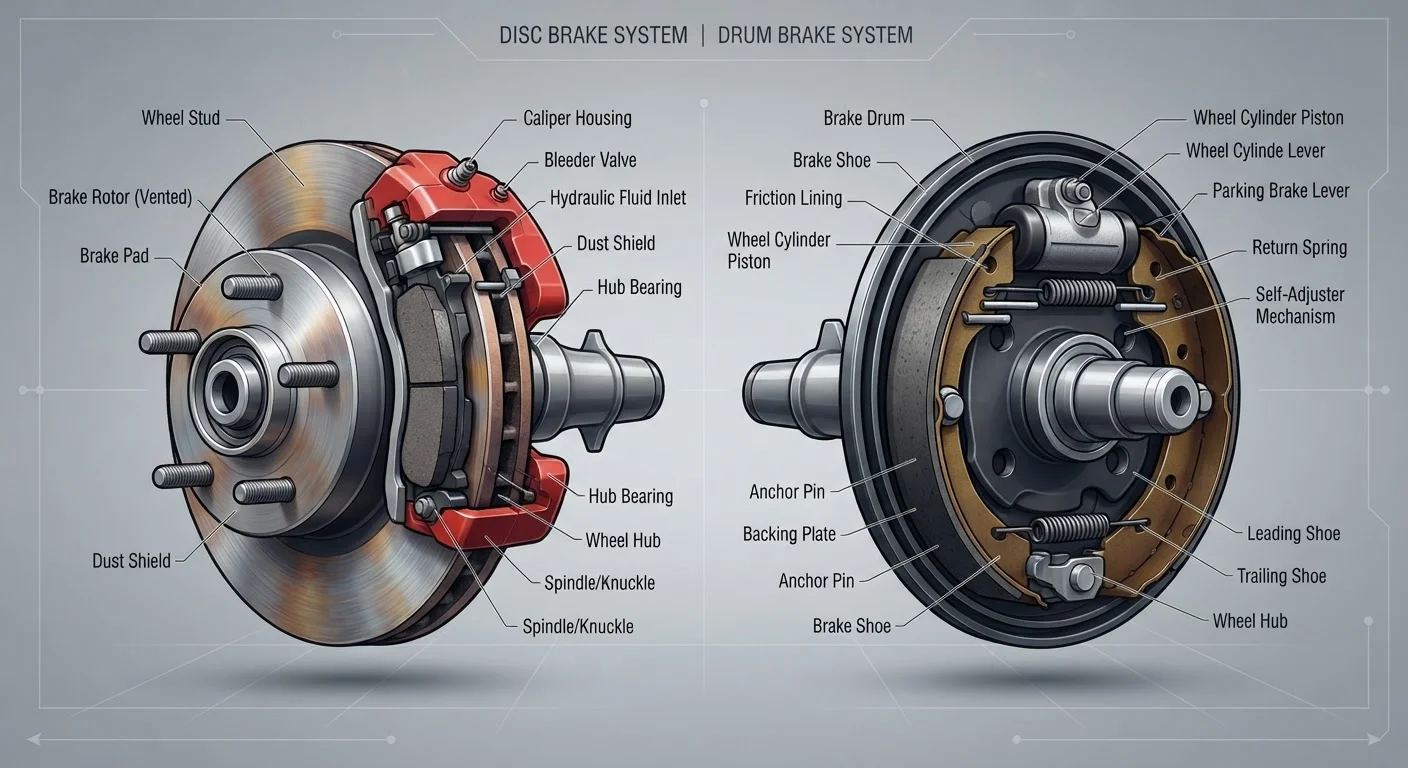
A disc brake system centers on a flat metal rotor — also called a disc — that spins with the wheel. When you press the brake pedal, hydraulic pressure forces a caliper to squeeze brake pads against both sides of that spinning rotor. The resulting friction slows the rotor, and with it, the wheel.
Because the rotor is exposed to open air, heat generated during braking dissipates quickly. Many rotors are also vented — cast with internal channels that draw cool air through the disc — further improving thermal management. This open design also makes disc brakes largely self-cleaning; water and debris are flung outward with each wheel rotation, helping maintain consistent performance in wet conditions.
The mechanical simplicity of a disc brake's two-sided clamping action also makes it well-suited to modern anti-lock braking systems (ABS), which rapidly modulate brake pressure to prevent wheel lockup. Consistent and predictable pad contact with the rotor gives the ABS control module accurate feedback to work with. For more on how stopping performance is shaped by factors beyond the brake hardware itself, see our guide to stopping distances at highway speeds.
How Drum Brakes Work
A drum brake system uses a hollow, cylindrical drum that rotates with the wheel. Inside the drum sit curved brake shoes lined with friction material. When hydraulic pressure is applied, a wheel cylinder pushes the shoes outward so they press against the inner surface of the drum — creating the friction needed to slow the vehicle.
One notable characteristic of drum brakes is self-energizing action: the rotation of the drum can pull one shoe tighter into contact, amplifying braking force without additional hydraulic pressure. This makes drum brakes relatively efficient for the amount of input force required, which is part of why they remain practical for rear-axle use on lighter vehicles.
The enclosed design that enables this efficiency also comes with a drawback: heat builds up inside the drum and dissipates slowly. Under repeated or prolonged braking — such as descending a long grade — drum brakes are more susceptible to brake fade, a reduction in stopping power caused by overheated friction surfaces.
| Criterion | Disc Brakes | Drum Brakes |
|---|---|---|
| Core mechanism | Pads clamp external rotor | Shoes press outward on drum interior |
| Heat dissipation | Excellent — open, vented design | Limited — enclosed housing traps heat |
| Wet weather performance | Strong — debris and water shed quickly | Moderate — enclosed drum resists water entry |
| Brake fade resistance | High | Lower under sustained heavy use |
| Typical placement | Front and rear (modern vehicles) | Rear axle on economy models |
| Component cost | Generally higher | Generally lower |
| Inspection ease | Visual check often possible | Drum removal typically required |
| ABS compatibility | Highly compatible | Compatible, but less precise feedback |
Maintenance Differences Every Owner Should Know
Both brake types need regular inspection, but they wear differently and require different service approaches.
Disc brake pads wear gradually and are straightforward to inspect visually — many pads include a metal wear indicator that produces an audible squeal when replacement is due. Rotors can develop grooves or runout (a slight warp) and may need resurfacing or replacement. Brake fluid condition matters too; degraded fluid reduces hydraulic pressure and raises the boiling point concern under heavy use.
Drum brake shoes tend to last longer at the rear because rear axles bear less braking load than front axles. However, the enclosed drum makes visual inspection harder without removing the drum itself — a step best performed by a qualified mechanic on a regular maintenance schedule. Springs, adjusters, and wheel cylinders inside the drum assembly also require periodic evaluation.
70%+
Braking force handled by front axle
Vehicle dynamics engineering principles indicate the front brakes perform the majority of stopping work due to weight transfer under deceleration.
~2x
Longer typical rear drum shoe lifespan vs. front pads
Because rear axles bear proportionally less braking load, rear drum shoes often outlast front disc brake pads by a considerable margin.
A qualified technician can assess both systems as part of a routine brake inspection. If you notice increased stopping distances, a pulling sensation when braking, grinding noises, or a soft brake pedal, have the system inspected promptly rather than waiting for a scheduled service interval.
Which Setup Is Right for Your Vehicle?
The choice between disc and drum brakes is rarely made by the driver — it is determined by the vehicle's manufacturer based on intended use, axle position, weight class, and cost targets. Understanding the difference, however, helps owners make informed decisions about maintenance, replacement quality, and what to expect from their vehicle's braking system.
Most modern passenger cars use disc brakes on all four wheels. Economy models and some light trucks may retain rear drum brakes as a cost-saving measure without meaningfully compromising everyday safety, since the rear axle contributes less braking force than the front. Larger trucks and performance vehicles overwhelmingly favor four-wheel disc setups for their superior heat handling and consistency.
Just as the choice of braking hardware reflects engineering tradeoffs, so does transmission design — if you're curious about how mechanical systems vary by application, our comparison of manual and automatic transmissions explores a similarly fundamental divide.
Regardless of which brake type your vehicle uses, keeping up with scheduled inspections and addressing symptoms early is the most reliable way to maintain safe stopping performance.